Stock perps vs options vs shares
By Tradytics. Updated .
Shares, options and stock perps all give you exposure to a stock. They differ in what you hold, whether it expires, what it costs to open and how it can lose money.
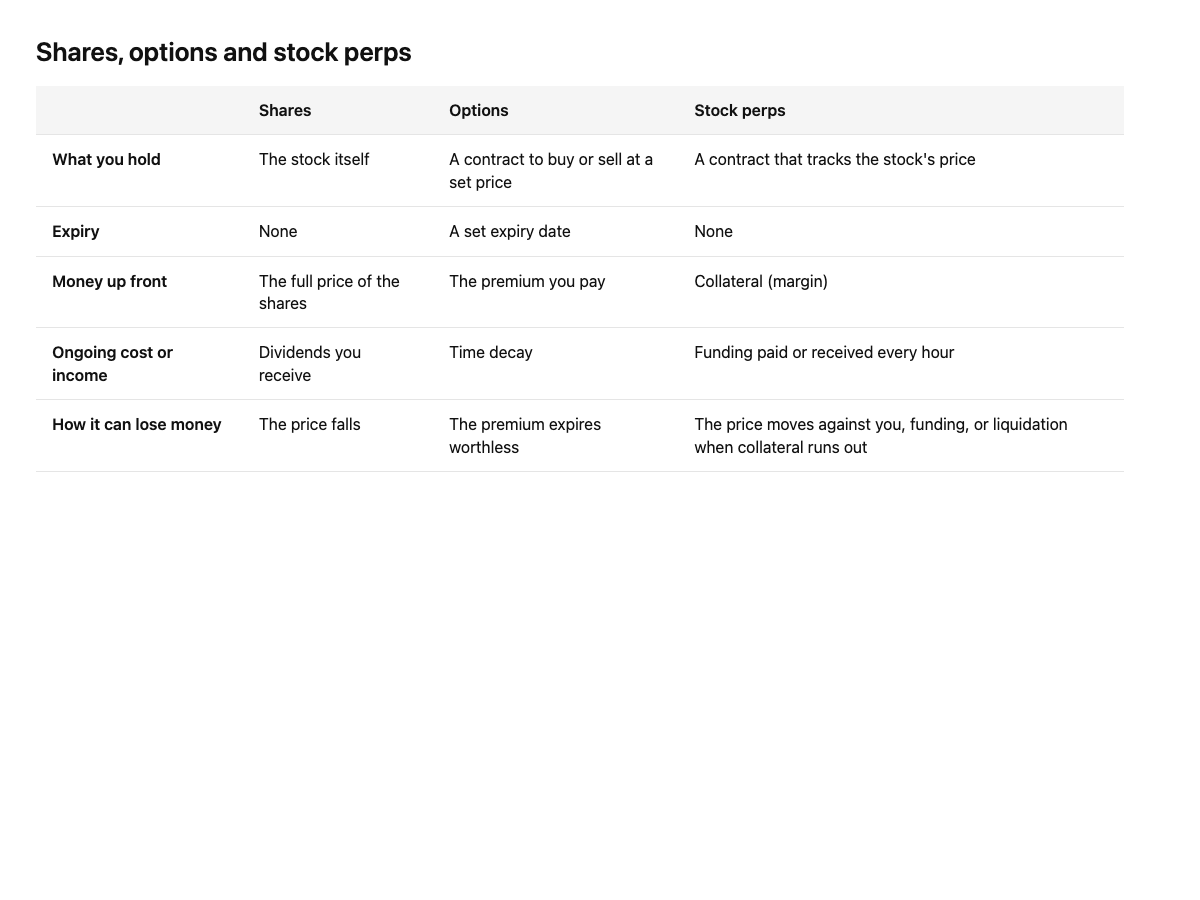
What decides the result
| Product | What decides the result | What to watch |
|---|---|---|
| Shares | The stock's price | The price can fall. There is no expiry. |
| Options | The price move, the time left and implied volatility | Time decay and the expiry date |
| Stock perps | The price move, funding and margin | Funding payments and liquidation |
When each one carries more risk
- Shares lose value as the price falls. You can hold them with no deadline.
- Options can expire worthless. A correct view on direction can still lose money if the move comes too late.
- Stock perps have no deadline. Funding can cost you every hour, and a loss that uses up your margin closes the position.
Where to start
Read what a stock perpetual is first. For the hourly payment, read what funding is.
Common questions
Is a stock perp the same as a futures contract?
Not quite. A futures contract ends on a set date. A stock perp has no expiry, and funding keeps its price close to the stock.
Which costs more to hold?
It depends on the position and the market. Shares cost their full price. Options cost the premium and lose time value. Stock perps cost margin and any funding you pay.