What happened when we followed the top five 13F portfolios
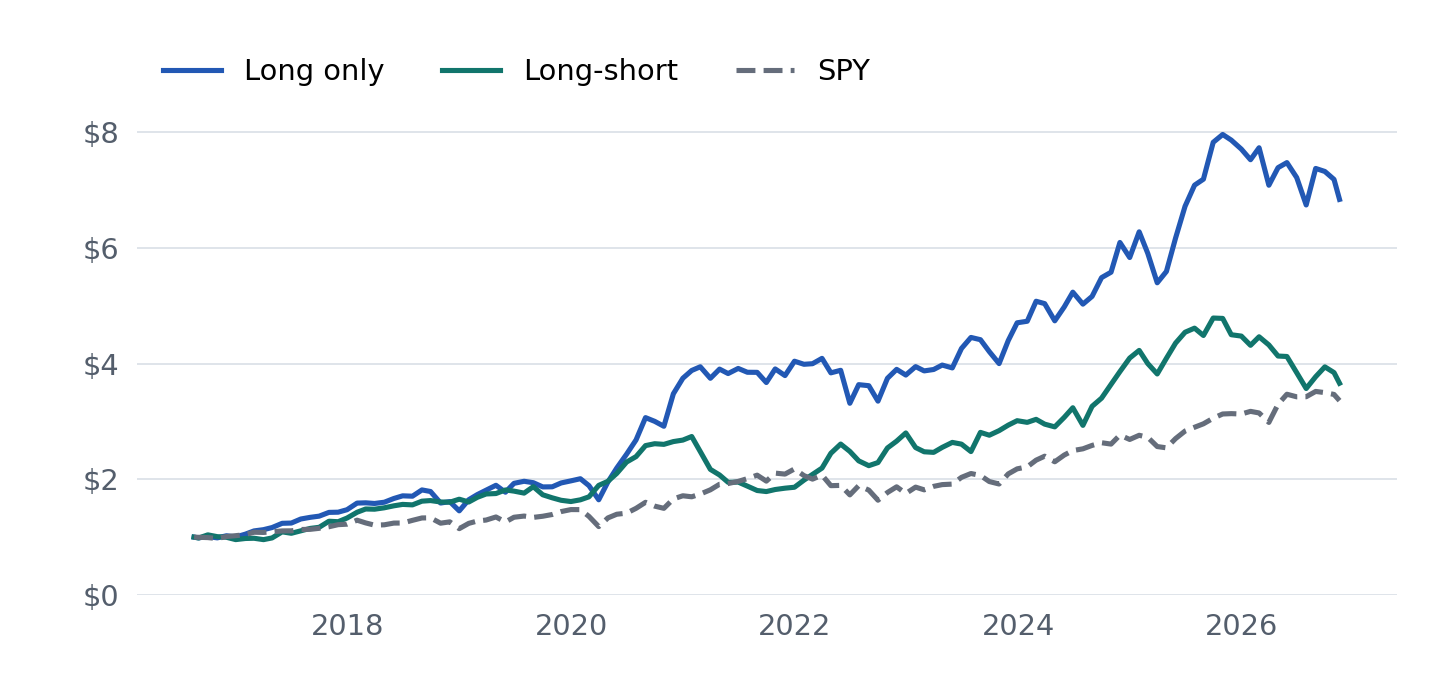
We ranked the disclosed stock portfolios of 49 hedge funds by recent performance. Each quarter, we held the stocks of the five highest-ranked funds. From August 2016 to November 2026, that portfolio returned 20.7% a year after modeled trading fees. SPY returned 12.6% a year over the same dates.
Then we added a short position in the stocks of the five lowest-ranked funds. The annual return fell to 13.5%.
How we ranked the funds
A 13F filing shows what a manager held at quarter-end. We used up to 20 of each fund's largest disclosed stock positions by value. For each completed holding period, we measured how that set of stocks would have performed against SPY. Each fund's score was its average excess return over the last four completed periods, with a minimum of two observations.
We rebalanced at the close of the first trading session after the filing deadline. The five highest-ranked funds formed the long side. We gave more weight to funds with higher positive scores and used equal weights when none were positive. For the short side, we used the five lowest-ranked funds and gave more weight to larger negative scores. Each side started at 100% of portfolio value before we netted overlapping stocks. We charged 0.10% on the dollar value traded.
Shorting changed the result
The long-only portfolio had a beta of 1.12 to SPY. Adding the short side cut beta to 0.07. It also deepened the largest drawdown, from 33.6% to 39.9%.
| Portfolio | Annual return | Max drawdown | Sharpe |
|---|---|---|---|
| Long only | 20.7% | -33.6% | 0.90 |
| Long-short | 13.5% | -39.9% | 0.70 |
| SPY | 12.6% | -34.1% | 0.75 |
Four quarters beat eight
With the same five-fund, long-only setup, using eight quarters of history brought the annual return down to 16.0%. Keeping the four-quarter lookback and giving the five funds equal weights returned 18.8%. In this sample, the lookback made a bigger difference than the choice between equal and score weights.
What the test covers
We tested eight combinations of lookback, fund count, and weighting, and the four-quarter, five-fund, score-weighted version came out on top. For the long-only result, estimated annual alpha against SPY was 6.7%, with a t-statistic of 1.56. We chose the 49 managers in 2026, so the roster reflects hindsight. A follow-up test would keep the rule fixed and use a manager list chosen before the test starts.
The study covers 41 holding periods from August 16, 2016 to November 17, 2026. It uses the returns of stocks disclosed in 13F filings. The managers' actual returns also reflect positions and trades outside that view. All results use split-adjusted closing prices and exclude dividends, borrow charges and interest on cash. SEC Form 13F guidance