Options flow signals API: live 5-year validated call and put setups
By Faizan Ahmad. Updated .
The Tradytics options flow signals API serves the exact same live setups shown on Tradytics Signals: eight call and put patterns selected from millions of backtests across five years of historical OPRA option quotes (2022 through 2026). Every signal is priced at the live NBBO ask, marked every five minutes, and tracked through structured profit targets and time stops.
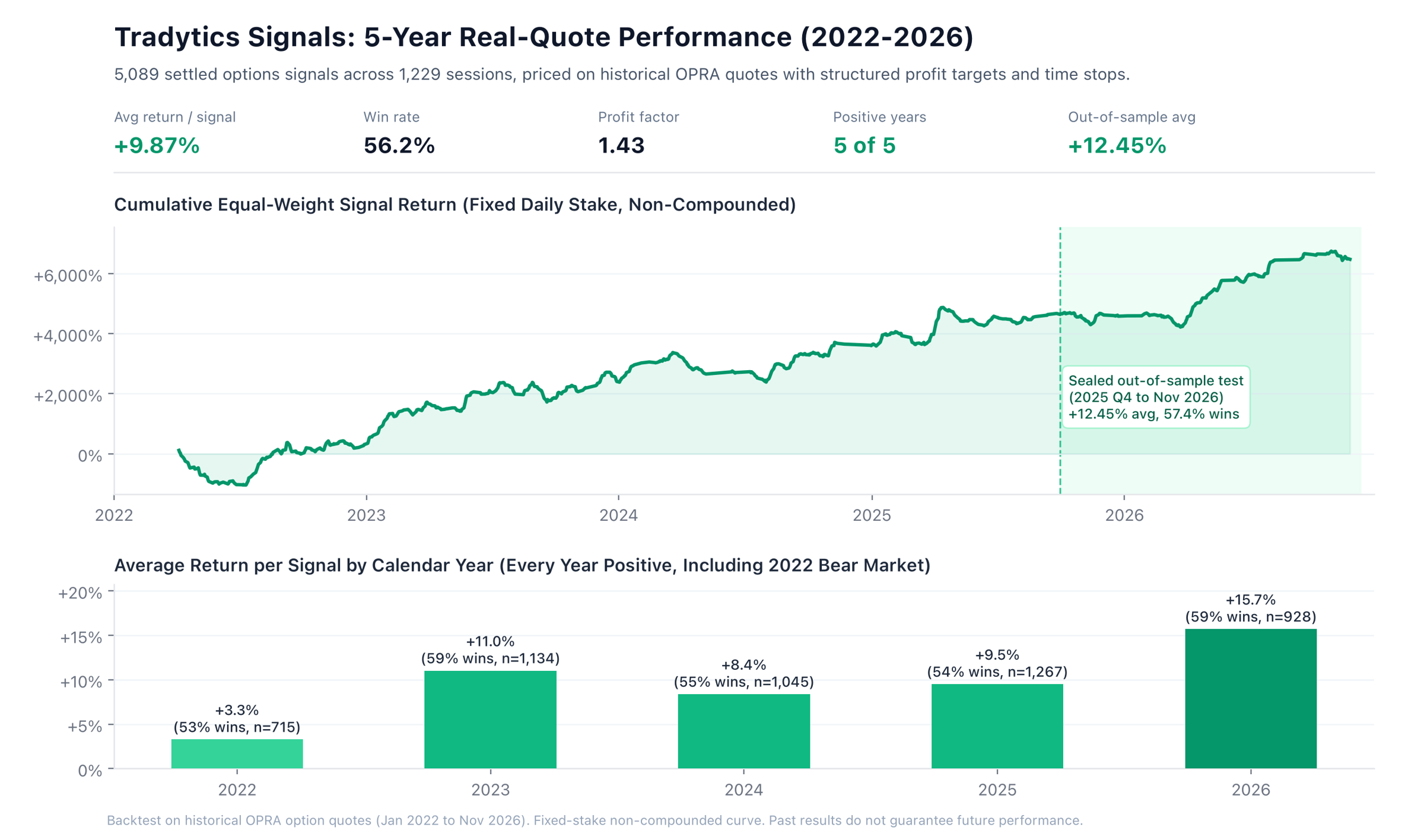
Across 5,089 settled signals over five years of historical OPRA quotes, the suite averaged +9.87% per signal with a 56.2% win rate, 1.43 profit factor, and 5 of 5 positive calendar years (and +12.45% average return with a 57.4% win rate on the sealed 2025 Q4 to 2026 out-of-sample holdout). Every win and loss is served transparently through the API.
What the Signals API returns
| Endpoint | What it returns |
|---|---|
GET /signals | Live and historical signals, newest first. Filter by pattern (source), symbol, status (open or settled), date, or a date range. |
GET /signals/{id} | One signal with its contract context, triggering options flow prints, and full five-minute mark history. |
GET /signals/performance | Live win rate, average return, median return, best, and worst returns per pattern across 7d, 30d, 90d, and all. |
Base URL: https://tradytics.com/api/public/v1. Create an API key from API keys and pass it as apiKey=YOUR_KEY (or Bearer header). See the Signals API reference for full parameter details.
Example response
A settled signal from GET /signals/432 (trimmed to key fields):
GET /signals/432

{
  "data": {
    "id": 432,
    "date": "2026-09-18",
    "source": "open-vol-calls",
    "pattern": "Opening Volatility Breakout Calls",
    "fired_at": "2026-09-18T13:35:39Z",
    "symbol": "NVDA",
    "contract": "NVDA261002C00220000",
    "type": "call",
    "strike": 220.0,
    "expiry": "2026-10-02",
    "price": 4.74,
    "bid": 4.6,
    "ask": 4.7,
    "premium_usd": 47400,
    "size": 100,
    "open_interest": 8090,
    "iv": 0.2983,
    "delta": 0.4855,
    "spot": 218.715,
    "status": "settled",
    "return": 0.6968,
    "raw_return": 1.0106,
    "best_return": 1.4787,
    "exit_reason": "t2_hit",
    "max_hold_days": 5,
    "exit_by": "2026-09-25"
  }
}
Key fields
returnandraw_return:returnis the blended return under the structured exit plan (half locked at +35%, runner protected at breakeven, +100% full target);raw_returnis the unblended contract return against entry ask. Both are decimals (0.6968is +69.68%).best_return: highest mark reached since the signal fired, against the entry ask.statusandexit_reason:statusisopenorsettled; settled signals report why they closed (t2_hit,runner_be,time_stop, orexpired) alongsidemax_hold_daysandexit_by.marks[]andprints[]: onGET /signals/{id}, every 5-minute NBBO midpoint mark and the underlying options prints around the trigger.
The eight pattern slugs
Pass any of these source values to filter GET /signals or GET /signals/performance:
source slug | Direction | Setup |
|---|---|---|
open-vol-calls | Call | Opening volatility breakout calls |
morning-flow-calls | Call | Morning macro flow calls |
darkpool-calls | Call | Dark pool leader calls |
repeat-flow-calls | Call | Midday repeat flow calls |
bear-bounce-puts | Put | Bearish stress bounce puts |
close-vol-calls | Call | Power-hour vol breakout calls |
close-macro-calls | Call | Power-hour institutional swing calls |
close-bear-puts | Put | Power-hour bearish hedge puts |
Join Signals with the rest of the API
Your API key unlocks the full market data stack on the same base URL: combine Signals with our options flow API, dark pool data API, gamma exposure API, and stock market data API. You can also query all three Signals endpoints directly from Claude, ChatGPT, or Cursor through the Tradytics MCP server.
Plans and rate limits
Every plan includes API access with tiered rate limits: Free (5 calls/min, 50/day), Plus (10 calls/min, 1,000/day), and Pro (300 calls/min, 50,000/day). See Tradytics pricing for current tiers.
Common questions
Are live signals delayed on the API? No, signals are served in real time as they fire, newest first, with 5-minute mark updates and full historical lookup.
Can I backtest custom sizing on top of the API? Yes. Because GET /signals/{id} includes the full 5-minute marks series and entry ask, you can test your own stop-loss, trailing stop, or position sizing rules locally or with the Tradytics backtester.
Is historical performance a guarantee? No. Five years of positive historical OPRA quote results show consistent edge, not a guarantee of future returns. Options carry significant risk of loss.
Read more: How Tradytics Signals are built and The eight patterns behind Tradytics Signals.