Positive vs negative gamma: what it means for the market
By Faizan Ahmad. Updated .
In positive gamma, options dealers hedge by selling into rallies and buying into dips, which tends to shrink moves and hold price near big strikes. In negative gamma, they hedge by buying rallies and selling dips, which tends to stretch moves in both directions and make trading faster and choppier. Neither one tells you direction. On October 30, 2026, SPY ended in negative gamma (-$335.55M) and fell 1.59%, while QQQ ended in positive gamma ($180.48M) and fell 3.16%.
Why does dealer gamma change how the market moves?
Dealers hedge their options with stock so they don't carry a directional bet. The size of that hedge follows the option's delta, and delta moves with price. Gamma decides which way the hedge has to be adjusted.
- Dealer long gamma (positive). As price rises, their position gets longer on its own, so they sell stock to get back to neutral. As price falls, it gets shorter, so they buy. Their hedging leans against the move.
- Dealer short gamma (negative). As price rises, their position gets shorter, so they have to buy. As price falls, it gets longer, so they have to sell. Their hedging adds to the move.
Add that up across every strike and you get total gamma exposure (GEX), the estimate of which way dealer hedging leans and how hard. The trade-by-trade version is in how market makers hedge options.
Positive vs negative gamma, side by side
| Positive gamma | Negative gamma | |
|---|---|---|
| Dealer hedging | Sells rallies, buys dips | Buys rallies, sells dips |
| Effect on moves | Tends to damp them | Tends to amplify them |
| How the day often feels | Tighter range, moves fade, price can stick near a big strike | Wider range, moves run, sharper intraday swings |
| Where price usually is | Above the gamma flip, often near heavy call strikes | Below the gamma flip, often near heavy put strikes |
| What traders often adjust | Expect breakouts to stall; fades work more often | Respect breakouts; smaller size, wider stops |
| What it does not mean | That prices can't fall | That prices will fall |
The line between the two regimes is the gamma flip, the price where estimated total gamma crosses zero.
What October 30, 2026 shows
| SPY | QQQ | |
|---|---|---|
| Close | $757.12 | $692.74 |
| Day's move | -1.59% | -3.16% |
| Total dealer gamma | -$335.55M (negative) | $180.48M (positive) |
| Gamma flip | $738.08 | $689.55 |
| Biggest strike | $758, -$364.81M | $675, -$269.10M |
If positive gamma meant calm, QQQ should have had the quieter day. It fell twice as far. That day technology sank 4.55% and AI chip stocks fell 9.29% after Intel's weak outlook, and QQQ is far heavier in those stocks. Dealer hedging is one force in the market, and selling of that size can run right over it.
Two more lessons from the same table. First, these readings describe the end of the day; gamma depends on price, so the regime during the session could have looked different. Second, QQQ closed only $3.19 above its flip. A 0.46% dip would have put it in negative gamma, so "positive" here meant barely positive.
What does the research say?
The mechanism is real, and the effect is modest. A 2025 study by Amaya, Garcia-Ares, Pearson and Vasquez, using Cboe's trade data to see actual market maker positions in S&P 500 index options from July 2020 to June 2023, found market maker gamma was usually positive and on average reduced volatility slightly. When it turned negative, volatility was higher. Its estimate of the largest effect was 3.3 percentage points of annualized daily volatility, well within normal day-to-day swings.
Baltussen, Da, Lammers and Martens (Journal of Financial Economics, 2021) found that the market's move over most of the day predicts its move in the last 30 minutes, and tied that pattern to hedging by short-gamma dealers. And Cboe reported that on August 15, 2023, market makers were long about $2bn of gamma in SPX 0DTE options at 3 PM, right when a selloff started. Long gamma did not stop it.
How to use the regime without overtrusting it
- Check the size, not just the sign. A total near zero is barely different from either regime.
- Check the distance to the flip. QQQ at $3.19 above its flip is not the same as a stock far above its flip.
- Expect news to win. Earnings, macro data and sector shocks move more stock than hedging does.
- Use it for how, not where. The regime helps with how wide a range to expect and how much size to carry, not with which way to bet.
How to see it on Tradytics
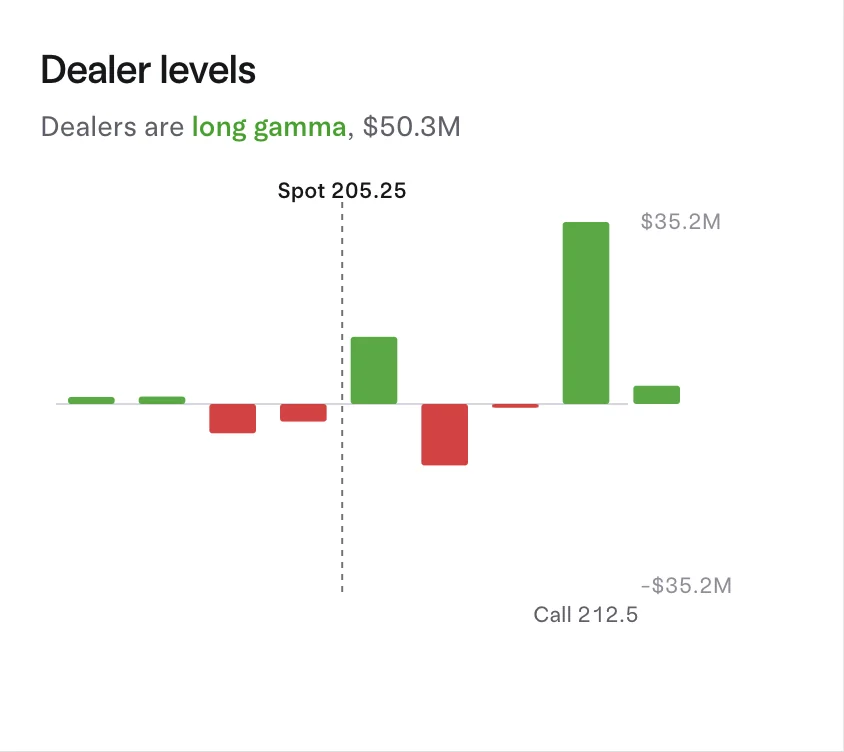
Each options research page, such as QQQ options, has a Dealer levels card that says in plain words whether dealers are long or short gamma, with the total and gamma by strike. The AI analyst (Chat button on any page) answers "Is SPY in positive or negative gamma?" with the total, the flip and the walls. Dealer gamma is on every plan.
Common questions
Is negative gamma bearish?
No. It means dealer hedging adds to moves in either direction. It's common after selloffs because heavy put strikes end up near price, which is why people confuse it with a bearish signal.
Can a stock be in positive gamma and still crash?
Yes. QQQ ended October 30, 2026 in positive gamma after a 3.16% drop. Positive gamma leans against moves; it doesn't cap them.
Is long gamma the same as positive gamma?
For market-wide readings, yes: "dealers are long gamma" and "positive GEX" describe the same estimate.
How fast can the regime change?
Within a session if price crosses the flip, and overnight when open interest updates or a big expiry rolls off.
Sources
- Amaya, Garcia-Ares, Pearson and Vasquez, 0DTE Index Options and Market Volatility: How Large is Their Impact? (January 25, 2025): market maker gamma usually positive, volatility higher when negative, maximum effect 3.3 points.
- Baltussen, Da, Lammers and Martens, Hedging Demand and Market Intraday Momentum (Journal of Financial Economics, 2021): short-gamma hedging and end-of-day momentum.
- Cboe, Evaluating the Market Impact of SPX 0DTE Options (September 8, 2023): market makers long about $2bn of gamma when the August 15, 2023 selloff began.
- SqueezeMetrics, Gamma Exposure (GEX), revised December 2017: positive GEX hedging buys lows and sells highs; negative does the opposite.
- SPY options traded $333.35M in premium on 2026-11-02: $193.21M in calls and $140.14M in puts, a net bullish lean of $31.89M.
- Put/call ratio 0.73.
- Options price a move of about ±$6.07 by 2026-11-02.
- Max pain for 2026-11-02 is $765.0.
Updated 2026-11-02 16:03 UTC