What is gamma in options?
By Faizan Ahmad. Updated .
Gamma is how much an option's delta changes when the stock moves $1. If a call has a delta of 0.50 and a gamma of 0.05, a $1 rise lifts its delta to about 0.55, so the next dollar of gain is worth more than the last. Gamma is highest for at-the-money options close to expiry, and it is always positive for option buyers and negative for option sellers.
Why does gamma matter?
Delta tells you how sensitive an option is right now. Gamma tells you how quickly that sensitivity will change once the stock starts moving. With positive gamma (you bought the option), your delta grows when the stock moves your way and shrinks when it moves against you: gains speed up, losses slow down. With negative gamma (you sold the option), it's the reverse, and a sharp move can turn a small position into a large one against you.
That edge isn't free. The options with the most gamma also lose value fastest each day, so buying gamma means paying theta, and selling gamma means collecting it.
How does gamma change with time to expiry? A SPY example
On October 30, 2026, SPY closed at $757.12, and options expiring Monday, November 2 priced an expected move of about ±$6.93 at 12.4% implied volatility. Take an illustrative SPY $758 call, priced at that same 12.4% volatility, with three different expiries. Then push SPY up or down by one expected move, $6.93, and see what happens to delta:
| Days to expiry | Delta now | Gamma | Delta if SPY rises $6.93 | Delta if SPY falls $6.93 |
|---|---|---|---|---|
| 90 | 0.57 | 0.008 | 0.63 | 0.51 |
| 7 | 0.49 | 0.031 | 0.70 | 0.29 |
| 1 | 0.44 | 0.080 | 0.89 | 0.06 |
The 90-day call barely notices a $6.93 move. The 1-day call goes from a coin flip to almost a share of stock on the way up, or to nearly nothing on the way down. In dollars, the 1-day call is worth about $1.59; the same move takes it to about $6.39, four times its price, or down to $0.12. That's gamma at work, and it's why same-day and weekly options swing so violently. Cboe makes the same point in its 0DTE material: close to expiration, near-the-money options become extremely sensitive to moves in the underlying.
The price of that sensitivity shows up in theta. In the same model, the 1-day call loses about $1.00 of its $1.59 to one day passing, while the 90-day call loses about $0.15 out of $21.98.
Where is gamma highest?
| Option | Gamma | Why |
|---|---|---|
| At the money, days to expiry | Highest | A small move decides whether it finishes in or out of the money |
| At the money, months to expiry | Moderate | Plenty of time for the stock to come back |
| Deep in the money | Low | Delta is already near 1 and has nowhere to go |
| Far out of the money | Low | Delta is near 0 and a $1 move barely changes the odds |
In standard pricing models, a call and a put with the same strike and expiry have the same gamma.
How does gamma add up across the whole market?
Market makers end up on the other side of most public option trades, so they carry the opposite gamma, and they hedge it by trading the stock. A study of S&P 500 options published by Cboe describes the mechanism: when market makers' combined gamma is negative, their hedging means buying as the market rises and selling as it falls, which can add to moves; when it is positive, their hedging leans against moves. The same study found their gamma is typically positive but often negative.
On October 30, 2026, Tradytics estimated SPY's dealer gamma at -$335.55M, meaning dealers trade with the move, with the biggest strike at $758 (-$364.81M). QQQ's was $180.48M, meaning dealers trade against the move. QQQ still fell 3.16% that day, more than SPY's 1.59%, which is a useful reminder: dealer gamma shapes how hedging flows behave, but it doesn't pick direction. The full picture is in gamma exposure (GEX) and positive vs negative gamma.
How to see it on Tradytics
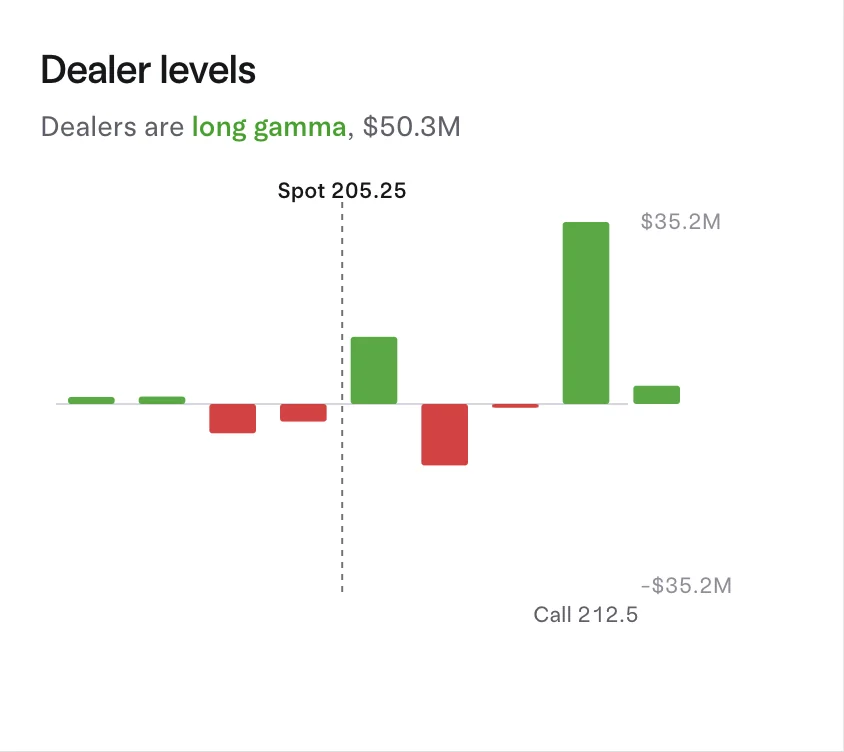
For your own trades, the options strategy builder shows gamma at work in its P&L by price and date: near the strike and close to expiry, the curve bends fastest. For the market, each research options page, such as SPY options, has a dealer levels chart with gamma by strike, the call wall, put wall and gamma flip. You can also ask the AI analyst; asked "Where are SPY's gamma walls?" for the October 30 session, it gave the put wall ($758), call wall ($810), gamma flip ($738.08) and total gamma (-$335.55M).
Common questions
Is high gamma good or bad?
It depends on your side. If you bought the option, high gamma means a big move pays off fast. If you sold it, high gamma means a big move hurts fast.
Why is gamma highest at the money?
That's where the outcome is most uncertain. A small move can flip an at-the-money option from finishing worthless to finishing in the money, so its delta changes the most per dollar.
What is a gamma squeeze?
A run where heavy call buying forces dealers who sold those calls to buy stock as it rises, which pushes it higher and forces more buying. The mechanics are in what is a gamma squeeze.
Does gamma matter for long-dated options?
Much less. With months left, a $1 move barely changes delta, so delta and vega matter more.
Why do 0DTE options move so much?
With hours left, gamma at the money is enormous, so small moves swing delta and price wildly. See what are 0DTE options.
Sources
- Cboe rule filing SR-CBOE-2019-126 (SEC Form 19b-4): gamma as the rate of change in delta, with a worked delta example.
- Cboe, 0DTE trading resources: near-the-money options grow extremely sensitive to the underlying as expiration approaches.
- Amaya, Garcia-Ares, Pearson and Vasquez, "0DTE Index Options and Market Volatility" (January 25, 2025, hosted by Cboe): how market makers' negative or positive gamma can add to or damp market moves.
- SPY options traded $332.69M in premium on 2026-11-02: $193.21M in calls and $139.47M in puts, a net bullish lean of $31.88M.
- Put/call ratio 0.72.
- Options price a move of about ±$6.07 by 2026-11-02.
- Max pain for 2026-11-02 is $765.0.
Updated 2026-11-02 16:03 UTC