What is a gamma squeeze?
By Faizan Ahmad. Updated .
A gamma squeeze is a fast rally fed by options dealers' hedging. Heavy buying of short-dated, out-of-the-money calls leaves dealers short those calls, so they buy stock to hedge; as the price rises, the calls' delta jumps (that's gamma), forcing them to buy more. The loop feeds itself until the call buying stops, the options expire or volatility collapses, and then it can unwind just as fast. It is rarer than social media suggests: the SEC's staff found no evidence of a gamma squeeze in GameStop in January 2021.
How does a gamma squeeze work?
- Traders buy lots of calls, usually cheap, out-of-the-money and expiring soon.
- Market makers sell them and hedge by buying some stock, sized by each call's delta. See how market makers hedge options.
- The stock rises, partly from that hedge buying. The calls move toward the money and their delta climbs quickly, because short-dated options near the money have the highest gamma.
- Dealers buy more stock to keep up with the higher delta. That lifts the price again.
- More traders pile in, implied volatility rises, and the cycle repeats.
- It ends when call buying dries up, the options expire, traders sell their calls, or volatility drops. Dealers then sell the stock they bought as a hedge, and the price can fall hard.
In GEX terms, a gamma squeeze is what deep negative gamma looks like on the way up: dealer hedging chasing the move.
What does it take?
- Options big next to the stock. The hedge buying has to matter against normal share volume. That's why squeezes tend to happen in smaller or thinly floated stocks, not in SPY.
- Short-dated, near-the-money calls. They carry the most gamma, so each move forces the most hedging.
- Customers buying, not selling. Calls bought at the ask put dealers short. Calls sold to dealers do the opposite. What "at the ask" and "at the bid" mean explains how to tell.
- Persistence. One burst of call buying gets hedged and forgotten. A squeeze needs wave after wave.
Gamma squeeze vs short squeeze
| Gamma squeeze | Short squeeze | |
|---|---|---|
| Who is forced to buy | Options dealers hedging calls they sold | Short sellers covering losing positions |
| Fuel | Call buying, especially short-dated | High short interest and a rising price |
| What ends it | Call buying stops, expiration, falling volatility | Shorts finish covering |
| What to check | Call volume vs open interest, side of the trades, dealer gamma | Short interest, days to cover, borrow cost |
The two can feed each other, which is why they're often confused.
What the SEC found about GameStop
GameStop's January 2021 run is the most cited "gamma squeeze." The SEC staff's October 14, 2021 report on that episode looked at the data and said staff "did not find evidence of a gamma squeeze in GME during January 2021." Its reasons:
- Options trading by individual customers did explode, from $58.5 million on January 21 to $563.4 million on January 22 and a peak of $2.4 billion on January 27.
- But that increase was mostly driven by buying puts, not calls.
- And market makers were buying calls, not writing them, which is the opposite of what a gamma squeeze needs.
The staff concluded that short covering wasn't the main driver either: positive sentiment, not buying to cover, sustained the weeks-long rise. The lesson: a stock going vertical with busy options isn't proof of a gamma squeeze. You need to see who bought and who sold.
Why most heavy call buying doesn't squeeze anything
On October 30, 2026, Citigroup was the most bullish stock in the market by net options premium: $93.80M of bullish lean out of $215.39M traded. The flow included 5,350 December 18 $75 calls bought at the ask for $24.82M, twice the 2,675 contracts already open, and 4,270 December 18 $72.5 calls for $20.86M. Citigroup still fell 2.6% that day.
Nothing about that is strange. The calls had 49 days left, so their gamma was far smaller than this week's options; Citigroup is a large, liquid stock that absorbs hedge buying easily; and one afternoon of buying is not the repeated pressure a squeeze needs. Big call buying is a flow story. A squeeze is a market-structure story, and it needs more conditions to line up.
The mirror image happens on the way down. SPY ended that session with -$335.55M of dealer gamma, so dealer hedging was set to add to selling on further drops. Traders sometimes call that a negative gamma selloff rather than a squeeze.
How to spot squeeze conditions early
- Call volume running far above open interest in near-dated contracts, a sign of new positions. See volume vs open interest.
- Prints at or above the ask, repeated over hours or days.
- Dealer gamma turning negative above the price, with price pressing toward the call wall and pushing it higher day after day.
- Implied volatility rising with the price, the opposite of the usual pattern for stocks.
How to see it on Tradytics
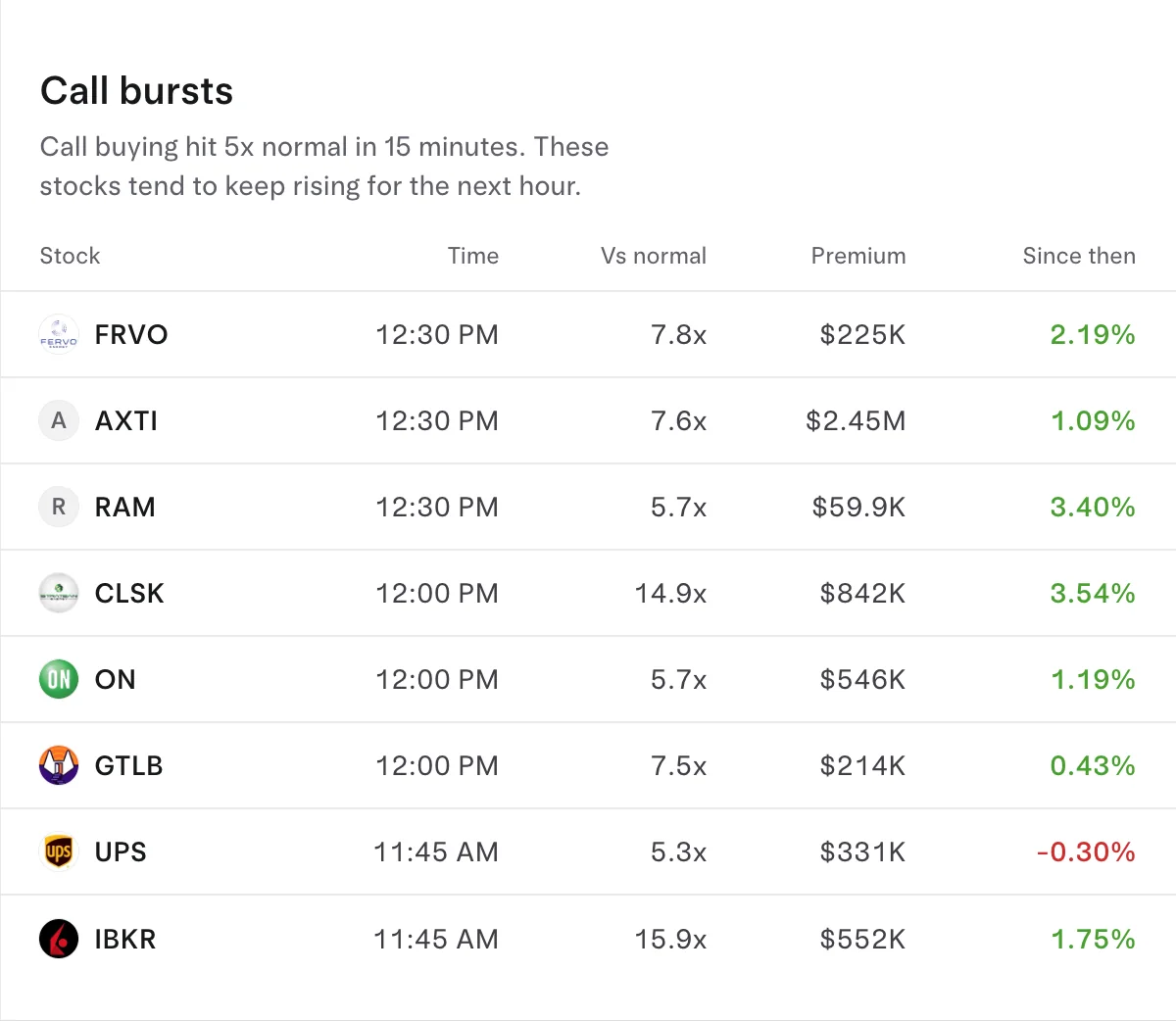
The options market page has a Call bursts card that lists stocks where call buying suddenly jumped to several times normal. From there, a stock's options research page shows the calls and puts split into bought and sold, the largest orders with size against open interest, and Dealer levels with the call wall and gamma by strike. Flow is live on Live and Pro; Free shows yesterday's session.
Common questions
Was GameStop a gamma squeeze?
The SEC staff said it found no evidence of one in January 2021: customer options buying was mostly puts, and market makers were buying calls rather than writing them.
Can a gamma squeeze go down?
The same loop works in reverse with heavy put buying, as dealers sell stock to hedge puts that move toward the money. Traders usually call that a negative gamma selloff.
How long do gamma squeezes last?
There's no fixed length. They tend to fade when the call buying stops or when the calls that fueled them expire, since that gamma disappears at expiry.
Does buying calls cause a gamma squeeze?
Only when the buying is large next to the stock's trading, concentrated in short-dated contracts and sustained. Most call buying, even big buying, never gets there.
Sources
- SEC staff, Staff Report on Equity and Options Market Structure Conditions in Early 2021 (October 14, 2021): no evidence of a gamma squeeze in GME; customer volume driven by puts; market makers buying calls.
- SqueezeMetrics, Gamma Exposure (GEX), revised December 2017: how dealer re-hedging follows delta changes.
- Amaya, Garcia-Ares, Pearson and Vasquez (January 25, 2025): how large dealer gamma effects on S&P 500 volatility can get, measured from actual market maker positions.
- SPY options traded $335.60M in premium on 2026-11-02: $193.59M in calls and $142.01M in puts, a net bullish lean of $32.05M.
- Put/call ratio 0.73.
- Options price a move of about ±$6.07 by 2026-11-02.
- Max pain for 2026-11-02 is $765.0.
Updated 2026-11-02 16:05 UTC