Volume vs open interest: what's the difference and why it matters
By Faizan Ahmad. Updated .
Volume is how many contracts traded today. Open interest is how many contracts are still open after the last close. Volume updates with every trade and starts from zero each session, while open interest is calculated by the Options Clearing Corporation (OCC) once a day, after the day's trades are cleared, so during the session you're looking at yesterday's number. When today's volume in a contract is bigger than its open interest, at least part of that trading must be new positions, which is why flow traders watch the ratio.
Volume vs open interest at a glance
| Volume | Open interest | |
|---|---|---|
| What it counts | Contracts traded in this session | Contracts still open (not closed, exercised or expired) |
| When it updates | With every trade | Once a day, after clearing |
| Who produces it | The exchanges, carried on the OPRA tape | OCC, from the exchanges' trade reports |
| Resets | Every session | Never; it carries over and changes day to day |
| What it tells you | How active a contract is today | How many positions are riding on it |
| What it can't tell you | Whether trades opened or closed | Whether those positions are long or short, bullish or bearish |
How open interest is counted
Every option trade has a buyer and a seller, and each one is either opening a new position or closing an old one. Open interest only changes based on that combination. The Options Industry Council lays it out this way:
| Buyer | Seller | Open interest |
|---|---|---|
| Opening | Opening | Up by the trade size |
| Opening | Closing | No change (a position changed hands) |
| Closing | Opening | No change (a position changed hands) |
| Closing | Closing | Down by the trade size |
Nobody on the tape knows which row a trade belongs to while it happens. The OIC explains that OCC can only report new open interest at the end of the day, "after clearing and pairing opening and closing positions." OCC builds the number from the exchanges' reports of opening and closing transactions and removes contracts that were exercised and assigned. That's why open interest is always one session behind. More on the number itself in what is open interest.
Why volume bigger than open interest matters
Open interest caps how much of today's volume can be closing old positions. If a contract started the day with a given open interest, at most that many contracts could have closed positions that existed before today. Anything beyond that had to open something, at least on one side. That's the logic behind every "volume over open interest" or "unusual activity" screen (see what is unusual options activity).
A real case from October 30, 2026: 1,885 Amazon September 17, 2027 240 calls traded at 9:40 AM for $6.55M, sold at the bid, against open interest of 309. Volume was about 6.1 times open interest, so at least 1,576 of those contracts couldn't have been closing old positions. With the seller as the aggressive side, the likely read is new calls sold, which leans bearish.
Two limits. First, someone can open and close within the same day, so volume over open interest proves new trading, not that the position was still open at the close. Second, a large trade in a contract with big open interest can be entirely new and still never trip the screen.
When volume is below open interest
This is where the ratio goes quiet. On October 30, the Tesla November 20 400 call traded 1,791 contracts at 10:00 AM and 5,441 at 10:14 AM, 7,232 in all, against open interest of 17,522. That's well under half the open interest, so the trades could be new positions, old ones closing, or a mix. The ratio can't tell, and that's most trades in popular contracts.
Rolls: one closing leg, one opening leg
Comparing each leg of a trade with its own open interest can reveal a roll. At 12:15 PM on October 30, two AMD puts traded the same 1,455 contracts in the same minute:
- January 21, 2028 340 put: $4.70M, against open interest of 4,682
- June 16, 2028 310 put: $4.49M, against open interest of 90
The June leg was 16 times its open interest, so it was largely new. The January leg was well within its open interest, so it could easily have been a position closing. Same size, same minute, a later expiry and a lower strike: that's the shape of someone rolling puts out in time. The next morning's open interest settles it, falling in January and rising in June if it was a roll. Multi-leg trades are covered in how to read spreads.
The next-morning check
Because open interest is published after clearing, the cleanest test of a big trade is the next session's open interest:
- Open interest rose by about the trade size: both sides opened. A new position.
- Open interest barely moved: a position changed hands, one side opening and one closing.
- Open interest fell by about the trade size: both sides closed.
Other trades in the same contract muddy this, but for a large print in a quiet contract it's usually clear. Opening vs closing covers the full method.
How to see it on Tradytics
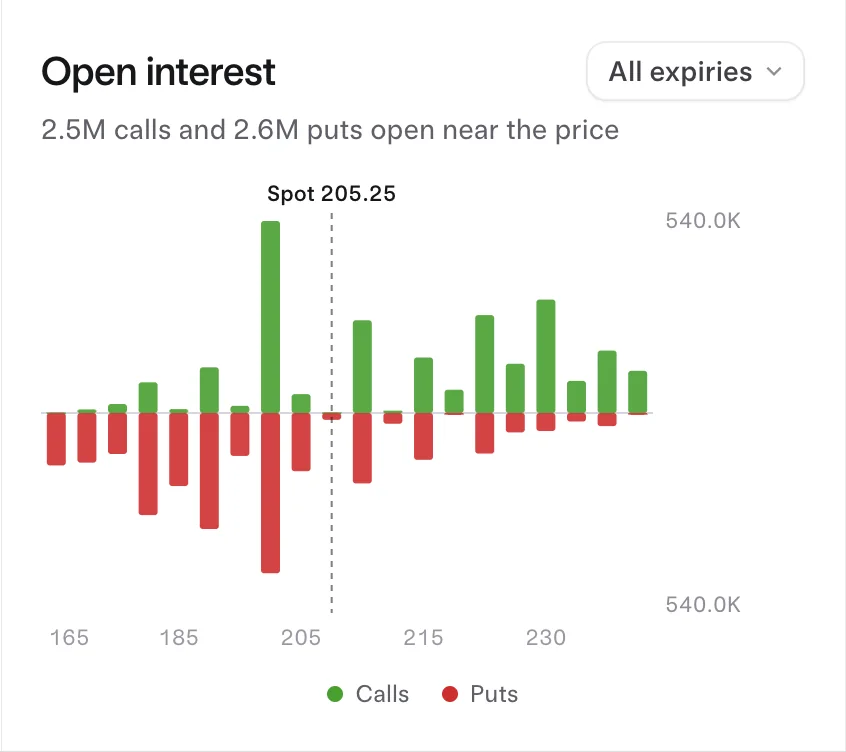
On the Live options flow page, every print shows its size, the contract's open interest and the Vol/OI ratio, and trades bigger than open interest carry an Opening tag, meaning most likely a new position. For one stock, the options page (for example TSLA options) charts open interest by strike for calls and puts, with max pain, and lists the largest orders with size against open interest. Live and Pro show flow live to the second; Free shows yesterday's session.
Common questions
Does open interest update during the day?
No. OCC reports it after clearing at the end of the day, so the open interest you see during a session is from the prior close.
Is rising open interest bullish?
Not by itself. Open interest counts open contracts, and every one has a long and a short side. The OIC says open interest on its own points neither bullish nor bearish.
Can volume be bigger than open interest?
Yes, often, especially in newly listed strikes or on news. It means at least part of the day's trading opened new positions or was opened and closed within the day.
Where can I see real opening and closing data?
Some exchanges sell it separately. Cboe's Open-Close Volume Summary sorts trades by buy or sell and open or close, but only for trades on Cboe's own four options exchanges.
Does high open interest mean a contract is liquid?
Not necessarily. The OIC calls the idea that volume and open interest equal liquidity a common misconception. The bid-ask spread is a better guide.
Sources
- Options Industry Council: General Information FAQ, how opening and closing trades change open interest, and that OCC reports it after clearing at the end of the day.
- Options Industry Council: Open Interest, Why It Matters (October 2025), OCC calculates open interest from the exchanges' trade reports and removes exercised and assigned contracts.
- Cboe DataShop: Open-Close Volume Summary, buy/sell and open/close volume for trades on Cboe's four options exchanges.
- OPRA, which disseminates the exchanges' last sale reports, quotes, volume and open interest.
- Most bullish options flow on 2026-11-02: MRVL ($23.00M net), AMZN ($16.00M net), TSLA ($12.11M net), LITE ($6.09M net), PLTR ($4.27M net).
- Most bearish options flow on 2026-11-02: AAPL ($40.91M net), AMD ($20.61M net), MU ($10.73M net), ORCL ($8.12M net), NVDA ($7.88M net).
Updated 2026-11-02 16:02 UTC