What is unusual options activity?
- Most bullish options flow on 2026-11-20: MU ($66.96M net), BABA ($35.03M net), NBIS ($29.39M net), SKHY ($13.58M net), MRVL ($11.21M net).
- Most bearish options flow on 2026-11-20: TSM ($73.73M net), SNDK ($69.53M net), MSTR ($63.77M net), SPCX ($49.06M net), AMD ($47.84M net).
By Faizan Ahmad. Updated .
Unusual options activity is trading in an options contract that is far bigger than normal for that contract, most often a single trade or a day's volume larger than the contract's open interest. Because the size is bigger than everything that was already open, at least part of it is very likely a brand-new position, which is why traders notice. It tells you someone just committed real money to a specific strike and date; it doesn't tell you why, and many unusual trades turn out to be hedges or parts of larger trades.
A real example: Citigroup calls on October 30, 2026
At 3:18 PM ET on October 30, 2026, 5,350 Citigroup (C) $75 calls expiring December 18, 2026 were bought at the ask for $24.82M. Only 2,675 of those contracts existed before the trade, so volume was twice the open interest. In the same minute, 4,270 of the $72.50 calls traded against open interest of 2,133, also bought at the ask, for $20.86M.
Those two prints, $45.68M together, are about half of the $93.80M in net bullish premium that made Citigroup the most bullish stock in the options market that day. The stock still closed down 2.6%.
Now look one level deeper. $24.82M across 5,350 contracts is about $46.39 per share, a price that only makes sense if the stock was trading far above $75. These calls were deep in the money, and calls that deep move almost dollar for dollar with the shares. This was much closer to owning Citigroup stock with less cash up front than to a long-shot bet, a detail the word "unusual" hides.
The unusual bets of October 30, 2026
These were the day's standout trades where size beat open interest:
| Time (ET) | Contract | Size vs open interest | Premium | Side | Lean |
|---|---|---|---|---|---|
| 3:18 PM | C Dec 18, 2026 $75 call | 5,350 vs 2,675 | $24.82M | Bought at ask | Bullish |
| 3:18 PM | C Dec 18, 2026 $72.50 call | 4,270 vs 2,133 | $20.86M | Bought at ask | Bullish |
| 1:03 PM | META Feb 19, 2027 $730 call | 4,481 vs 793 | $10.59M | Bought at ask | Bullish |
| 1:04 PM | STX Nov 20, 2026 $655 put | 1,621 vs 70 | $8.71M | Sold at bid | Bullish |
| 9:33 AM | AMD Dec 15, 2028 $910 put | 170 vs 52 | $7.28M | Bought at ask | Bearish |
| 3:05 PM | C Dec 18, 2026 $50 call | 1,000 vs 107 | $7.12M | Sold at bid | Bearish |
| 1:56 PM | GOOG Jan 15, 2027 $275 put | 4,903 vs 2,761 | $6.59M | Sold at bid | Bullish |
| 9:40 AM | AMZN Sep 17, 2027 $240 call | 1,885 vs 309 | $6.55M | Sold at bid | Bearish |
Notice how few of them are the cheap, short-dated lottery tickets people picture. Only one of the eight expires within a month, and all three Citigroup trades are deep in the money.
Why do traders watch unusual options activity?
- It's likely new money. Size above open interest means at least part of the trade opened a position rather than closed one (see opening vs closing).
- It shows commitment. Premium is cash at risk, and $24.82M in one print is not a casual order.
- It's specific. A strike and an expiry say what move the trader needs and by when, something a stock purchase never tells you.
- Occasionally it is informed. A study of 1,859 US takeovers found abnormal options volume before about 25% of them, mostly in short-dated out-of-the-money calls. That is rare and hard to spot as it happens; see whether unusual activity means insider trading.
What unusual options activity is not
It is not a buy or sell signal on its own. A big put purchase on an index ETF is often insurance on a portfolio. A big call sale can be a shareholder writing calls against stock. One leg of a spread looks dramatic until you see the other leg printed in the same second. And because every trade has both a buyer and a seller, the "bought" or "sold" label is an inference from the fill price. Whether trading off unusual activity pays is a separate question, answered in does following unusual options activity work?
How unusual is unusual?
There is no official threshold. The main tests are size versus open interest (Citigroup's 2x, Seagate's 23x), size versus the contract's usual volume, premium compared with the stock's normal options trading, and how aggressively the trade filled. Each test is explained with examples in what makes an options trade unusual.
How Tradytics shows this
Tradytics reads the full OPRA tape: every trade on every US options exchange, live, about a second after it prints, stitched into orders and tagged as bought or sold from its price against the quote. On the Live options flow page, the Opening tag marks any order bigger than the contract's open interest, and the Vol/OI column shows by how much; type "unusual calls bought at the ask over $5M" and the page builds that view. Free shows the previous session; Plus and Pro show unusual orders as they happen.
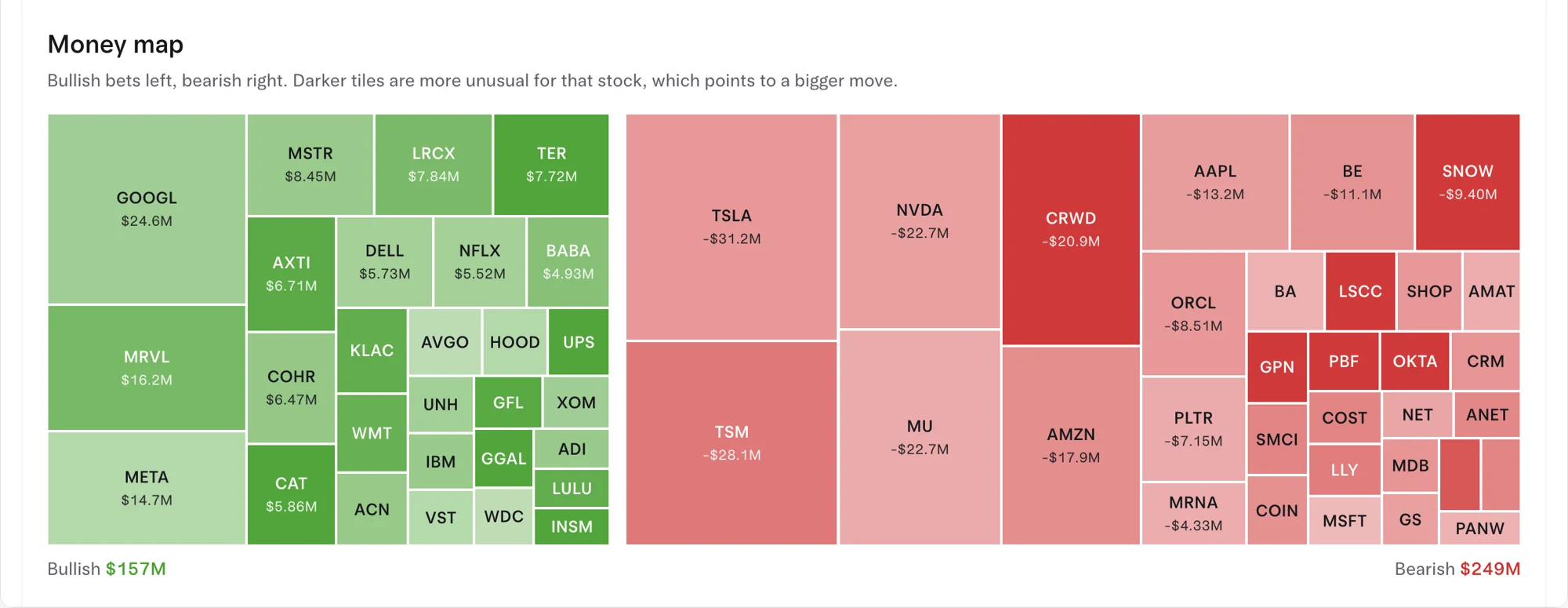
Every stock's options research page (Plus and Pro), such as AMD's, has a largest and unusual orders card, and the options market page has the money map above plus repeat flow, the contracts bought again and again across sessions. Call volume far above open interest and repeat call buying in ETFs both held up in Tradytics' study of 10.9 million options prints over 378 sessions, and both feed its Signals (how they are built).
On Tradytics: clean options flow from the full tape, Signals from a study of 560 million pattern and horizon combinations, and every order since January 3, 2022 in the options flow API and the backtester.
Common questions
Is unusual options activity bullish or bearish?
It depends on the contract and the side. Calls bought at the ask and puts sold at the bid lean bullish; puts bought at the ask and calls sold at the bid lean bearish. Five of the eight unusual bets on October 30, 2026 leaned bullish.
What Vol/OI ratio counts as unusual?
Anything above 1 means more contracts traded than existed before. On October 30, 2026 the unusual bets ranged from 2x (Citigroup $75 calls) to 23x (Seagate $655 puts: 1,621 contracts against 70 open).
Can a small trade be unusual?
Yes. The AMD December 2028 $910 puts were only 170 contracts, but open interest was 52 and the premium was $7.28M because the puts were deep in the money.
Where does the data come from?
Trades come from OPRA, the consolidated feed of every US options exchange. Open interest comes from the Options Clearing Corporation (OCC), which calculates it from the exchanges' trade reports.
Sources
- FINRA: Options: defines open interest as the number of outstanding contracts in an options market or contract.
- Options Industry Council: Open Interest, Why It Matters: the OCC calculates open interest, and how opening and closing trades change it.
- Augustin, Brenner and Subrahmanyam, Management Science (2019): abnormal options volume before about 25% of 1,859 US takeovers.