How Tradytics Signals work
By Faizan Ahmad. Updated .
Tradytics Signals (Signals in the menu) are real orders from the live options flow that match one of seven flow patterns. The patterns come from one of the largest studies of retail options flow published by any platform: more than half a billion pattern and horizon combinations tested on 10.9 million options prints over 378 sessions, joined to real 1-minute stock bars and real option quotes, and judged on months they were not fitted on. When an order matches, the signal is to buy the same contract at the ask. Every signal stays on the page and is tracked to expiry. Plus and Pro see signals live; Free sees them a day late.
Where do signals come from?
Each signal comes from one of seven patterns in the flow:
| Pattern | What it watches for |
|---|---|
| Repeat flow | The same at- or out-of-the-money contract bought again and again in one session, with little sold against it |
| Opening calls | One call order about as large as the contract's open interest, at the stock's usual implied volatility |
| Heavy calls | A call on a low-priced stock trading several times its open interest |
| ETF repeat | The same in-the-money ETF call bought again across recent sessions |
| ITM puts | In-the-money puts bought at the ask on high-priced stocks |
| Call burst | Bullish premium in a stock running far above its normal pace on a strong market day |
| Index tide | Calls bought in a stock while SPY, QQQ and IWM see heavy one-way bullish flow |
The study joined every print to what the stock and the option actually did next, at real prices, so a pattern had to survive real quotes to make the list. A trained filter then hides the weakest prints inside each pattern. Each pattern is covered in the seven patterns behind Tradytics Signals.
Why patterns from flow and not AI picks?
An AI pick is a model's opinion, and a confidence score is a number the model gives itself. A signal is an order someone actually placed, matched to a rule that was tested before it went live. You can see the exact print that fired it, and every signal is kept on the page, winners and losers, so the feed is something you can check rather than a highlight reel.
What does a signal show?
| Part | What it tells you |
|---|---|
| Contract | The ticker, call or put, strike, expiration, and the bid and ask when it fired |
| Pattern | Which of the seven patterns matched |
| Note | A title and a short paragraph on what the flow did and what the trade needs from the stock |
| Return | The contract's latest mark, or its settlement after expiry, against the ask paid |
| Best | The highest the contract has been marked since it fired, against the ask paid |
| Since it fired | The contract's marks over time |
| The flow behind it | This contract's prints, the same ticker's flow in the 15 minutes before, and the index flow |
The feed shows signals as cards or a table. Filter by pattern, by open or expired, or search a ticker to see its past signals.
How are signals tracked?
Each signal is bought at the ask when it fires. Its contract is marked at the midpoint of the bid and ask every 5 minutes through the session, and after expiry it settles at what the option was worth at the close. Return is the latest mark or the settlement against the ask paid; Best is the high-water mark. Signals have no exit rule on the page: where to take profits is your call, and Best shows what was on offer.
When do you see signals on each plan?
| Free | Plus | Pro | |
|---|---|---|---|
| Price | $0 | $39 a month or $299 a year | $69 a month or $499 a year |
| Signals | A day late | Live | Live |
| AI analyst (to ask about a signal) | 3 questions a day | 20 a day | Unlimited |
On Free, the latest session's signals stay locked until the next session opens at 9:30 AM New York time. Their pattern, note and Return show, and the contract stays hidden. Everything older is open in full.
A routine for using signals
- Open Signals and filter to open contracts.
- Read the pattern and the note, then open the flow behind it.
- Check the ask against what you can afford to lose: on a bought option, the premium is the most you can lose.
- Check the ticker's research options and dark pool pages, or ask the AI analyst about anything you don't follow.
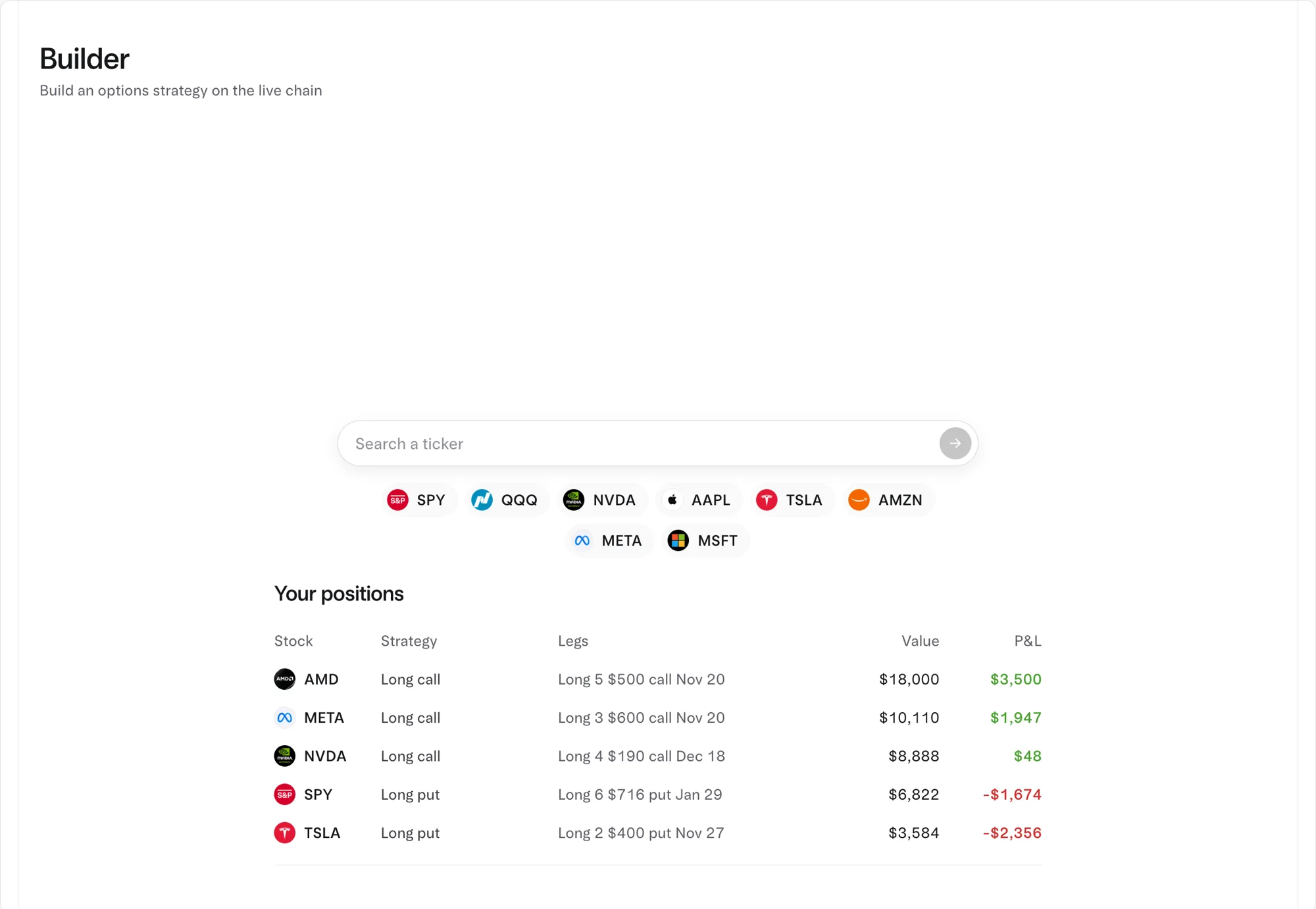
- If you take it, place the order at your broker; Tradytics' broker link is read only. To see the payoff by date, rebuild it in the options strategy builder.
A signal near earnings carries one more risk: implied volatility usually drops after the report, which can shrink option prices even when the stock moves your way. What is IV crush? explains it. For a different kind of AI-run trading, the Tradytics AI Fund is an options fund managed entirely by AI on frontier models, with every trade published.
Common questions
Are Tradytics Signals free?
Yes, a day late. Free sees every signal except the latest session's, which unlocks when the next session opens. Plus and Pro see signals live.
How are the patterns found?
From a test of more than half a billion pattern and horizon combinations on 10.9 million options prints over 378 sessions, judged on the contract's own result at real prices. How Tradytics Signals are built covers the research.
Does Tradytics give signals a confidence score?
No. Each signal shows the order that fired it and how the contract has done since, not a number a model gives itself.
Can I place a trade from Tradytics?
No. Tradytics' broker link is read only, so you place trades at your broker.
What kinds of trades are signals?
Single calls and puts: the same contract the flow bought, at the ask.
Sources
- Options Price Reporting Authority (OPRA): the consolidated last sale and quotation feed from the US options exchanges, where every print and quote behind a signal comes from.
- FINRA: Options: FINRA's investor guide to options, including that an option buyer's maximum loss is the premium paid.