What is IV crush?
By Faizan Ahmad. Updated .
IV crush is the sharp drop in implied volatility right after a known event, most often an earnings report. Before the event, options carry extra premium for the uncertainty; once the news is out, that premium disappears overnight and option prices fall with it. That's why you can buy calls, watch the stock rise after earnings, and still lose money: the stock has to move more than the options were already pricing.
Why does IV crush happen?
Ahead of a scheduled event, nobody knows the result, so traders pay up for options and implied volatility climbs. The moment the result is public, the biggest unknown is gone. Option sellers no longer need to be paid for it, and IV falls back toward normal levels, often in a single session.
A 2024 Cboe research paper on retail options trading describes the same pattern: option premiums and implied volatility are already elevated before earnings, the drop in implied volatility afterward can outweigh what the stock's move adds, and traders who close after the report can lose money even when the stock moves more than it does on a normal day.
A real setup: Apple before Monday's earnings
On October 30, 2026, Tradytics showed Apple's implied volatility at 42.4%, up 12.3 points, ahead of its earnings report on Monday, November 2. Its options expiring Wednesday, November 4, the first expiry after the report, were priced at 45.7% IV, an expected move of about ±$16.49, or 4.8% of Apple's $345.10 close.
Illustrative arithmetic: an at-the-money AAPL $345 call expiring November 4, priced off that 45.7% IV, costs about $7.51 a share ($751 a contract) at Friday's close. Now assume the report knocks that expiry's IV down to 25%, and you check the call on Tuesday with one day left:
| Apple by Tuesday | Call value | P&L per contract |
|---|---|---|
| Unchanged at $345.10 | $1.87 | -$564 |
| Up 1% | $4.14 | -$337 |
| Up 2% | $7.16 | -$35 |
| Up 3% | $10.51 | $300 |
| Up 5% | $17.39 | $988 |
Apple had to rise about 2% just to break even. Some of that loss is four days of time decay, but the crush on its own is large: take the same call at the same stock price on the same day and drop its IV from 45.7% to 25%, and it falls from $7.51 to $4.17. That's 44% of its value gone before the stock moves or a single day passes, vega working in reverse, all at once.
What does IV crush look like after the fact?
Amazon showed it the same day. On October 30, 2026, its implied volatility fell 27.3 points to 39.5%, from about 66.8%, while the stock slipped 1.2% to $240.80. Tradytics' AI story for the day said the stock fell as investors weighed slower retail growth and heavy spending after earnings. A put buyer was right on direction, but a 1.2% drop is small next to the move a 66.8% IV prices into near-dated options. Being right about direction is not enough; you have to be right about size.
How do traders deal with IV crush?
| Approach | Effect on crush exposure | The trade-off |
|---|---|---|
| Compare the expected move with the stock's past earnings moves | Tells you whether options are pricing more or less than usual | The past doesn't promise the next report |
| Buy a spread instead of a single option | The short leg offsets much of the vega | Profit is capped |
| Buy a later expiry | Less of the price is event premium | Costs more, and still drops some |
| Sell before the report | Avoids the crush entirely | No exposure to the move you wanted |
| Sell premium into the report | You collect the crush | Large losses if the stock moves more than priced |
Whether a stock's options are priced high for that stock is what IV rank and IV percentile measure, and the flow side of this setup is in what big call buying before earnings means.
How to see it on Tradytics
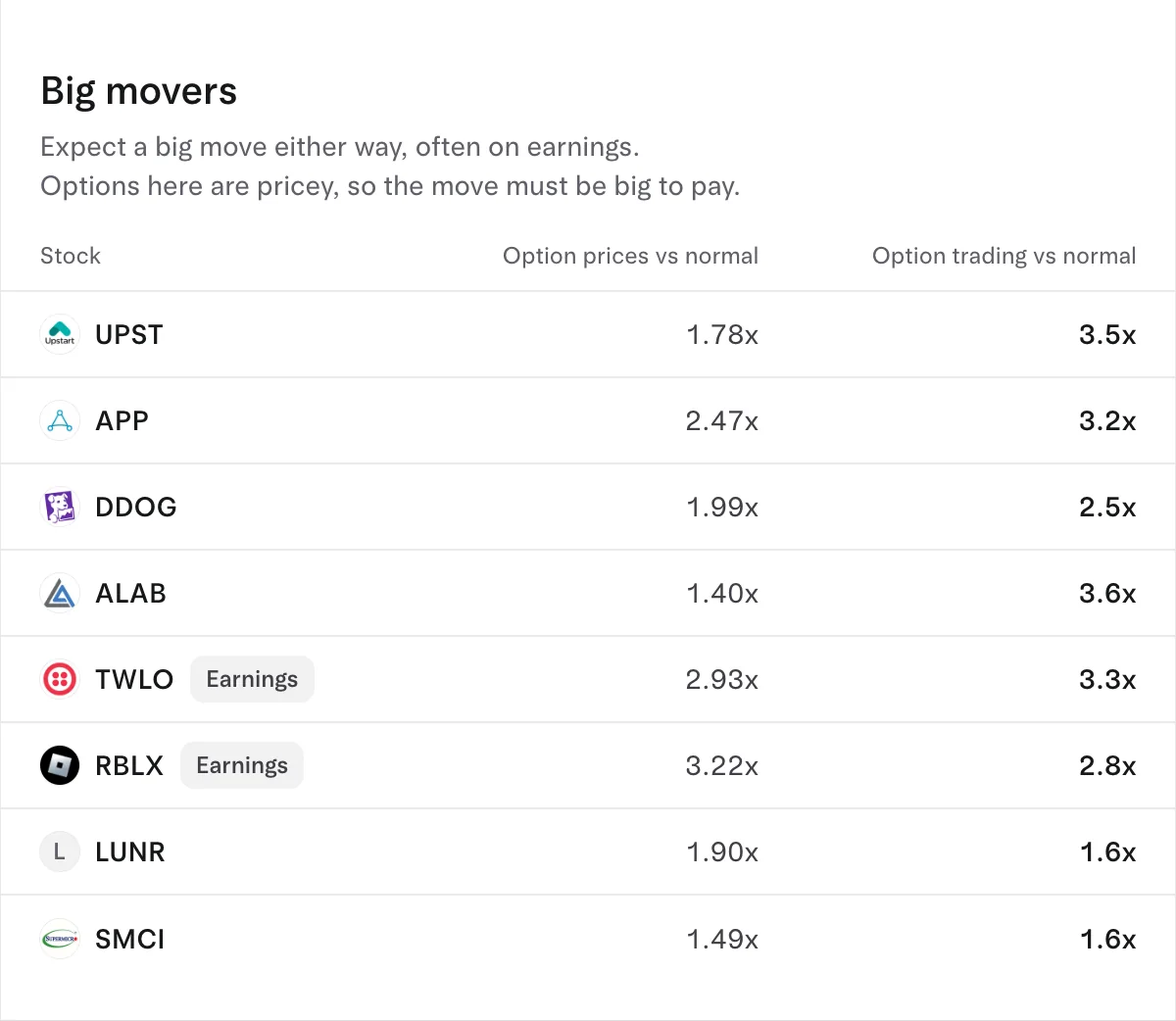
Open a stock's research options page, such as AAPL options, and look at the expected move by expiry and the implied volatility term curve: the bump at the first expiry after earnings is the premium that gets crushed. The options market page has the Big movers card, which lists stocks whose options are priced well above normal, often ahead of earnings. Upcoming reports are on the earnings calendar on the markets page.
Common questions
Does IV crush hit puts too?
Yes. Calls and puts both carry event premium, and both lose it when IV drops.
How much does IV fall after earnings?
It varies by stock and report. On October 30, 2026, Amazon's implied volatility fell 27.3 points in one session.
Does IV crush only happen around earnings?
No. Any scheduled event with a big unknown can do it: drug trial results, regulatory decisions, central bank meetings, court rulings.
Is IV crush the same as time decay?
No. Theta takes a little each day; IV crush is a one-time drop in volatility. Option buyers feel both after an event.
Can you profit from IV crush?
Option sellers collect it, but they carry the risk of a move bigger than the market priced, and that risk is real every earnings season.
Sources
- Selina Han, "Unveiling the Sophistication: Understanding Retail Investors' Trading Behavior in the U.S. Options Market" (Cboe, May 17, 2024): elevated implied volatility before earnings, and how its drop afterward can outweigh gains from the stock's move.
- OCC and the US options exchanges, Characteristics and Risks of Standardized Options (June 2024): estimates of future volatility as a driver of option premiums.
- SPY options traded $335.25M in premium on 2026-11-02: $193.55M in calls and $141.70M in puts, a net bullish lean of $32.08M.
- Put/call ratio 0.73.
- Options price a move of about ±$6.07 by 2026-11-02.
- Max pain for 2026-11-02 is $765.0.
Updated 2026-11-02 16:04 UTC