Tradytics Signals: high-conviction options setups backed by 5 years of real quotes
By Faizan Ahmad. Updated .
Tradytics Signals (Signals in the main menu) is a live feed of institutional options setups backed by five years of real-quote testing. Instead of flooding your screen with unverified alerts or black-box AI guesses, the system only fires when live market conditions and real options flow align with one of eight validated setups.
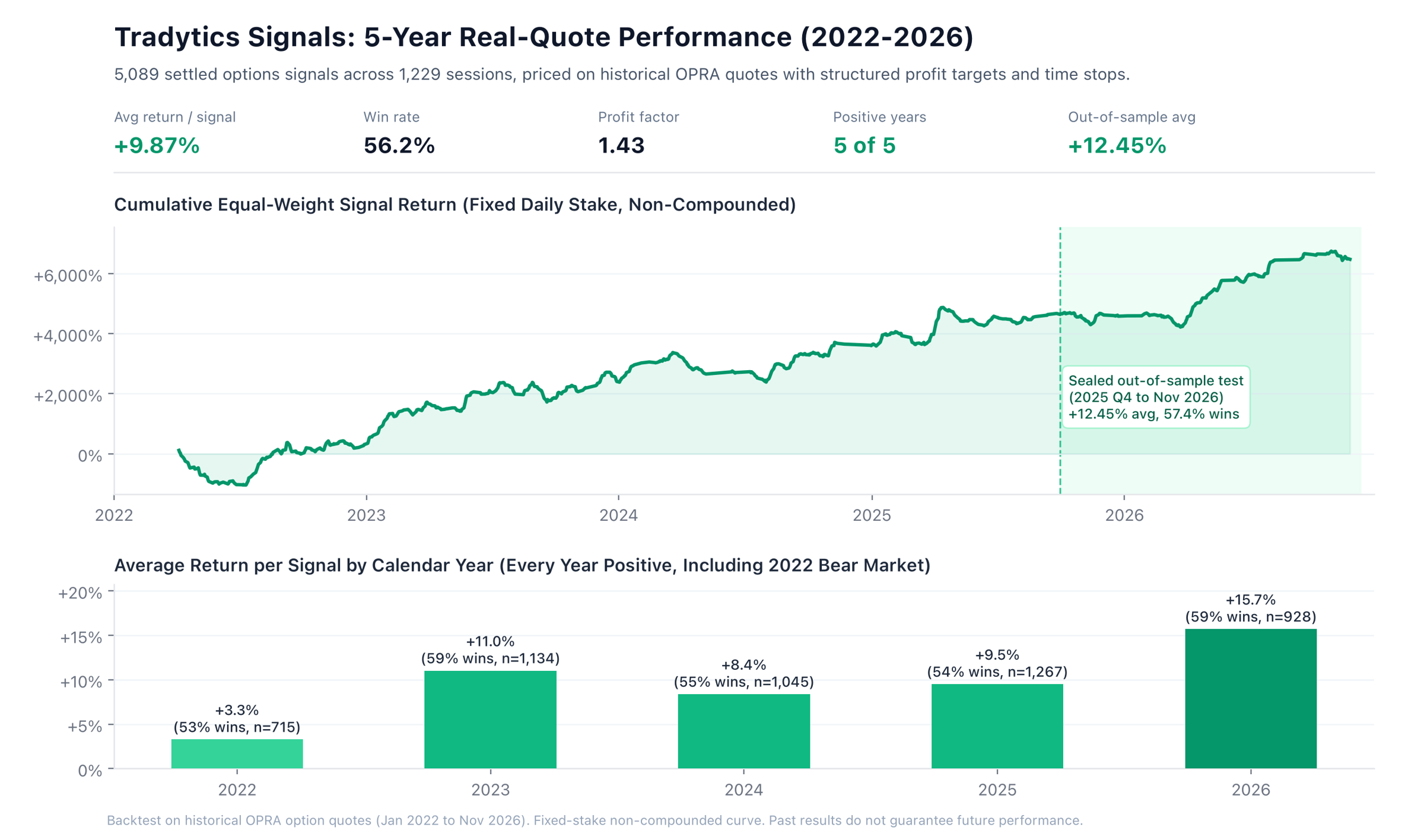
Across 5,089 settled signals from January 2022 through November 2026 on historical OPRA option quotes, the system averaged +9.87% per signal with a 56.2% win rate, a 1.43 profit factor, and a 2.28 Sharpe ratio. Every single calendar year finished positive, including 2022 (+3.3%), 2023 (+11.0%), 2024 (+8.4%), 2025 (+9.5%), and 2026 (+15.7% through November). On the sealed out-of-sample holdout (2025 Q4 through November 2026), accuracy held even stronger at +12.45% average return and a 57.4% win rate.
What makes Tradytics Signals different?
Most alert platforms either show raw unusual activity with no proof it works, or let an LLM hallucinate trade ideas with made-up confidence scores. We ran millions of backtests on five years of live OPRA quotes and kept only the patterns that passed strict out-of-sample validation.
- Priced at real ask, tracked transparently: every signal records the live NBBO ask when it fires, updates with live quotes every 15 seconds, and logs 5-minute marks permanently. Wins and losses both stay on the record.
- Structured exit plan built in: instead of holding contracts into expiration decay, each signal follows a clear exit plan (book half at +35%, move the runner's stop to entry price, target +100% on the remainder, or close at the 5-day or 10-day time limit).
- Regime-aware pacing: when the broader tape gets choppy or weak, the engine automatically throttles call setups rather than forcing bad entries, and displays a clean notice above the feed.
- Both sides of the market: six bullish call setups capture breakouts, steady accumulation, and late-day momentum, while two bearish put setups activate during stressed market tapes.
The eight signal setups at a glance
You can filter the feed by any individual setup using the dropdown at the top right, or hover over any Pattern badge in the table for a quick refresher.
| Badge | Direction | What it captures |
|---|---|---|
| Open vol | Call | Overnight institutional call positioning confirmed by aggressive buying right after the open |
| Morning flow | Call | Institutional buyers stepping into liquid calls during the morning session in a healthy trend |
| Dark pool | Call | Heavy prior-day institutional dark pool activity followed by fresh midday call buying at the ask |
| Repeat flow | Call | Buyers repeatedly accumulating the exact same call contract across recent sessions |
| Bear puts | Put | In-the-money put buying during weak, higher-volatility markets after a short relief bounce |
| Close vol | Call | Late-day call setup into the closing bell when options positioning points to an upcoming breakout |
| Close swing | Call | End-of-day swing call entry on liquid market leaders when multi-day institutional flow turns bullish |
| Close bear | Put | End-of-day in-the-money put hedge triggered when market stress rises and institutional flow turns bearish |
See the eight patterns behind Tradytics Signals for a fuller walkthrough of how each setup behaves.
How to read the Signals table
Each row gives you the full contract at a glance: when it fired, the ticker, call or put, expiry and status, strike, stock price, bid and ask at entry, blended Return, Best mark reached, Exit criteria, Pattern, and a short plain-English note.
- Return: blended performance against the entry ask under the built-in scale-out plan. Open rows move live; closed rows freeze at their final exit price.
- Best: the highest mark the contract reached after firing, useful for seeing how far winners ran.
- Exit criteria: shows whether the trade is still in its 5-day or 10-day window, already hit +35%, locked in profit on a breakeven runner, doubled at +100%, or timed out. Hover any badge to read the exact rule.
Click any row to open its detail sheet with the full 5-minute price chart since entry, contract metrics, and the options flow prints around the trigger.
Signals by API and AI agents
Every signal, its five-minute mark history, and live performance metrics are available through the Tradytics Signals API and MCP server. Quants, bots, and AI assistants can pull the exact same live feed that powers the web app.
Plans and live access
Plus and Pro subscribers see every signal in real time as it fires, with live 15-second quotes and full detail sheets. Free users can inspect all past sessions and see real Return, Best, Exit criteria, and Pattern values on the latest session while its contract details unlock the next trading day.
A practical routine for using Signals
Signals works best as a high-conviction shortlist rather than blind auto-trading. Check the feed right after the open, around midday, and in the final 15 minutes before the close. Open any setup that fits your market view, check the chart and upcoming catalysts (or read what IV crush does around earnings), and pair it with Tradytics AI or our options backtester to test sizing before committing capital.
Common questions
Are backtest returns guaranteed in live trading? No. Five years of positive historical OPRA quote results (p = 0.0003) show the edge has been real and persistent, not random noise, but markets evolve and live execution always involves spreads, commissions, and slippage. Options can lose 100% of their premium.
Why are there fewer signals on some weeks? By design. The system filters out low-odds call entries during weak or turbulent markets instead of pushing noise just to keep the feed busy.
How is this different from the AI Fund? The AI Fund runs a managed portfolio on its own schedule. Signals is a real-time flow and positioning alert feed you can filter, inspect, or plug into your own workflow through custom dashboards or the API.