What can you ask the Tradytics AI analyst?
By Faizan Ahmad. Updated .
You can ask the Tradytics AI analyst about any US stock, ETF or the market as a whole, using the data Tradytics has: options flow, dark pool prints, dealer gamma, prices and charts, research, news and the scanner. It's an agent, not a chatbot: it reads your question, decides which data it needs, pulls that data itself, shows its steps, and answers in plain words with cards it builds, such as flow summaries, tables of the biggest trades and gamma charts. Open it with the Chat button on any page. Free gets 3 questions a day, Live 20 and Pro unlimited.
What makes it an agent, not a chatbot?
A chatbot answers from what it remembers. The Tradytics AI analyst works the way an analyst at a trading desk would:
- It reads the question and works out what it needs to answer it: a flow summary, the biggest trades, gamma by strike, a price chart, the news.
- It pulls that data itself from Tradytics: options flow, dark pool prints, dealer gamma, prices and charts, research, news and the scanner.
- It shows its steps. The line above each answer (it reads "Done" when finished) opens to show what it did.
- It answers in plain words and builds cards for the numbers: flow summaries, tables of the largest trades, gamma charts.
So the numbers in an answer come from data pulled for your question, and you can see what was pulled. That's the difference between an agentic analyst and a chat window that guesses.
What kinds of questions work?
Anything the data can answer. A few that match what it pulls:
| Data it pulls | Example question |
|---|---|
| Options flow | "What is the options flow saying on NVDA? Show me the biggest bets." |
| Dealer gamma | "Where are SPY's gamma walls and the gamma flip?" |
| Dark pool prints | "Where are Apple's biggest dark pool levels?" |
| Prices and charts | "How has AMD traded over the last month?" |
| Research | "When does Apple report earnings, and what do analysts expect?" |
| News | "Why did AMD fall today?" |
| Scanner | "Which large stocks have bullish options flow and earnings this week?" |
The first two are real questions we asked after the October 30, 2026 session. Here's what came back.
Example: "What is the options flow saying on NVDA?"
On the Free plan, we asked: "What is the options flow saying on NVDA? Show me the biggest bets." The analyst pulled Nvidia's flow and answered that it was mixed with a slight bearish lean, with net premium of -$18.86M. It built a flow card with the totals and a table of the largest trades.
Then it did the part most flow tools leave to you. The biggest print, $114M in November 20 $240 puts, printed at the mid and was flagged as a spread, so the analyst said not to read it as a clean bearish bet. A raw flow feed would have put a nine-figure put trade at the top of your screen with no warning.
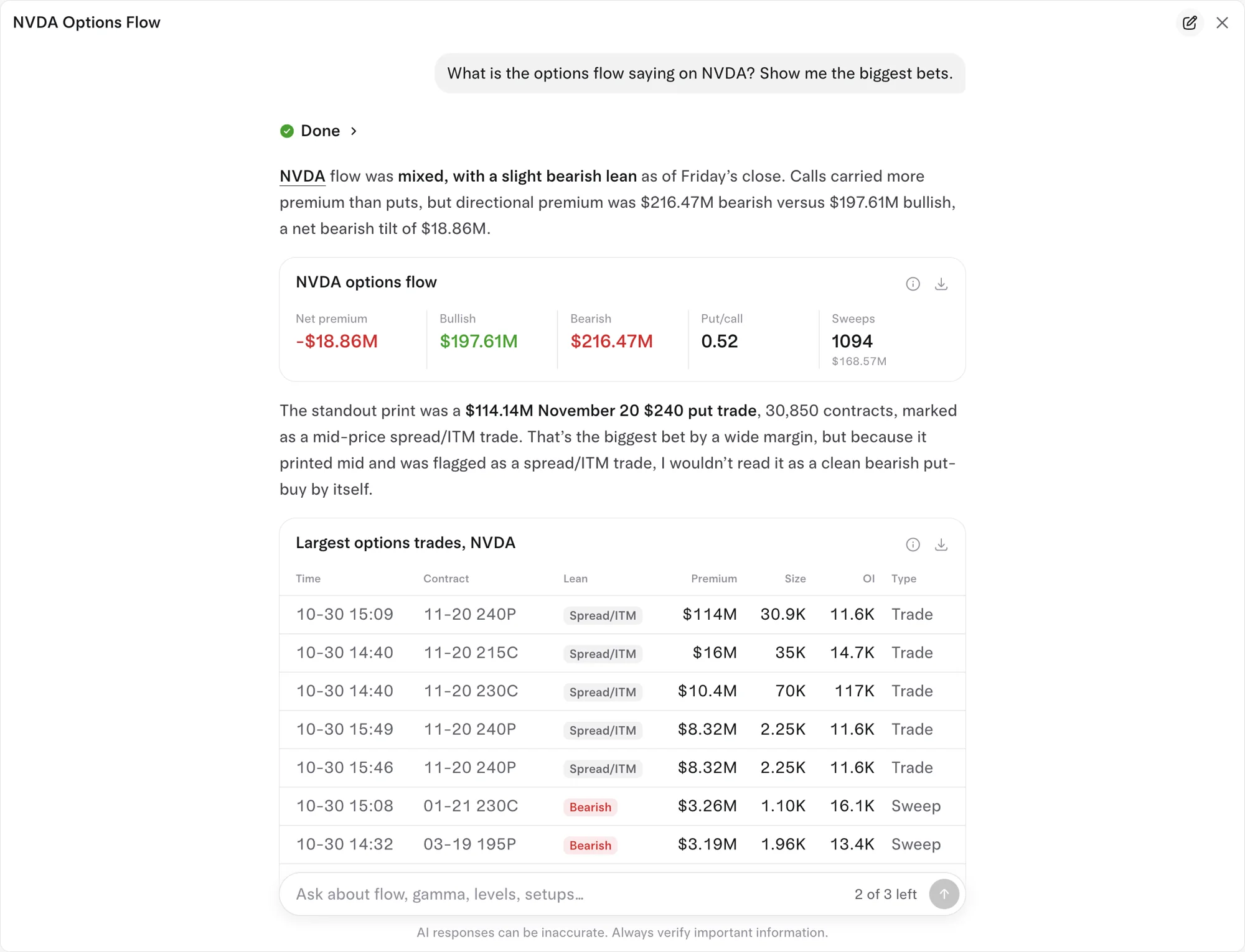
That reading is the hard part of flow. How to read spreads and multi-leg trades in the flow shows how to do it yourself.
Example: "Where are SPY's gamma walls?"
Next we asked: "Where are SPY's gamma walls and the gamma flip? Is SPY in positive or negative gamma?" The analyst pulled SPY's dealer gamma and answered with the put wall ($758), the call wall ($810), the gamma flip ($738.08) and total gamma of -$335.55M. Negative means dealers trade with the move, which can make swings bigger.
It drew a gamma-by-strike chart with SPY's $757.12 price marked, and pointed out a detail that's easy to miss: SPY sat above the $738.08 flip, yet total gamma was still negative, with the $758 put wall just above the price as the level to watch.
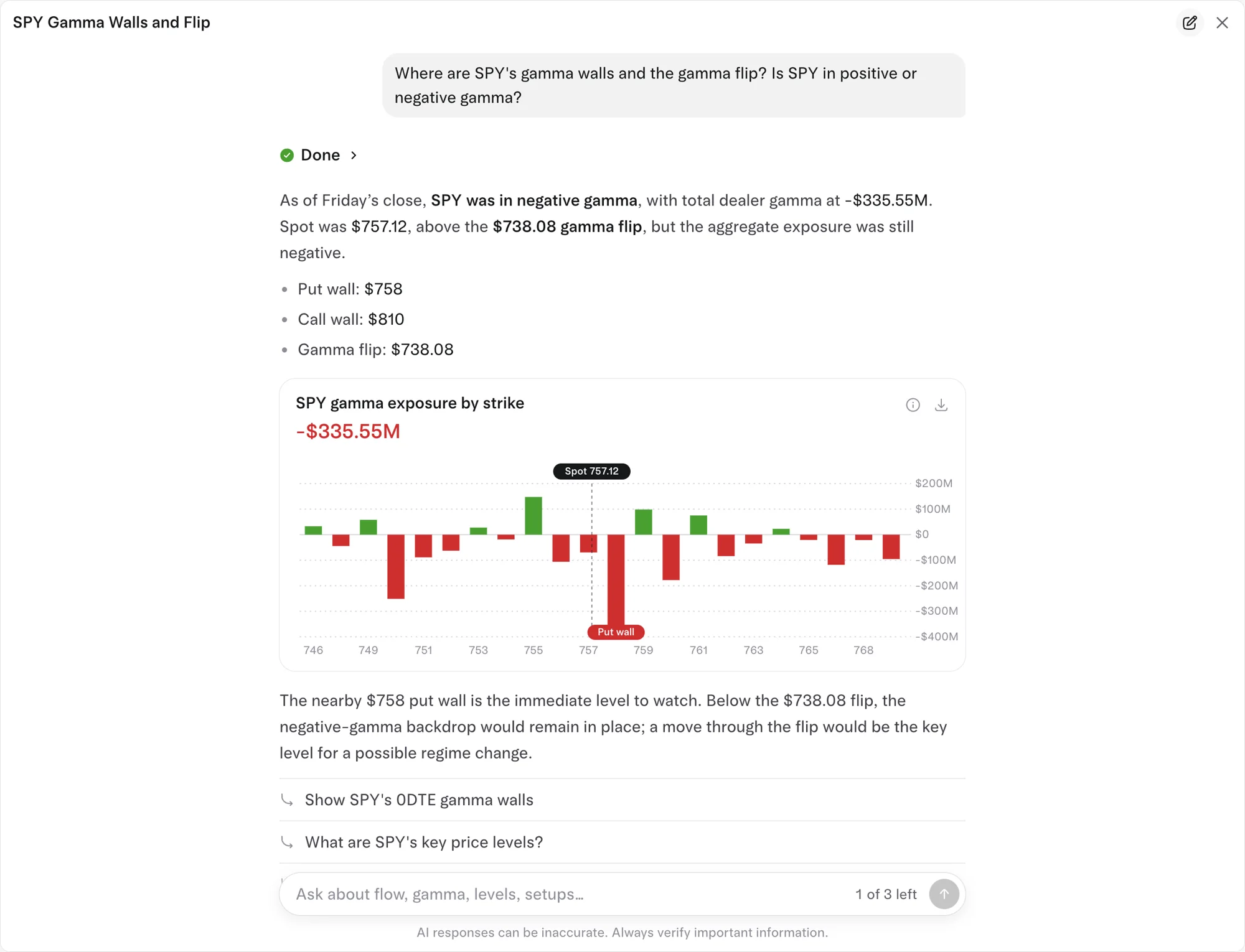
If those terms are new, start with what is gamma exposure (GEX)? and what are call walls and put walls?
A simple routine with the analyst
- Stay on the page you're reading, say /research/NVDA/options, and click Chat.
- Ask one specific question with the ticker and what you want back: "show me the biggest bets", "where are the walls".
- Open the steps to see what it pulled.
- Read the answer first, then the cards. The answer tells you which numbers matter and which prints to discount.
- Check the one number you'd act on against the page itself: the trade in the largest orders list, the wall on the dealer levels chart.
What can't it do?
It can't know for certain who bought or sold, or whether a trade was a hedge; nobody outside the trade can. What it does is read the evidence (side, size against open interest, spread and multi-leg flags, how the stock moved) and say what a trade likely is. It also doesn't trade for you: broker links on Tradytics are read only.
How many questions do you get?
| Free | Live | Pro | |
|---|---|---|---|
| Price | $0 | $39 a month or $299 a year | $69 a month or $499 a year |
| AI analyst questions | 3 a day | 20 a day | Unlimited |
Limits reset at midnight New York time, and the chat box shows how many you have left. Details are in how many AI questions do you get on Tradytics?
Common questions
Where do I find the Tradytics AI analyst?
The Chat button sits at the bottom right of every page in the app, so you can ask about whatever you're looking at.
Does the AI analyst make up numbers?
It pulls the data before it answers and shows its steps, so its numbers come from Tradytics' data, not from memory. Like any AI it can still be wrong, so check the number you'd act on against the page.
Can it tell whether a big options trade is a hedge?
It tells you what a trade likely is. In the NVDA example, it flagged the $114M put print as a mid-price spread rather than a clean bearish bet.
Is it the same as asking ChatGPT about a stock?
No. A general chatbot doesn't have Tradytics' options flow, dark pool and gamma data to pull. On Pro, the Tradytics MCP server lets Claude, ChatGPT and Cursor use the same data as tools; see how to use Tradytics data in ChatGPT, Claude and your own code.
How does it compare with other AI tools for traders?
See the best AI tools for options traders for a side-by-side.
Sources
- Options Price Reporting Authority (OPRA): the consolidated last sale and quotation feed from the US options exchanges, the source of options flow.
- FINRA: Trade Reporting Facility (TRF): where off-exchange (dark pool) trades are reported.