What makes an options trade unusual?
By Faizan Ahmad. Updated .
An options trade is unusual when it is out of proportion for that particular contract and stock, not just big in dollars. The strongest test is size versus open interest: above 1x, at least part of the trade is likely new money. Then check premium against the stock's normal options trading, whether the trade filled aggressively at the ask or the bid, and how short the expiry and how far the strike are, since those decide how big and how fast a move the trader needs.
The tests at a glance
| Test | What to check | Stronger when | October 30, 2026 example |
|---|---|---|---|
| Size vs open interest | Vol/OI | Well above 1x | Seagate (STX) Nov 20 $655 puts: 1,621 vs 70 open (23x) |
| Premium vs the stock's normal flow | Share of the stock's directional premium | A big slice of the day | Teradyne (TER): net $17.47M of $35.33M |
| How it filled | Side chip, sweep | At or above the ask, at or below the bid | Meta Feb 2027 $730 calls bought at the ask |
| Expiry | Days to expiry | Short | Contrast: AMD Dec 2028 $910 puts, over two years out |
| Strike distance | % out of the money | Far | Meta $730 calls, 17.6% above the price |
1. Is the size bigger than open interest?
Open interest is the number of contracts already outstanding. Only existing contracts can be closed, so a trade bigger than open interest has to be at least partly new. That makes Vol/OI the first filter almost every flow tool uses. Remember that open interest only updates once a day: the OCC can report the new count only after clearing the day's trades, so during the session you're comparing against last night's number.
On October 30, 2026, 1,621 Seagate $655 puts expiring November 20 were sold at the bid for $8.71M against open interest of 70. That's 23x, and at least 1,551 contracts had to be new. A put seller collects premium and keeps it if the stock stays above the strike, so this leans bullish. The full logic is in volume vs open interest.
2. Is the premium big for this stock?
$17M means very different things in different names. On October 30, 2026, Teradyne's net bullish premium was $17.47M out of $35.33M in bullish and bearish premium: half its day. Nvidia's net was a similar $19.61M, but out of $933.06M, about 2%. Same headline number, completely different weight.
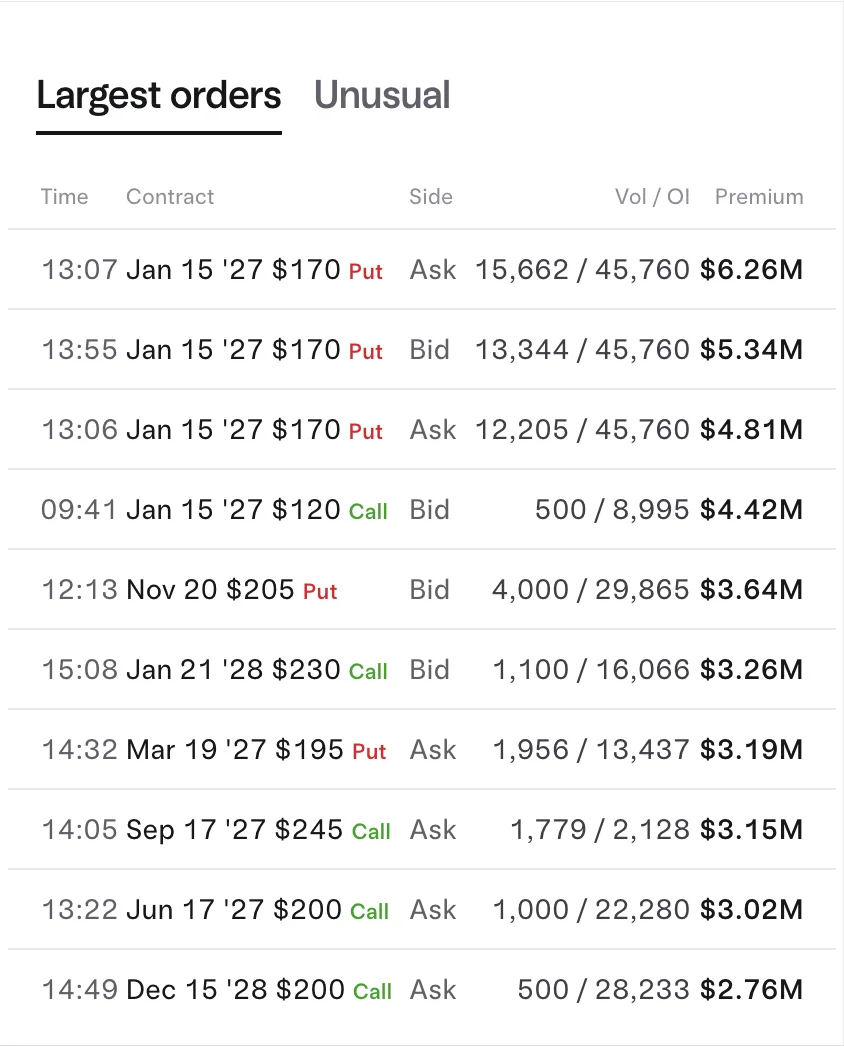
The same goes for single prints. Nvidia's biggest order that day was 15,662 January 2027 $170 puts for $6.26M. Large in contracts, but below the contract's 45,760 open interest and under 1% of Nvidia's directional premium: routine for Nvidia, and nothing like a $6M print in a small stock.
3. How did it fill?
A trade at or above the ask means the buyer paid up; at or below the bid means the seller took what was offered. Either way, someone was in a hurry. A sweep, one order filled across several exchanges at once, adds urgency. A fill at the midpoint gives no read. On October 30, 2026, 4,481 Meta $730 calls were bought at the ask for $10.59M, against open interest of 793: aggressive and new. The side labels are explained in what "at the ask" and "at the bid" mean.
4. How short is the expiry, and how far is the strike?
A short expiry and a far strike mean the trader needs a big move soon. Those contracts are cheap per share, so they can be bought in huge size, and they are the profile behind most insider trading cases (more on that). They are also how people buy lottery tickets, which is why they deserve suspicion in both directions (why anyone buys far out-of-the-money calls).
The Meta calls sit in between: the $730 strike was 17.6% above Meta's $620.83 at the time, with 112 days to the February 19, 2027 expiry. Then look at the same minute: 4,481 Meta $780 calls also traded, the same size as the $730 print. If those were sold against the $730s, this was a call spread, paying about $8.90 a share for a payoff capped at $50. That is a far more measured bet than "$10.59M in calls" sounds.
5. Can a big premium mislead?
Yes, when most of it is intrinsic value. On October 30, 2026, 170 AMD $910 puts expiring December 15, 2028 were bought at the ask for $7.28M, against open interest of 52. That's about $428 a share, but with AMD at $507.72, $402 of it was simply the amount the put was already in the money. A put that deep behaves much like a short position in 17,000 shares. It is a way to be short AMD for two years, not a cheap bet on a crash.
What does not make a trade unusual?
- Size alone in giant markets. On October 30, 2026, seven of the day's eight biggest prints were SPX index options worth $170.75M to $438.98M each. For index desks that is ordinary business.
- Size below open interest. It may be someone closing.
- Mid prints. No side, no read.
- Legs that offset. A spread's two halves can each look unusual and together be a small, defined bet.
How to see it on Tradytics
On the Live options flow page, the Vol/OI column and the Opening tag handle test 1, the Premium filter handles size, and the side chips cover the fill. For one stock, its options page (for example NVDA's) lists the largest and unusual orders with size next to open interest. The money map on the options market page shades each stock by how unusual its flow is for that stock.
Common questions
What Vol/OI ratio is unusual?
Above 1 is meaningful because it means new contracts. The October 30, 2026 unusual bets ran from 2x (Citigroup $75 calls) through 5.7x (Meta $730 calls) to 23x (Seagate $655 puts).
Is volume above open interest always new buying?
No. It can be new selling just as easily, which is why you check the side. And if contracts were opened and closed earlier the same day, even size above open interest isn't a guarantee.
Is a $1M options trade unusual?
Depends on the stock. In Nvidia it's noise; in a small company with a quiet options market it can be the biggest trade in weeks.
Does unusual mean the trader knows something?
Usually not. Most unusual trades are hedges, spreads and ordinary bets. See does following unusual options activity work?
Sources
- Options Industry Council: General Information FAQ: the OCC can only report new open interest after clearing and pairing the day's opening and closing positions.
- Options Industry Council: Open Interest, Why It Matters: how the OCC calculates open interest and how trades change it.
- FINRA: Options: definition of open interest and the basics of calls, puts and premium.
- Most bullish options flow on 2026-11-02: MRVL ($23.33M net), AMZN ($16.59M net), TSLA ($12.07M net), LITE ($6.09M net), PLTR ($4.19M net).
- Most bearish options flow on 2026-11-02: AAPL ($40.88M net), AMD ($20.37M net), MU ($10.45M net), NVDA ($7.79M net), ORCL ($7.77M net).
Updated 2026-11-02 16:05 UTC