What are 0DTE options?
By Faizan Ahmad. Updated .
0DTE options ("zero days to expiration") are options traded on the last day of their life, so they expire at that day's close. S&P 500 index options (SPX), SPY and QQQ now have an expiration every weekday, so there is a same-day contract to trade in every session, and in July 2026 0DTE trades made up a record 66.2% of all SPX options volume, according to Cboe. They are cheap because almost no time is left, and that is also the catch: small moves in the underlying swing their price hard, and an out-of-the-money 0DTE option that isn't in the money by the close expires worthless.
Which options expire every day?
Any option becomes a 0DTE option on its final trading day. What changed is how often that day comes around. In 2022 Cboe added Tuesday and Thursday expirations to SPX weeklys, which already expired on Mondays, Wednesdays and Fridays, so the index now has an expiration every trading day. Exchanges did the same for SPY and QQQ with daily expirations from Monday to Thursday on top of the Friday weeklys.
| Underlying | How often it expires | Settles in | Exercise |
|---|---|---|---|
| SPX (S&P 500 index) | Every trading day | Cash | European: only at expiration |
| XSP (Mini-SPX, one-tenth the size of SPX) | Has same-day contracts too: Cboe reported a record 138,000 XSP 0DTE contracts a day in July 2026 | Cash | European |
| SPY and QQQ | Monday through Friday | Shares | American: can be exercised any day |
| Stocks with weekly options | Fridays, plus monthly and quarterly dates | Shares | American |
So on a Friday the 0DTE menu is long. On Friday, October 30, 2026, weekly options on Nvidia, Tesla, Apple, Microsoft, AMD, Meta and Amazon all expired that afternoon, alongside the day's SPX, SPY and QQQ contracts.
Why are 0DTE options cheap, and why do they move so fast?
An option's price has two parts. Intrinsic value is how far in the money it is right now. Time value is what buyers pay for the chance that it gets there, or goes further, before expiry. On expiration day the time value is nearly used up and falls to zero by the close, which is why out-of-the-money 0DTE contracts can cost pennies.
It is also why their prices jump. With only hours left, each dollar the stock moves changes the odds of finishing in the money by a lot, which is what traders mean when they say short-dated options have high gamma. Time decay, or theta, works against the buyer by the minute.
A real print shows the other end of the range. On October 30, 2026, at 9:30 AM ET, 200 Microsoft $430 calls expiring that same day traded for $1.91M, with MSFT at $524.665. That is about $95.50 a share for a contract that was $94.67 in the money, so only about $1 of its price was time value. A deep in-the-money 0DTE option like this moves almost dollar for dollar with the stock: closer to a stock trade than a lottery ticket. Cheap, far out-of-the-money 0DTE contracts are the opposite. They are all time value and finish worth nothing unless the stock reaches the strike before the close.
Who trades 0DTE options, and why?
- Short-term speculators like the small cost, the fast payoff and a loss capped at what they paid.
- Premium sellers sell same-day options to collect the time value as it melts, and take the risk of a big move against them.
- Hedgers protect a portfolio for one day, such as an inflation report or a Fed decision, without paying for weeks of protection they don't need.
- Market makers take the other side of most of these trades and hedge with stock or futures through the day.
Because buyers and sellers both crowd in, a large 0DTE print on its own says little about direction. Reading that flow is a separate skill, covered in how to read 0DTE options flow.
0DTE vs weekly vs monthly options
| 0DTE | Weekly (days left) | Monthly (weeks left) | |
|---|---|---|---|
| Time value left | Almost none | Some | More |
| Cost of an out-of-the-money strike | Lowest | Low | Higher |
| How hard the price reacts to the stock | Hardest | Hard | Milder |
| Time decay per hour | Fastest | Moderate | Slow |
| Typical holding period | Minutes to hours | Days | Weeks |
| Common uses | Day trades, one-day hedges, premium selling | Earnings and data-release trades | Swing trades, longer hedges |
The categories overlap: a weekly or monthly option becomes a 0DTE option on its last day. For what longer expiries tell you, see short-dated vs LEAPS options flow.
What are the risks of 0DTE options?
FINRA's investor guidance on 0DTE trading lists the main ones:
- A buyer can lose the entire premium in a single day, and does whenever the option finishes out of the money.
- Prices are very sensitive to moves in the underlying, so gains and losses arrive fast.
- Sellers of uncovered calls face losses with no ceiling if the underlying rallies hard.
- Your broker may close a position before the bell if you don't have the cash or shares to handle exercise, which can lock in a loss or cap a gain.
Settlement adds one more. SPY, QQQ and stock options settle in shares, so an in-the-money contract held through the close turns into 100 shares per contract (or a short position for puts) that you then carry overnight. SPX settles in cash, so no shares change hands.
How to see it on Tradytics
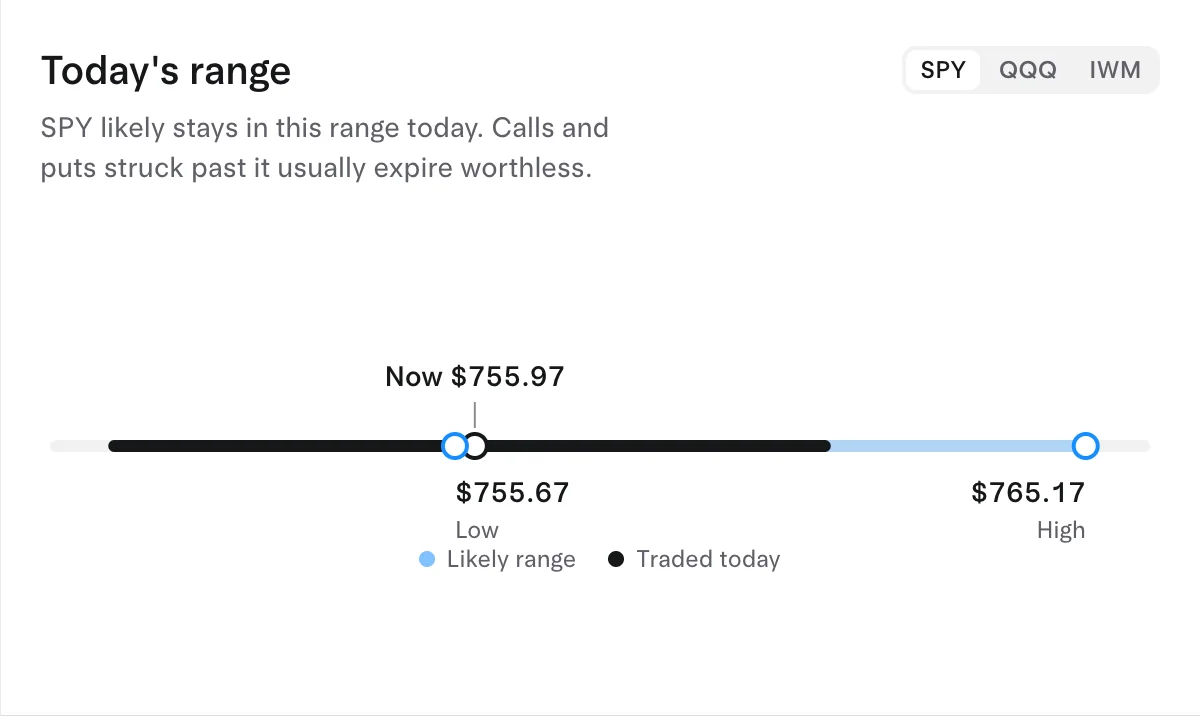
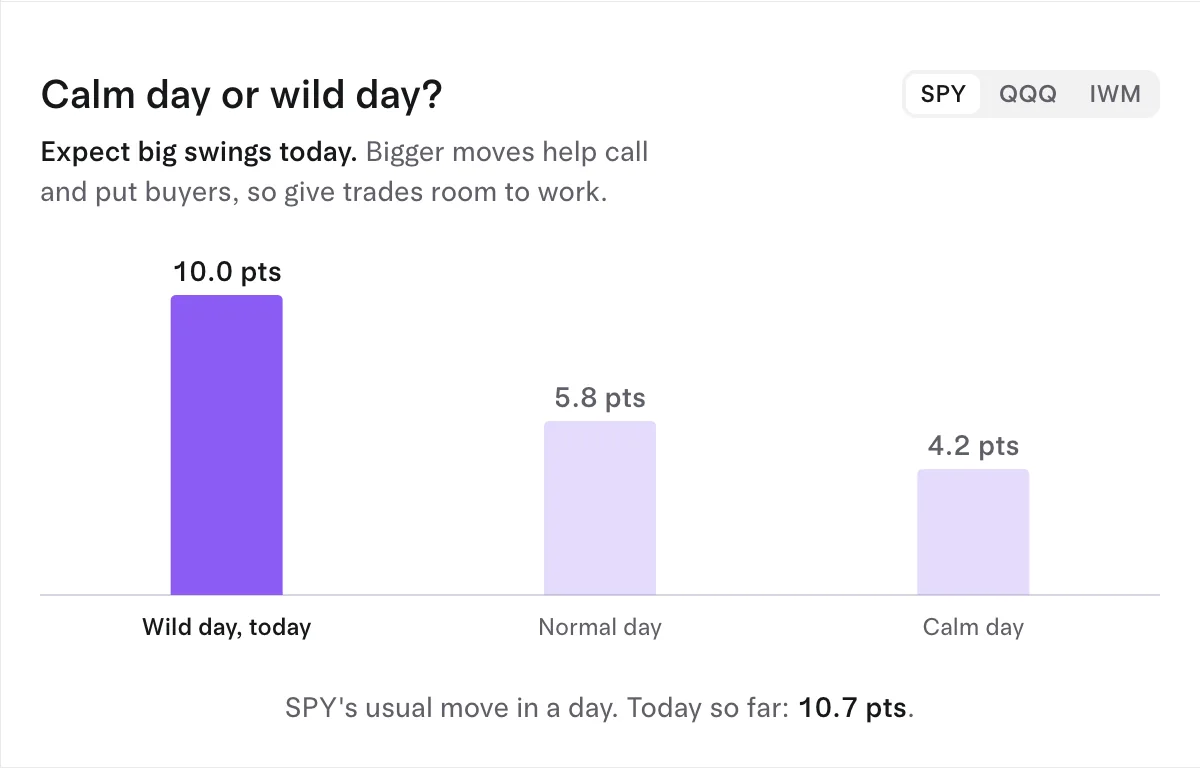
The Options market page tracks 0DTE flow for SPY, QQQ, IWM and SPX, next to Today's range (where SPY sits in the range options expect for the day) and Calm day or wild day (how big a day options are pricing). On the live options flow page, every print shows its expiry and days to expiry, and the Expiry filter narrows the list to same-day contracts. 0DTE flow only matters while the contracts are alive, so this is a Live or Pro job: the Free plan shows yesterday's session, which is good for studying how a day played out but not for trading it.
Common questions
Can you hold 0DTE options overnight?
No. They expire at the end of the day. An in-the-money SPX option settles in cash, while an in-the-money SPY, QQQ or stock option becomes shares, which you then hold overnight.
Are 0DTE options good for beginners?
They are the hardest options to trade well, because there is no time to recover from a wrong call and the premium can go to zero in hours. Most beginners learn more, for less, with contracts that have weeks left; see how beginners should use options flow.
Why is 0DTE volume so high?
Daily expirations, a low cost per contract and exposure that ends the same day. Cboe reported a record 66.2% of SPX options volume in same-day contracts in July 2026.
Is a weekly option the same as a 0DTE option?
Only on its last day. A weekly option bought on Monday that expires Friday is a 0DTE option on Friday.
Do 0DTE options move the stock market?
Dealer hedging of same-day positions can add to moves when dealers are short gamma, but research on Cboe trade data found the effect is usually modest. The details are in how to read 0DTE options flow.
Sources
- Cboe: 0DTE trading resources: defines 0DTE options as contracts that expire at the end of the current trading day, and describes SPX options as cash settled and European style.
- Cboe press release, April 13, 2022: adds Tuesday and Thursday SPX Weeklys to the existing Monday, Wednesday and Friday expirations, giving expirations every trading day.
- NYSE American rule text filed with the SEC (Release 34-96902, 2023): Short Term Option Daily Expirations on Monday through Thursday for SPY and QQQ.
- Cboe July 2026 trading volume report: 0DTE reached a record 66.2% of SPX options volume, and XSP set a record 0DTE average of 138,000 contracts a day.
- FINRA: Zeroing In on an Options Trading Strategy: 0DTE: risks for buyers and sellers, price sensitivity and pre-close liquidation.
- Most bullish options flow on 2026-11-02: MRVL ($22.86M net), AMZN ($15.80M net), TSLA ($12.08M net), LITE ($6.09M net), PLTR ($4.32M net).
- Most bearish options flow on 2026-11-02: AAPL ($40.91M net), AMD ($20.30M net), MU ($10.61M net), ORCL ($7.99M net), NVDA ($7.77M net).
Updated 2026-11-02 16:04 UTC