How beginners should use options flow
By Faizan Ahmad. Updated .
Beginners should use options flow to find and study ideas, not as a list of trades to copy. A simple routine works: check the market's overall lean, pick one or two names with large, one-sided trades, read each trade's side, size against open interest and expiry, rule out spreads and hedges, then look at the chart and the news before deciding anything. Keep positions small and defined-risk, skip same-day (0DTE) contracts, and practice the routine on paper for a few weeks before using real money.
What can options flow tell a beginner, and what can't it?
| Flow can tell you | Flow can't tell you |
|---|---|
| Where large money traded today, and in which contracts | Who traded, and why |
| Whether a trade paid up at the ask or sold down at the bid | Whether it was a hedge against a stock position you can't see |
| Whether a trade was bigger than the contract's open interest (so likely new) | Whether it opened or closed a position, for certain |
| How premium split between calls and puts | Whether the trade will make money |
The right-hand column isn't a weakness of one app. The exchange tape that every flow tool reads doesn't include those facts, as where options flow data comes from explains.
What's a simple daily routine for beginners?
- Read the market's lean. On October 30, 2026, large prints across the US market netted -$86.53M, a bearish lean, with a put/call ratio by premium of 1.07, on a day the S&P 500 fell 1.59%. That tells you the backdrop before you look at any one stock.
- Pick one or two names, not twenty. Start with the most bullish or bearish names by net premium, or a stock you already follow.
- Read four things on each big trade: call or put, side (ask or bid), size against open interest, and days to expiry. For a column-by-column walk-through, see how to read options flow.
- Rule out the look-alikes. Matching prints in the same second are probably a spread. Puts bought by someone who owns the stock are a hedge. Trades smaller than open interest may be closing.
- Check the chart and the news. Flow doesn't override a market-wide selloff.
- Write it down. Note what you would do and why, then check back in a week. That record is how you find out whether flow helps you.
Four mistakes beginners make, with real trades
1. Assuming every put trade is bearish
At 1:56 PM on October 30, 2026, 4,903 Alphabet (GOOG) January 15, 2027 $275 puts traded against open interest of 2,761, sold at the bid, for $6.59M. That is a seller collecting premium: they keep all of it if Alphabet is above $275 at expiry. Selling puts leans bullish. Side decides the meaning, as is a put sweep bullish or bearish? shows.
2. Treating the biggest trade as the best signal
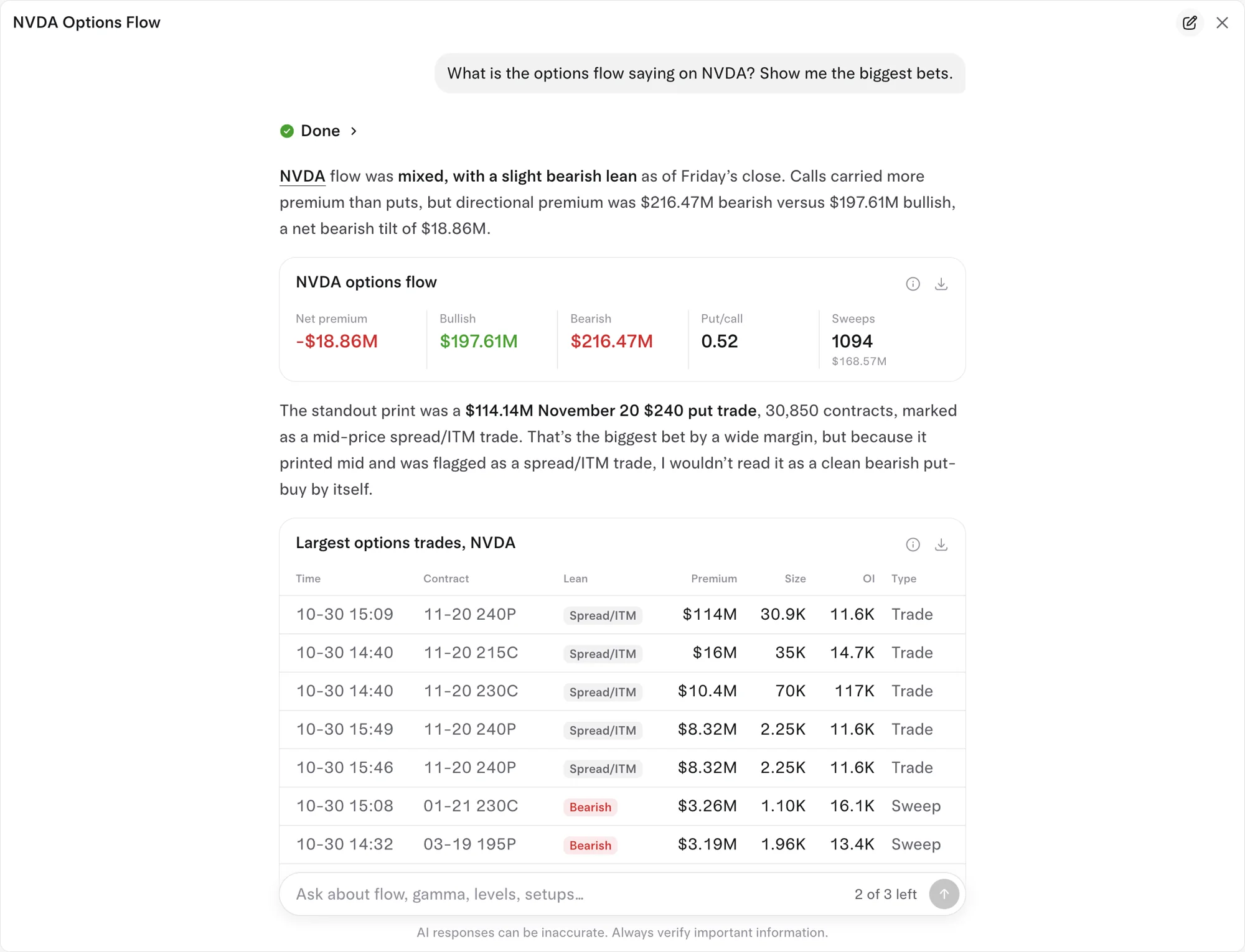
Asked for Nvidia's biggest bets, the Tradytics AI analyst flagged that the largest print, $114M in November 20 $240 puts, was a mid-price spread, not a clean bearish bet. The largest prints are often packages, hedges or rolls; how to read spreads in the flow shows how to take them apart.
3. Copying a short-dated contract
FINRA warns that buyers of same-day options can lose the entire premium, that these contracts are very sensitive to moves in the underlying, and that brokers may close positions before the bell. The trader you're copying may be hedged with stock, may be closing a position, or may simply be wrong, and with hours left there's no time to recover.
4. Chasing a move that already happened
Much of the flow you see is a reaction to news, printed after the stock has moved. Why options flow alerts seem late explains how to tell the difference.
How do you keep the risk small?
- Remember that a bought option can go to zero. Size each one so that losing all of it wouldn't hurt.
- Stick to defined risk: buying calls or puts, or debit spreads. FINRA notes that sellers of uncovered calls face losses with no ceiling.
- Give trades time. Contracts with weeks left forgive a slow start; same-day contracts don't.
- Never size up because a "whale" did. Their account, hedges and horizon aren't yours.
How to see it on Tradytics
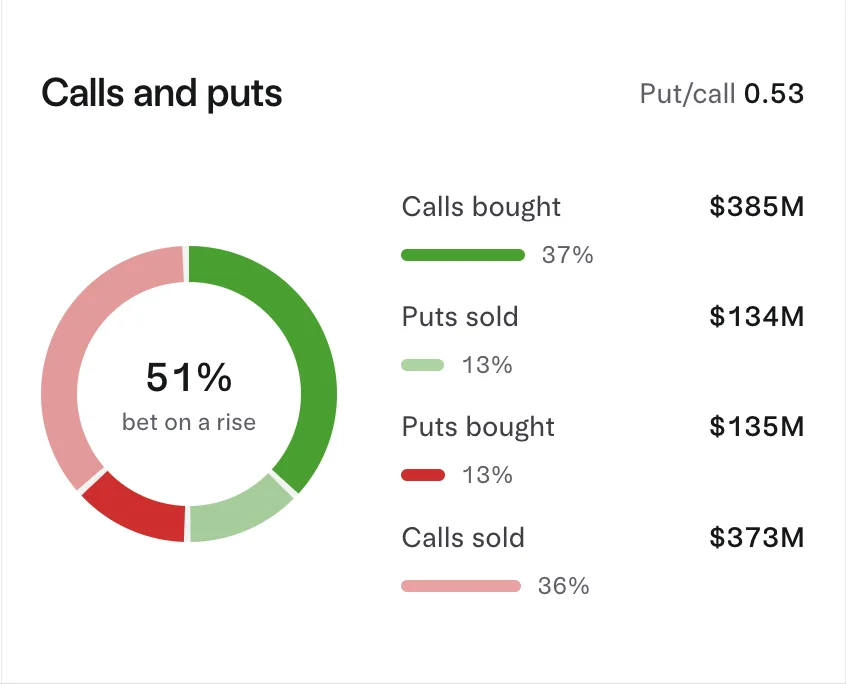
Start on the Free plan: every page and tool works on yesterday's session with no card, which is the right speed for learning. The AI analyst (the Chat button on every page, 3 questions a day on Free) reads a stock's flow for you: ask "What is the options flow saying on NVDA? Show me the biggest bets." and it pulls the net premium, a flow card and a table of the largest trades, and points out which big prints are spreads. Then check the same trades yourself on the options flow page and the stock's options research page, which splits calls and puts into bought and sold.
Common questions
Can beginners make money following options flow?
Some do, many don't. No flow tool wins on its own, because big trades include hedges, spreads and closing trades. Flow works best as a way to find stocks worth studying.
Do I need a paid plan to learn?
No. Yesterday's session is enough to learn how to read side, size, open interest and expiry. Pay for live flow once you have a routine that needs it.
Is options flow the same as unusual options activity?
Flow is the stream of large trades; unusual activity is the subset that stands out against a contract's normal volume and open interest. See what is unusual options activity.
How long should I practice before using real money?
Long enough to have a written record of several dozen setups and what happened next. If the record doesn't show the flow helping your decisions, it isn't yet.
Sources
- FINRA: Zeroing In on an Options Trading Strategy: 0DTE (June 4, 2026): buyers can lose the entire premium; prices are very sensitive to the underlying; uncovered call writers face unlimited potential loss; firms may liquidate positions before the close.
- OPRA Binary Data Recipient Interface Specification (version 6.4b, August 25, 2026): the trade messages every flow tool reads carry the contract, size, price and exchange, with no buyer, seller or opening flag.
- Most bullish options flow on 2026-11-02: MRVL ($22.83M net), AMZN ($16.00M net), TSLA ($12.09M net), LITE ($6.09M net), PLTR ($4.12M net).
- Most bearish options flow on 2026-11-02: AAPL ($41.05M net), AMD ($20.46M net), MU ($10.78M net), NVDA ($8.45M net), ORCL ($8.17M net).
Updated 2026-11-02 16:02 UTC