Why options flow alerts seem to come after the move
By Faizan Ahmad. Updated .
Options flow alerts usually seem late for four reasons: much of the flow is a reaction to a move that already happened (hedges and profit-taking after news), big moves often happen overnight or at the open before any option trades, many apps show data 15 minutes or more behind or only alert once a threshold is crossed, and the alerts that "called" a move are picked out in hindsight. The tape itself is fast: OPRA's processing took a median of 18.5 microseconds in August 2026, so on a live feed the lag is rarely in the data.
Is options flow data actually delayed?
Live options data isn't. OPRA, which consolidates every US options exchange's trades, reports a median processing time of 18.5 microseconds for August 2026 and a 99th percentile of about one millisecond; your app's own delivery adds some time on top. On Tradytics Live and Pro, prints appear to the second.
Delayed data is a different product. OPRA defines data as delayed once at least 15 minutes have passed and doesn't charge usage fees for it, which is one reason free sites lean on it. As of October 2026, the free flow tiers we checked ran from 15 minutes to two trading days behind, and Tradytics Free shows yesterday's session. If you watch a delayed feed during the day, every alert is late by design. Dark pool prints are another case again: they are after-the-fact reports by nature (see is dark pool data real time?).
A real example: AMD on October 30, 2026
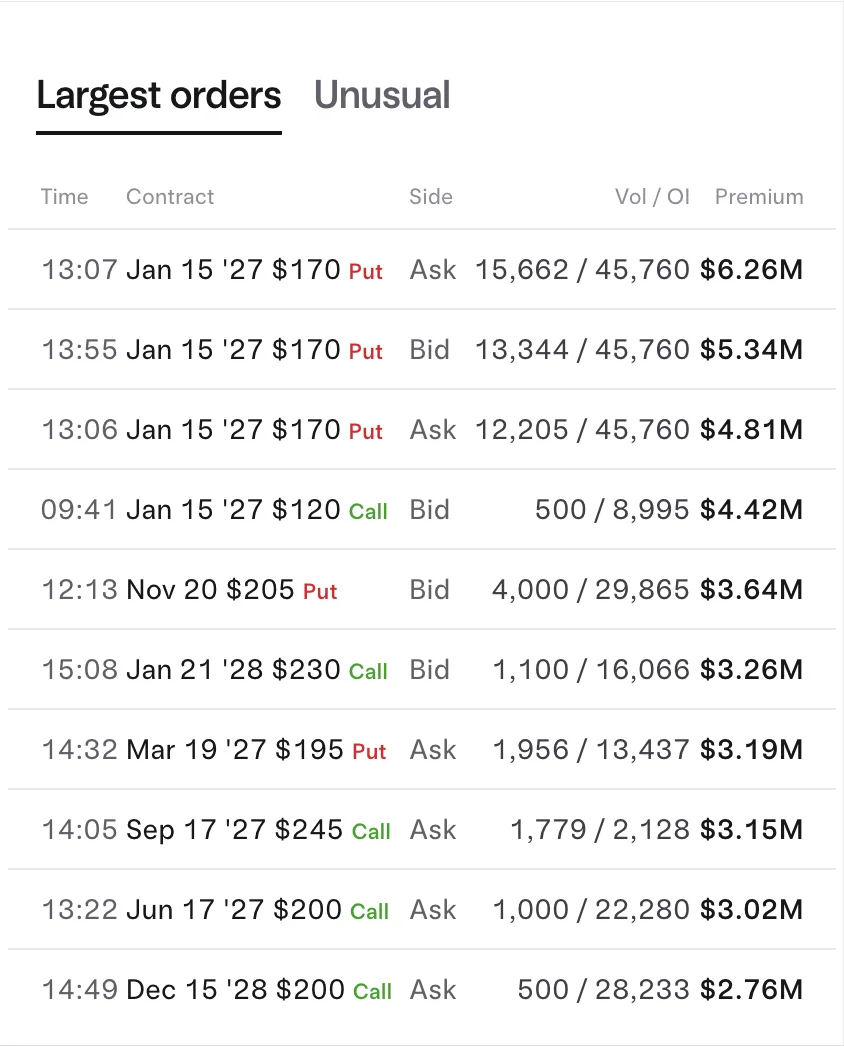
AMD fell 10.3% that day after Intel's weak outlook rattled chip stocks, ahead of AMD's own earnings the following Tuesday. Its largest options order of the day, 170 December 15, 2028 $910 puts bought at the ask for $7.28M, printed at 9:33 AM with AMD at $507.72. AMD closed at $508.22. Three minutes after the open, the stock was already within a dollar of where it would finish. Anyone who saw that put purchase as a bearish alert was looking at a trade made after the move. AMD's net premium for the day, -$28.20M, was an accurate description of the session and no use as a warning.
Reason 1: much of the flow is a reaction
A large share of options trading responds to price instead of anticipating it. After a drop, portfolio managers buy puts for protection and traders who already owned puts sell them at a profit. After a breakout, call buyers pile in. The tape records every one of those trades the moment it happens, which is after the move that set it off. Reaction flow still tells you something, such as how scared or eager the market is, but it isn't foresight. How to tell if a big trade is a hedge covers the most common kind.
Reason 2: the move happens when options aren't trading
Earnings, guidance and big news often land before the open or after the close. The stock gaps, and the day's options trades happen at the new price, as AMD's biggest put trade did. No feed, however fast, can show a trade that hadn't happened yet.
Reason 3: delays, thresholds and next-day confirmation
- Delayed feeds run at least 15 minutes behind.
- Thresholds take time to cross. A sweep is only a sweep once it has filled across exchanges; an "unusual" flag needs volume to build first; a daily list of top bullish names only exists after the close.
- Confirmation arrives tomorrow. Whether a trade really opened a position shows up in open interest, which OPRA sends once a day at about 6:30 a.m. ET. By the time a position is confirmed, the stock has had a full session to move.
Reason 4: hindsight picks the winners
On October 30, 2026, Tradytics logged 73,896 large prints. With that many, some will always line up with whatever the stock did next, and those are the ones that get screenshotted. The ones that went nowhere were just as real. Research points the same way: when Jun Pan and Allen Poteshman rebuilt option signals from public trades and quotes, the way flow tools do, those signals predicted stock returns for only the next one or two trading days, and then prices reversed. That pattern looks more like flow riding short-lived buying pressure than flow seeing the future.
How do you use flow so it isn't late?
- Check the timestamp against the chart. Was the print before the move or after it? That one habit filters out a lot of reaction flow.
- Favor flow that comes first. Buying that builds while the price is still flat, near the money and bigger than open interest, is more interesting than buying that follows a gap.
- Plan the next session, not the current candle. Positioning built over several days is useful for swing trading even when it is no help intraday.
- Read reaction flow as sentiment. Heavy put buying after a drop shows fear, which can matter, but it doesn't predict the drop that already happened.
How to see it on Tradytics
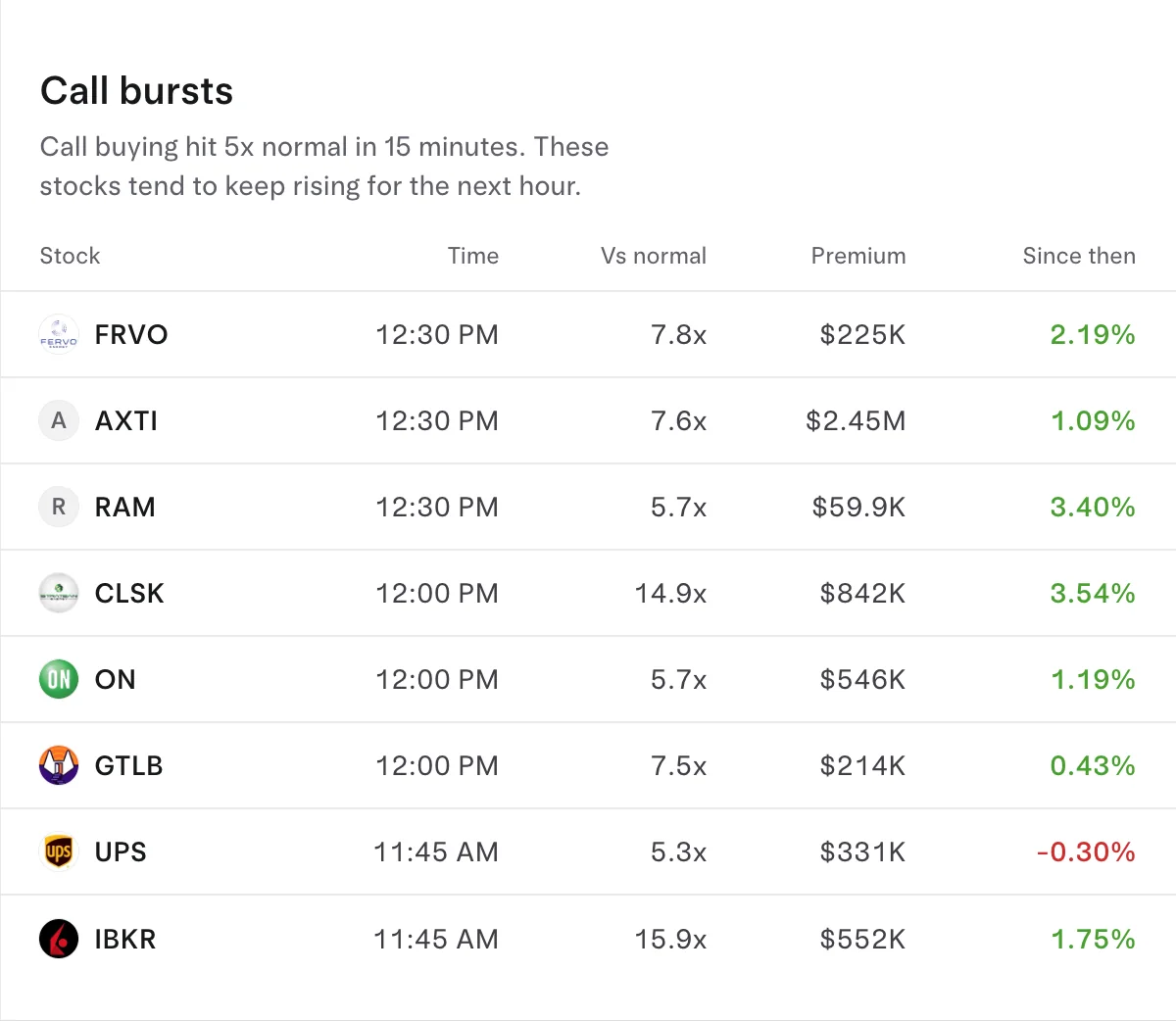
On Live and Pro, the live options flow page shows prints to the second with the time on every row, so you can line each one up with the chart. Each research options page, such as AMD options, plots net flow through the day against the stock price, which shows at a glance whether the flow led the price or followed it. The Options market page has a call bursts card listing stocks with sudden bursts of call buying. Free shows yesterday's session, which suits next-day planning rather than intraday alerts.
Common questions
Are flow alerts delayed on purpose?
On many free tiers, yes: delayed data is cheaper to distribute, and OPRA charges no usage fees for it. Paid live feeds aren't delayed; when they feel late, it's usually because the trade itself came after the move.
Why did the stock move before the alert?
Usually because the news came first and the options trade was a reaction to it, or because the move happened before the open, when no options were trading.
Does unusual flow ever come before a move?
Sometimes. Research has found informed trading in options, but in data that showed who opened positions, which the public tape doesn't. Some of it is illegal, as in insider trading cases; some early-looking flow is just luck that looks like foresight afterward. For the full picture, see does following unusual options activity work?
Is a 15-minute delay a problem for swing traders?
Rarely. Swing setups are planned after the close and confirmed with the next morning's open interest, so seconds don't matter. For day trading and same-day contracts, a delay makes the data close to useless.
Sources
- OPRA SIP operating metrics (through August 2026): median message latency of 18.5 microseconds and a 99th percentile of 1,033.5 microseconds in August 2026.
- OPRA fee schedule: data becomes "delayed" after at least 15 minutes; requests for delayed data aren't counted for usage-based fees.
- OPRA Binary Data Recipient Interface Specification (version 6.4b, August 25, 2026): open interest messages are sent once a day, at about 6:30 a.m. ET.
- Pan and Poteshman, NBER Working Paper 10925 (2004): option signals built from publicly observable trades and quotes predicted returns for only the next one or two trading days, after which prices reversed.
- Most bullish options flow on 2026-11-02: MRVL ($23.05M net), AMZN ($16.54M net), TSLA ($12.03M net), LITE ($6.09M net), PLTR ($4.19M net).
- Most bearish options flow on 2026-11-02: AAPL ($40.91M net), AMD ($20.30M net), MU ($10.45M net), ORCL ($7.77M net), NVDA ($7.76M net).
Updated 2026-11-02 16:05 UTC