How to tell if a big options trade is a hedge
By Faizan Ahmad. Updated .
A big options trade is most likely a hedge when it protects something the trader probably already owns: puts on an index or ETF, months from expiry and close to the current price, often bought after a drop or paired with a cheaper put or a sold call to cut the cost. A bet tends to look different: a single stock, a short expiry, a strike far from the price and no offsetting leg. The flow can't prove intent, but these clues sort most large trades correctly.
A real hedge: QQQ June 2027 puts on October 30, 2026
On October 30, 2026, the Nasdaq 100 fell 3.16% and QQQ closed at $692.74. Late in the session, 30,750 QQQ $680 puts expiring June 17, 2027 traded for $123.40M, with QQQ at $691.11. Only 7,889 contracts were open beforehand, the print filled above the ask, and the same strike kept trading in the minutes after, including 4,612 contracts for $18.51M. Every clue points to insurance:
- The instrument. QQQ lets a fund hedge a whole basket of large tech stocks in one trade.
- The expiry. 230 days of protection, not a bet on next week.
- The strike. 1.6% below the price, so protection starts almost immediately.
- The scale. 30,750 contracts cover about 3.08 million shares, roughly $2.1B of QQQ at the price then.
- The timing. Bought on a sharp down day, when holders who want to stay invested buy protection instead of selling.
- The holdings it might protect. Over the prior 10 sessions, $11.31B of QQQ printed in dark pools around $715.20, above where it closed. Whoever owns that stock had a reason to insure it. That is context, not proof (see dark pool levels).
The price confirms it's insurance with a deductible. At $40.13 a share, the puts only pay for themselves at expiry below $639.87, about 7.4% under QQQ's price when they printed. That is what months of protection on a big position costs.
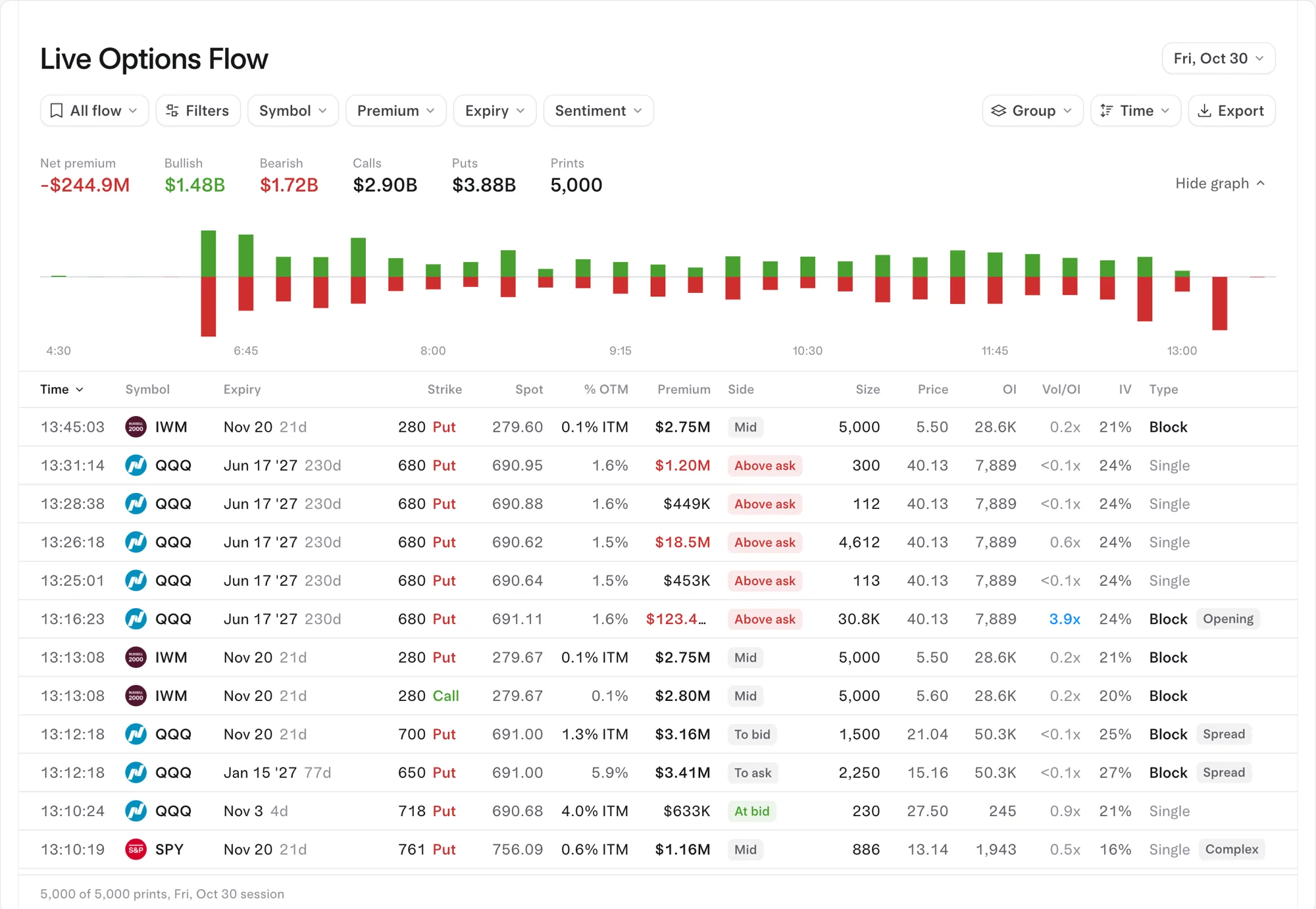
Hedge or bet: the clues side by side
| Clue | Leans hedge | Leans bet |
|---|---|---|
| Underlying | An index or ETF: SPY, QQQ, IWM, SPX | A single stock |
| Expiry | Months away | Days or weeks |
| Strike | Near the price | Far out of the money |
| Structure | Paired legs: a put spread, a collar, or stock alongside | One leg alone |
| Timing | Into a drop, or ahead of a known market-wide risk | Ahead of a company-specific catalyst |
| What it says | "I own this and want a floor" | "I expect this move by this date" |
Put spreads: insurance on a budget
Funds often cut the cost of protection by buying one put and selling a cheaper one below it. On October 30, 2026, just after the 4:00 PM close, two SPY puts expiring January 29, 2027 printed in identical size: 19,170 of the $716 strike for $21.80M and 19,170 of the $605 strike for $5.81M, with SPY at $756.39. Matching size in the same minute means one order with two legs, and with open interest of 16 and 414 it was almost entirely new.
If, as is usual, the $716 puts were bought and the $605s sold, the trade cost about $16M and protects against a fall of roughly 5% to 20% by late January. Below $605 the protection stops, which is the point: the buyer insures the likely drop and accepts the extreme one. Read leg by leg, you'd see a "$21.80M bearish put buy" and a "$5.81M bullish put sale." Read together, it is one hedge (more in how to read spreads in the flow).
Collars: when a sold call is half of a hedge
A collar is a shareholder buying a put and selling a call with the same expiry. The put sets a floor, and the call caps the upside and helps pay for the put. In the flow, the sold call looks bearish on its own; next to a put bought in the same second, it's an owner protecting stock. The Options Industry Council describes a collar as a temporary, slightly less than complete hedge against a possible near-term decline.
Why index puts are mostly hedges
On October 30, 2026, index options carried a put/call ratio by premium of 1.26, against 0.91 for single stocks. That gap is normal: portfolios get insured with index puts, so a heavy put tilt in SPY, QQQ or SPX is expected, not a crash call. A big put purchase in a single stock with no index hedge alongside is more likely a view on that company (see the put/call ratio).
What does a hedge tell you?
A hedge doesn't say "this will fall." It says "I own this, I'm nervous, and I'm staying." The Options Industry Council describes the protective-put buyer as bullish overall but worried about a sharp temporary drop. So heavy hedging into a selloff tells you about positioning and nerves, not direction. Copying a hedge as if it were a bearish bet is a mistake: the hedger is perfectly happy if the insurance expires unused.
How to see it on Tradytics
On the Live options flow page, set Symbol to SPY, QQQ or IWM and Expiry to later dates, then look for put rows with the Opening tag and any prints at the same moment (the Spread and Complex tags catch many paired legs). For the holdings side, a ticker's dark pool page, such as QQQ's, shows its dark pool levels: the prices where the most dark pool dollars printed over the last 10 sessions. Or ask the AI analyst whether a specific trade looks like a hedge, a spread or a fresh bet.
Common questions
Are most big put trades hedges?
On indexes and ETFs, a large share are, though there's no reliable public percentage. Single-stock puts are more mixed: some protect shares, some are outright bets.
Does a hedge mean the trader is bearish?
Not necessarily. A protective put buyer is typically bullish on what they own and wants a floor under a sharp drop.
Can calls be hedges?
Yes. A short seller buys calls to cap losses if the stock rips higher. Context decides, just as with puts.
Is a put sweep bullish or bearish?
It depends on whether the puts were bought or sold and whether they protect stock. See is a put sweep bullish or bearish? and, for the side itself, how to tell if a trade was bought or sold.
Sources
- Options Industry Council: Protective Put: a hedge against a temporary dip, for an investor bullish overall but worried about a sharp decline.
- Options Industry Council: Collar: writing a call and buying a put with the same expiration against shares owned.
- Most bullish options flow on 2026-11-02: MRVL ($23.33M net), AMZN ($16.59M net), TSLA ($12.07M net), LITE ($6.09M net), PLTR ($4.19M net).
- Most bearish options flow on 2026-11-02: AAPL ($40.88M net), AMD ($20.37M net), MU ($10.45M net), NVDA ($7.79M net), ORCL ($7.77M net).
Updated 2026-11-02 16:05 UTC