Is dark pool data real time?
- Dark pool and block prints on 2026-11-20: 21,790 prints worth $322.08B, $157.80B of it in dark pools.
- Most traded in dark pools and blocks: SPY ($35.50B), QQQ ($19.11B), AAPL ($11.75B), NVDA ($11.61B), MSFT ($8.71B).
By Faizan Ahmad. Updated .
No. Dark pool prints are after-the-fact reports by nature, on every platform. Off-exchange trades are reported to FINRA after they execute, normally within 10 seconds, but the biggest ones (negotiated blocks, average-price and portfolio trades) are often reported late, sometimes hours later, at a price from earlier in the day, flagged with late or out-of-sequence condition codes. No tool can show a dark pool trade before it is reported, so "real-time dark pool data" can only ever mean real-time reports of trades that already happened. The edge is in levels and ranking, which is why Tradytics ranks every block print against the stock's own year and builds dark pool levels from them.
How fast do off-exchange trades have to be reported?
When a stock trades anywhere other than an exchange, in a dark pool or with a wholesaler, the broker-dealer involved reports it to one of FINRA's trade reporting facilities (TRFs). From there it goes out on the same consolidated tape that carries exchange trades. FINRA's rule for regular hours is "as soon as practicable but no later than 10 seconds after execution," and any trade reported later than that must be designated late. If the firm doesn't add the late flag, the facility adds it.
| When the trade happened (ET) | Reporting deadline | Flag |
|---|---|---|
| 9:30 AM to 4:00 PM | 10 seconds | Late flag if reported after 10 seconds |
| 8:00 AM to 9:30 AM, 4:00 PM to 8:00 PM | 10 seconds | Outside-hours flag, or its late version after 10 seconds |
| Midnight to 8:00 AM | By 8:15 AM the same day | Outside-hours flag |
| 8:00 PM to midnight, or a non-business day | Next business day by 8:15 AM, as an "as/of" trade | Outside-hours flag |
The 8:00 AM line and the 8:15 AM deadlines come from temporary relief in FINRA Rule 6380A that lasts until December 31, 2027 at the latest; the base rule starts the 10-second clock at 4:00 AM. Most reports are much faster than the limit: in a week of June 2014, FINRA found 97.3% of off-exchange trades in listed stocks were reported within two seconds. The slow ones are the ones traders care about most.
Why do the biggest dark pool prints show up late?
Big off-exchange trades are often negotiated. A fund agrees with a bank to trade a block at the day's average price, at the closing price, or as part of a basket of many stocks. The price comes from a formula or an earlier moment, and the trade reaches the tape when the deal is booked. FINRA has separate flags for this: one for late reports, one for a "prior reference price" (the report must carry both the execution time and the earlier reference time) and one for average-price and other formula-priced trades. Trades with these flags generally don't update the stock's last sale price, because they don't reflect the market at that moment.
On October 30, 2026, a 3,684,100-share SPY dark pool print worth $2.84B was reported at 4:28 PM ET at $769.559, about $12 above where SPY closed ($757.12) and right at the prior day's close: a late, previously agreed trade, not a fresh bet at that price. Seeing it the instant it was reported would not have helped anyone. It was a receipt for a deal done earlier, not an order still working. The full anatomy of prints like this is in what a late or out-of-sequence print is.
The three clocks behind every print
| Clock | What it measures | Typical gap |
|---|---|---|
| Execution time | When the trade happened or was agreed | None |
| Report time | When the broker reported it to FINRA | Seconds for most trades; minutes to hours for late and reference-price trades |
| Display time | When it appears in your data tool | Depends on the tool; no vendor can show a print before it is reported |
FINRA's own summary data runs on slower clocks. Its daily short sale volume files are posted by 6:00 PM ET on the trade date. Its weekly volume for each dark pool (each alternative trading system, or ATS) comes out no earlier than two weeks after the week ends for Tier 1 stocks, the big liquid names, and four weeks for the rest. So "delayed dark pool data" can mean anything from a print shown after its report to a month-old venue breakdown, and they are not the same thing.
Does speed matter for dark pool data?
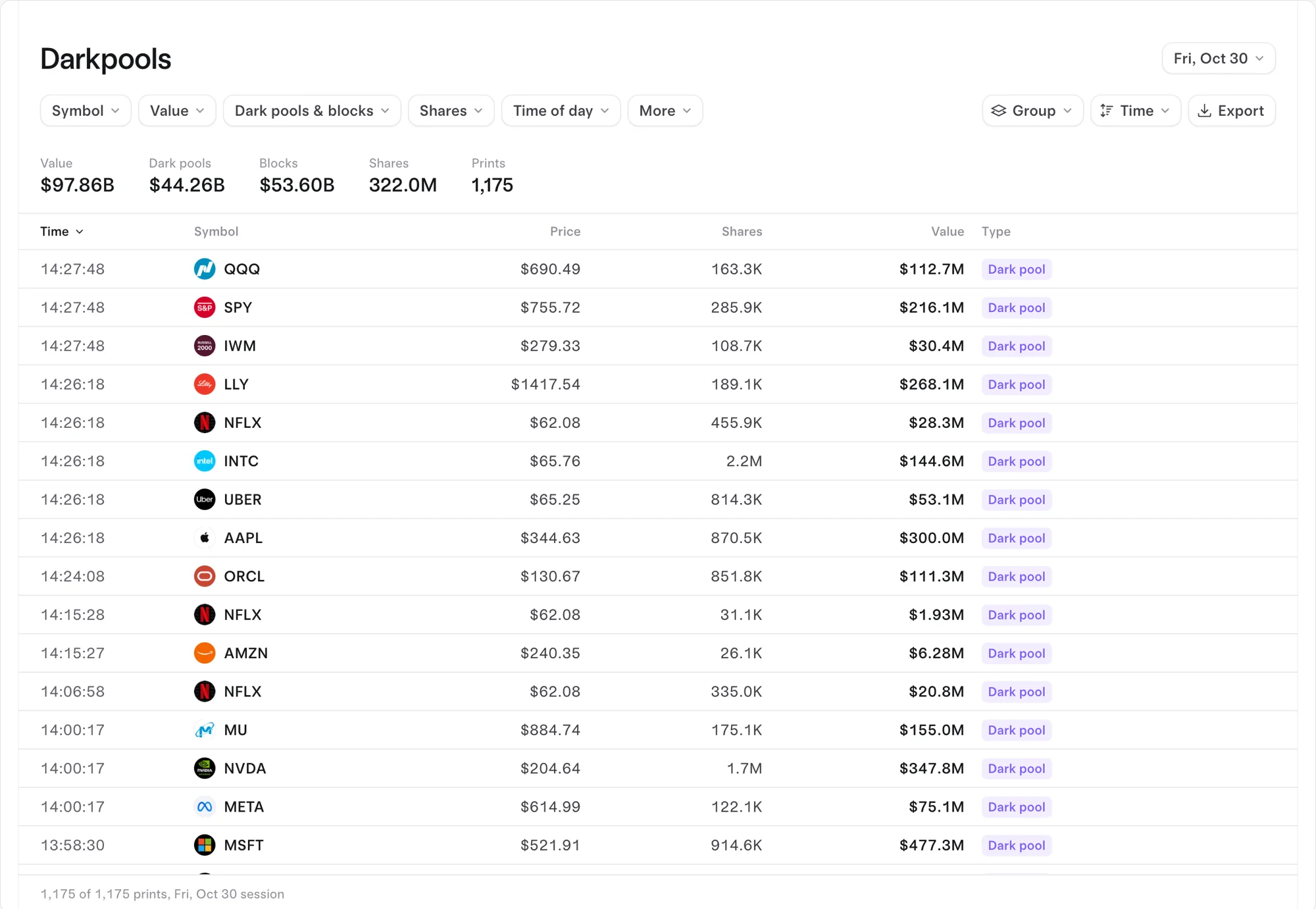
Not for the way dark pool data is used. Dark pool data is read for levels (where size accumulated over days) and for how big a print is for that stock, not for the second a print happened. On October 30, 2026, SPY's biggest dark pool level sat at $769.48: $20.78B in 155 off-exchange prints, more than three times the $6.37B of dark pool and block prints SPY sees on a usual day. One more print arriving a little later doesn't move a level built from 155 of them.
Speed would only matter if you tried to trade the print itself, and that is what dark pool data is worst at. You don't know when the deal was struck, what reference price it used, or which side started it. So when a data vendor advertises "real-time dark pool data," remember that every vendor gets the same after-the-fact reports; the difference is in what the tool does with them. How to read dark pool prints and what dark pool levels are cover the reading that does work.
Options flow is a different story
Listed options trade on exchanges, and every trade goes out on OPRA, the consolidated options tape. There is no off-exchange reporting step like the one stocks have, which is why Tradytics can show options flow live to the second: it reads the full OPRA tape, every trade on every US options exchange, about a second after it prints. Every dark pool print, on any platform, reaches the tape only after the trade, by rule. More in are there dark pools for options.
How Tradytics shows this
Tradytics builds its dark pool tools around levels and ranking, where the edge is. The dark pool page lists every dark pool block print and exchange block with its time, price, shares, value, venue and sale condition, so late and reference-price prints can be spotted, and ranks each print against the stock's own last 12 months, so you see at a glance whether today's print is the biggest of the year (more in ranked dark pool prints). For one stock, open its dark pool page, for example SPY, for prints today, dark pool levels as a volume profile of where the dollars concentrated, and how much traded against a usual day; the same levels sit on the chart, with dark pool history since January 2022 in the API. Free shows the previous session; Plus and Pro show today's prints and every stock's dark pool research.
On Tradytics: ranked dark pool prints, history since January 2022 in the dark pool data API, and dark pool rules tested in the backtester.
Common questions
Can anyone see dark pool trades the moment they happen?
No. Until a broker reports the trade, nobody outside the deal knows it happened. Most reports arrive within seconds, but late and reference-price trades can surface hours after they were agreed.
Is FINRA's dark pool data delayed?
The trade-by-trade tape follows the reporting rules above. What's delayed is FINRA's breakdown by venue: weekly volume for each ATS is published two to four weeks after the week ends.
Why do some dark pool prints appear after 4:00 PM?
Some are after-hours trades, some are late reports of trades done during the day, and some are trades priced at the closing price, which can only be booked once the close is known.
Does the Tradytics Free plan show dark pool prints?
Yes, for the previous session. Plus ($39 a month) and Pro ($69 a month) show today's prints, each ranked against the stock's own last 12 months, plus every stock's dark pool research.
Sources
- FINRA Rule 6380A, Transaction Reporting: the 10-second deadline, the late designation, outside-hours deadlines and the temporary 8:15 AM relief.
- FINRA, Trade Report Modifiers: the late, prior reference price and average-price flags and whether each updates the last sale.
- FINRA Rule 6110: the two-week and four-week delays on weekly ATS volume.
- FINRA Regulatory Notice 14-46: the 2014 reporting-speed data and how off-exchange trades reach the consolidated tape.
- FINRA, Daily Short Sale Volume Files: posted by 6:00 PM ET on the trade date.