What are dark pool prints?
- Dark pool and block prints on 2026-11-20: 21,790 prints worth $322.08B, $157.80B of it in dark pools.
- Most traded in dark pools and blocks: SPY ($35.50B), QQQ ($19.11B), AAPL ($11.75B), NVDA ($11.61B), MSFT ($8.71B).
By Faizan Ahmad. Updated .
A dark pool print is the public record of a stock trade that happened off an exchange. The firm that executed it reports it to a FINRA trade reporting facility, and it appears on the consolidated tape with the symbol, price, number of shares, time and condition codes. A print shows that a trade happened and at what price. It doesn't show the order beforehand, who bought or sold, or why.
On this page
- What's in a dark pool print?
- Where do dark pool prints come from?
- How can you tell a dark pool print from an exchange block?
- Does "Dark pool" on a print mean an ATS?
- What can a print tell you, and what can't it?
- Where can you see dark pool prints on Tradytics?
- Why do dark pool prints show up after the market closes?
- Are dark pool prints buys or sells?
- How big does a print have to be to matter?
- What does a late or out-of-sequence condition mean?
- Can a public off-exchange print identify the firm that traded?
What's in a dark pool print?
A print reports the ticker, trade time, price, share count, and reporting venue. The trade value is price times shares.
Every print carries the same few fields. Here is one real print from October 30, 2026.
| Field | What it tells you | Example: SPY |
|---|---|---|
| Time | When the trade was reported, usually seconds after it executed, sometimes much later | 1:58 PM ET |
| Price | The price per share | $753.81 |
| Shares | How many shares changed hands | 1,000,000 |
| Value | Price times shares | $753.81M |
| Venue | Off-exchange (reported to FINRA) or the exchange where it traded | Dark pool |
Prints also carry sale condition codes, which flag late reports, trades outside regular hours and special pricing. What's missing matters as much: no buyer, no seller, no sign of which side started the trade, and no way to tell if this was the whole order or one slice of a bigger one.
Where do dark pool prints come from?
Trades in listed stocks that happen away from an exchange are reported to one of FINRA's trade reporting facilities: the FINRA/Nasdaq TRF in Carteret, the FINRA/Nasdaq TRF in Chicago, or the FINRA/NYSE TRF. From there they are published on the consolidated tape alongside exchange trades, so they count in a stock's volume.
FINRA Rule 6380A sets the clock. A trade must be reported as soon as practicable and no later than 10 seconds after execution, and anything later is marked late. Trades between 4:00 AM and 9:30 AM ET, or between 4:00 PM and 8:00 PM ET, are reported the same way with a flag for outside regular hours. That is why prints keep arriving after the close.
Even so, dark pool prints are after-the-fact reports by nature. The biggest trades, such as negotiated blocks, average-price and portfolio trades, are often reported late, sometimes hours later, at a price from earlier in the day, flagged with late or out-of-sequence codes. So nobody reads prints for the exact second a trade happened. They're read for where size built up over days. More in is dark pool data real time?
How can you tell a dark pool print from an exchange block?
Check the venue first. A FINRA-reported off-exchange print and an exchange auction can have similar size.
Not every big print is a dark pool trade. Here were SPY's four biggest prints on October 30, 2026, when SPY closed at $757.12:
| Time (ET) | Shares | Price | Value | Venue |
|---|---|---|---|---|
| 4:28 PM | 3,684,100 | $769.559 | $2.84B | Dark pool |
| 4:00 PM | 2,899,620 | $755.72 | $2.19B | NYSE Arca |
| 4:18 PM | 1,000,000 | $755.584 | $755.58M | Dark pool |
| 1:58 PM | 1,000,000 | $753.81 | $753.81M | Dark pool |
Only the 1:58 PM print traded during the session. The 4:00 PM trade on NYSE Arca happened on an exchange at the close: it's an exchange block, not a dark pool print (see block trades vs dark pool prints). The 4:18 PM print came after the close, near the closing auction price. And the biggest, at 4:28 PM, was priced at the prior day's close, about $12 above where SPY closed: a late, previously agreed trade.
Does "Dark pool" on a print mean an ATS?
Not necessarily. A trade reported to FINRA's facilities could come from an alternative trading system (a dark pool in the strict sense), a wholesaler filling retail orders, or another broker-dealer trading from its own inventory or crossing client orders. Tradytics shows all of those as one off-exchange category, labeled Dark pool.
That difference is large. In the first quarter of 2023, ATSs handled 10.7% of US stock share volume while all off-exchange venues handled about 44%, according to the SEC. A print labeled Dark pool tells you the trade happened off-exchange, not which kind of firm filled it. How much trading happens in dark pools has the full split.
What can a print tell you, and what can't it?
A print shows where, when, and at what price shares traded. It gives no account identities or reliable buy or sell direction.
| A print tells you | A print doesn't tell you |
|---|---|
| The price and size of a trade | Who bought and who sold |
| That it happened off-exchange, or on which exchange | Which side started the trade |
| When it was reported, and if it was flagged late or outside hours | Whether it opened or closed a position |
| How big it was next to the stock's usual day | Whether it was a hedge or one slice of a bigger order |
That right-hand column is why a single print is neither bullish nor bearish on its own, and why traders read prints in bulk. How to read dark pool prints shows the routine on a real day.
Where can you see dark pool prints on Tradytics?
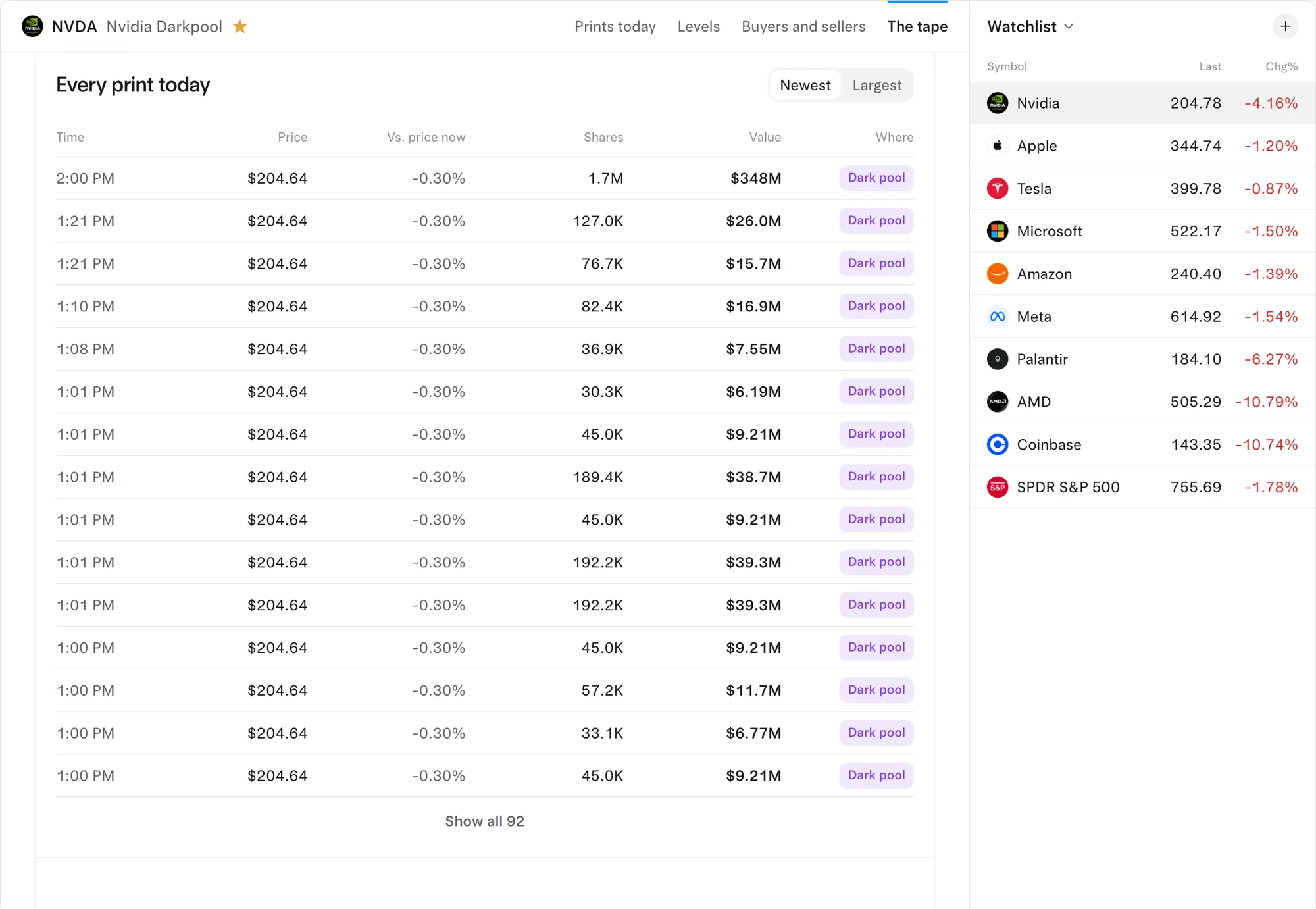
The dark pool page shows the whole market: totals for the session (value, dark pool dollars, block dollars, shares and prints) and every block print with its time, symbol, price, shares, value and venue. Each dark pool print is ranked against the stock's own last 12 months, so you see at a glance whether today's print is the biggest of the year (more in ranked dark pool prints). For one stock, open its research page, such as SPY's dark pool page, where the tape lists every print of the day and dark pool levels show where the dollars concentrated as a volume profile; the same levels sit on the chart, with dark pool history since January 2022 in the API. Free shows the previous session; Plus and Pro show today's prints and every stock's dark pool research.
On Tradytics: ranked dark pool prints, history since January 2022 in the dark pool data API, and dark pool rules tested in the backtester.
Common questions
Why do dark pool prints show up after the market closes?
FINRA's rules require trades done between 4:00 PM and 8:00 PM ET to be reported within 10 seconds with an after-hours flag, so the tape keeps running after the close. Trades priced at the close are also often reported after it, and late reports of earlier trades can arrive at any time.
Are dark pool prints buys or sells?
Both. Every print has a buyer and a seller, and the public record doesn't say which side started it.
How big does a print have to be to matter?
Judge it against the stock, not in dollars. SPY sees $6.37B of dark pool and block prints on a usual day, so its 1:58 PM print was about 12% of that, while the same dollar amount would dwarf a usual day in most stocks. That is why Tradytics ranks each print against the stock's own last 12 months.
What does a late or out-of-sequence condition mean?
The trade was reported more than 10 seconds after it executed, or out of time order, so its price may come from earlier in the day. Treat those prints as history, not as fresh interest at that price.
Can a public off-exchange print identify the firm that traded?
A consolidated print identifies the reporting venue or facility. It does not name the buyer or seller. FINRA's separately published venue statistics answer a different question about aggregate volume.
Sources
- FINRA, Trade Reporting Facility (TRF): what the TRFs are and the three active facilities.
- FINRA Rule 6380A, Transaction Reporting: the 10-second deadline, late designation and reporting hours for pre-market and after-hours trades.
- FINRA, Where Do Stocks Trade?: ATS trades submitted to a TRF and published on the consolidated tape with exchange trades.
- SEC, Disclosure of Order Execution Information, Release 34-99679 (March 6, 2024): first quarter 2023 shares of volume for ATSs (10.7%) and all off-exchange venues (about 44%).