What is a dark pool?
By Faizan Ahmad. Updated .
A dark pool is a private stock trading venue where buyers and sellers are matched without their orders being shown to the public first. Legally it is an alternative trading system (ATS) run by a registered broker-dealer under the SEC's Regulation ATS. Only the order book is dark: every trade must still be reported to FINRA and appears on the public tape after it happens. Big investors use dark pools to buy or sell large amounts of stock without tipping off the market.
How does a dark pool work?
On an exchange like Nasdaq or NYSE, anyone can see the best bids and offers waiting to trade. FINRA calls exchanges "lit" markets for that reason. A dark pool keeps its orders private. Subscribers send orders in, the system matches them by its own rules, and nobody outside sees an order until it fills.
Many dark pools don't set prices on their own. The SEC notes that they often match orders at prices taken from the exchanges, and some match only at the midpoint, halfway between the best public bid and offer. That is the trade-off a big investor accepts: less certainty of getting filled, in exchange for not moving the price by advertising the order.
What is dark and what isn't
"Dark" describes the time before a trade, not after it. Here is how the three main places US stocks trade compare.
| Venue | Run by | Before the trade | After the trade |
|---|---|---|---|
| Lit exchange | A registered national securities exchange | Best bids and offers shown to everyone | Trade published on the consolidated tape |
| Dark pool (ATS) | A broker-dealer following Regulation ATS | Orders hidden from everyone outside the system | Reported to a FINRA trade reporting facility, then published on the same tape |
| Wholesaler | A broker-dealer acting as market maker | Doesn't display the prices it will trade at | Reported to a FINRA trade reporting facility, then published on the same tape |
Because dark pool trades land on the consolidated tape next to exchange trades, they count in a stock's daily volume like any other trade. For a side-by-side of rules, fees and quotes, see dark pool vs lit exchange.
Who runs dark pools?
Every dark pool is operated by a broker-dealer that must register with the SEC, join a self-regulatory organization such as FINRA and follow Regulation ATS. The SEC's own description is that these systems meet the legal definition of an exchange but are not required to register as one. In the first quarter of 2023, US-listed stocks traded on 33 such ATSs, next to 16 exchanges, according to the SEC.
Since the SEC's 2018 rules, each ATS that trades listed stocks files a Form ATS-N that the SEC posts publicly. It explains how the pool matches orders, who can trade there and what the broker-dealer operator and its affiliates do on the platform. The SEC wanted this public partly because many pools are run by multi-service brokers whose own interests can conflict with those of the pool's customers. Whether that makes them legal and safe is covered in are dark pools legal?
Is every off-exchange trade a dark pool trade?
No, and this is the most common mix-up. "Dark pool" isn't defined in securities law. The SEC uses it for ATSs that don't display quotes in the public quote data, and it does not call wholesalers or other broker-dealers trading from their own inventory dark pools, even though they also trade off-exchange.
The difference is big. In the first quarter of 2023, ATSs handled 10.7% of US stock share volume, while all off-exchange trading was about 44%. When you read that "nearly half of trading happens in dark pools," the number is off-exchange trading in general. How much trading happens in dark pools breaks it down.
What does a dark pool trade look like?
On October 30, 2026, at 1:58 PM ET, 1,000,000 SPY shares traded at $753.81 off-exchange, a $753.81M trade. Nobody saw that order before it filled. Afterward the trade report showed the price, the size and that it was reported off-exchange. It did not show who bought, who sold or why.
That after-the-fact record is called a dark pool print. Traders collect thousands of them to see where large money changed hands. Prints are the only trade-by-trade view of a dark pool that outsiders get.
How to see it on Tradytics
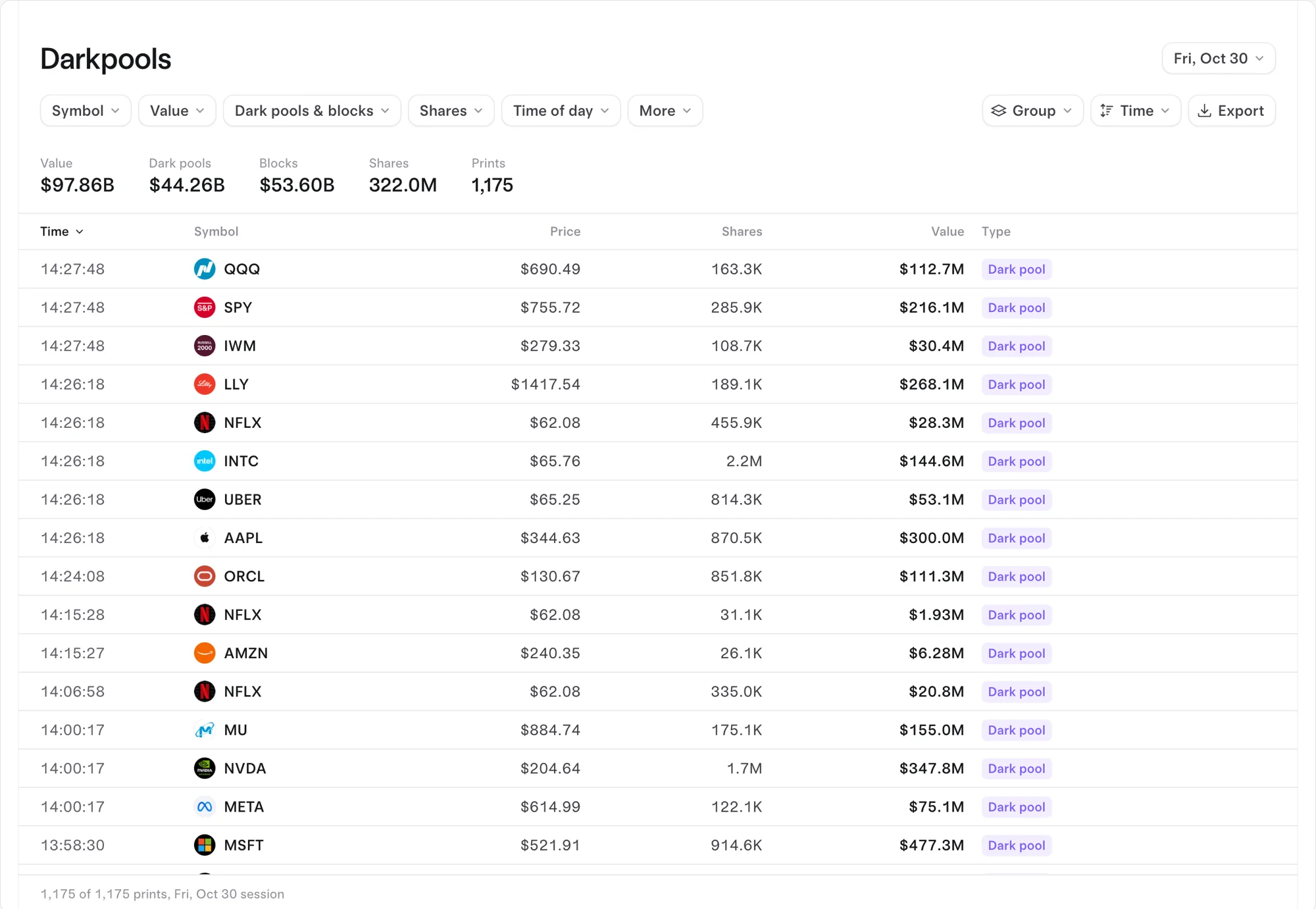
The Dark pool prints page lists each large print with time, symbol, price, shares, value and venue, either Dark pool or the exchange where a block traded, with the session's totals on top. Each stock has its own page too, such as SPY's dark pool page, with the day's prints, dark pool levels and how today compares with a usual day. Tradytics labels every trade reported to FINRA's facilities as Dark pool, so the label covers the whole off-exchange market, not only ATSs. The Free plan shows yesterday's session; on Live and Pro, prints appear within about 15 minutes of being reported.
Common questions
Why is it called a dark pool?
Because its orders aren't displayed. FINRA describes a dark pool as an ATS that isn't "lit," meaning it doesn't publicly show the prices and sizes people want to trade at. The trades themselves are public once reported.
Are dark pools legal?
Yes. They have been regulated under the SEC's Regulation ATS since 1998, and their operators are registered broker-dealers supervised by FINRA. Operators have been fined for misleading their customers, which is a different thing from the pools being illegal.
Can regular investors trade in a dark pool?
Individual investors don't connect to dark pools themselves. Your broker decides where your order goes, and it can send it to an exchange, a wholesaler or an ATS. Does my order go through a dark pool? explains how to check.
Is dark pool data real time?
No. Dark pool prints are after-the-fact reports by nature, and the largest trades are often reported late, sometimes hours later. Traders read them for where size built up over days, not for the second a trade happened. More in is dark pool data real time?
Sources
- SEC, Regulation of NMS Stock Alternative Trading Systems, Release 34-83663 (July 18, 2018): "dark pool" as ATSs that don't display quotes, ATSs meeting the exchange definition, broker-dealer registration, prices derived from exchanges, midpoint matching and conflicts of interest.
- SEC, Disclosure of Order Execution Information, Release 34-99679 (March 6, 2024): first quarter 2023 venue counts and shares of volume (33 ATSs, 16 exchanges, ATSs 10.7%, off-exchange about 44%) and the description of wholesalers.
- FINRA, Where Do Stocks Trade?: lit vs dark venues, and ATS trades reported to a FINRA trade reporting facility and published on the consolidated tape.
- SEC press release 2018-136 (July 18, 2018): Form ATS-N public disclosure and safeguards for subscribers' confidential trading information.
- Dark pool and block prints on 2026-10-30: 13,984 prints worth $277.16B, $107.38B of it in dark pools.
- Most traded in dark pools and blocks: QQQ ($16.44B), SPY ($14.91B), NVDA ($9.47B), AAPL ($9.03B), MSFT ($6.76B).
Updated 2026-11-02 16:04 UTC