Are there dark pools for options?
By Faizan Ahmad. Updated .
No. US listed options trade on the options exchanges, and every trade is published on OPRA, the consolidated options tape, when the exchange prints it. The off-exchange reporting system that stock dark pools rely on, FINRA's trade reporting facilities, covers stocks, not options. Even a huge negotiated options block gets crossed on an exchange, so it shows up on the tape when it trades instead of being reported later at an old price.
Why don't options have dark pools?
Stocks live in two worlds: exchanges, and everything else. A stock trade can happen in a dark pool or with a wholesaler and be reported afterward to a FINRA trade reporting facility. FINRA's rules for those facilities apply to "designated securities," which they define as NMS stocks, and the SEC's Regulation NMS defines an NMS stock as any NMS security other than an option. Options are left out by definition.
Listed options live in one world. They're listed and traded on exchanges, and OPRA distributes the last sale reports and quotes that originate from them: BOX, Cboe's four options markets, IEX Options, MEMX, MIAX's markets, Nasdaq's six (including PHLX and ISE) and NYSE American and Arca. There's no second, off-exchange tape of options trades waiting to be revealed.
Where do giant options orders go, then?
They get negotiated, then crossed on an exchange. A fund wanting tens of thousands of contracts agrees a price with a broker or market maker, and the two sides are sent to an exchange together. Cboe's AIM, for example, lets a firm trade against its own customer's order or bring in another firm, through a short auction where others can step in with a better price. The trade prints on that exchange and goes out on OPRA. What is a block trade in options? covers the mechanics.
The difference in timing is stark. On October 30, 2026, SPY's biggest stock print, $2.84B, was a late dark pool print, reported at 4:28 PM ET at the prior day's price. The day's biggest options print, 1,000 SPX December 18, 2026 12,000-strike puts for $438.98M, printed at 3:26 PM ET with the index at 7,588.92, and that is when it hit the tape. So did the day's biggest single-stock options print, a block of 52,800 NVDA January 15, 2027 $180 calls for $172.81M at 11:55 AM ET, with Nvidia at $205.81.
Stocks vs listed options: where big trades go
| Stocks | Listed options | |
|---|---|---|
| Where big trades happen | Exchanges, dark pools (ATSs) or with dealers | Exchanges, including crossing auctions and trading floors |
| How they're reported | Exchange trades go straight to the tape; off-exchange trades are reported to FINRA within 10 seconds | The exchange prints the trade and OPRA carries it |
| Big trades reported late? | Often: negotiated blocks, average-price and portfolio trades | No off-exchange step to be late |
| On Tradytics (Live and Pro) | Within about 15 minutes of the report | Live, to the second |
| On Tradytics (Free) | Yesterday's session | Yesterday's session |
What about my options orders and payment for order flow?
Many brokers get paid for options order flow, and their quarterly Rule 606 reports have a section for options orders under $50,000 showing which venues got them and the net payment received. But a market maker that buys your order flow still has to fill your order on an exchange, for example through a crossing auction like AIM. So your options fill is on the tape like everyone else's. Stock orders work differently, which does my order go through a dark pool? explains.
What about OTC options?
Banks and large funds also write private options with each other: two-party contracts with custom strikes, dates and terms, outside the listed market. Those aren't listed options. They don't trade on an exchange, they aren't on OPRA, and no flow tool can show them. They're a different product, not a hidden version of the options you trade.
Why it matters for reading flow
Options flow is the timely side of the picture: every listed trade is on the tape as it happens, so a big options bet is visible the moment it's made. Dark pool data is the after-the-fact side: a big stock block can surface minutes or hours later at an old price. Read them differently. Use flow for what traders are doing today, and dark pools for levels built over days. Is dark pool data real time? covers the stock side in detail.
One caveat: being on the tape doesn't make a trade easy to read. A block can be a hedge, one leg of a spread, or a position being closed. The tape tells you size, price and time, not intent.
How to see it on Tradytics
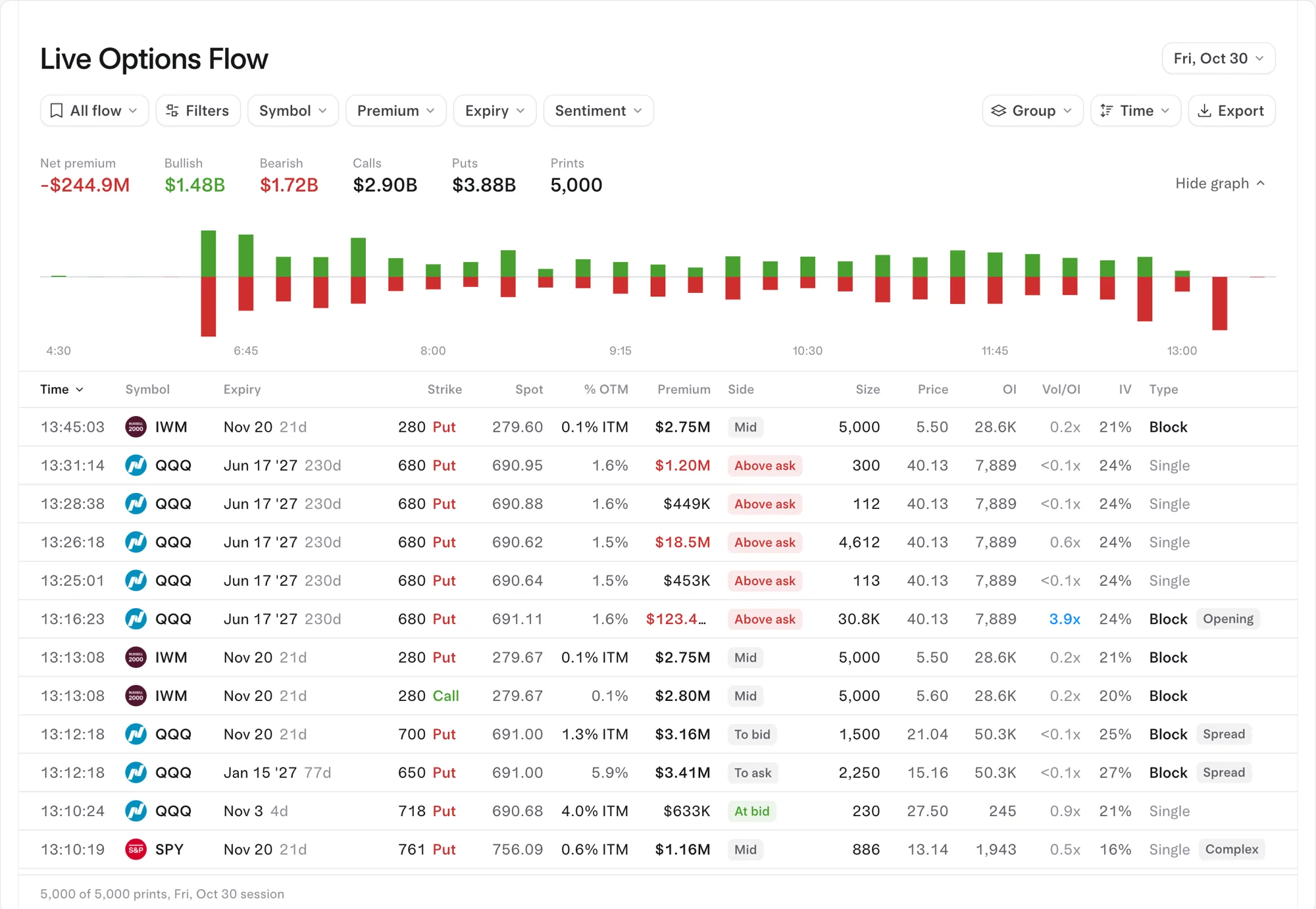
The live options flow page lists large options prints with their side, size against open interest, type (Sweep, Block, Split or Single) and tags like Opening and Complex; Tradytics types any single trade of 5,000 contracts or more as a Block. For one stock, its options page (for example NVDA) shows the largest and unusual orders. Stock prints are on the dark pool page. Flow is live to the second on Live and Pro; Free shows yesterday's session for both.
Common questions
Can listed options trade off-exchange?
No. Listed options trade on the options exchanges and go out on OPRA. Private OTC options between institutions exist, but they're custom contracts, not listed options.
Where do institutional options trades show up?
On OPRA, like every listed options trade, often as a block or a multi-leg package printed at one moment.
Is there a dark pool for SPX or other index options?
No. Index options trade on exchanges too. The $438.98M SPX put print on October 30, 2026 was on the tape at 3:26 PM ET, when it traded.
Why does options flow show up faster than dark pool prints?
Because options trades print directly on an exchange, while off-exchange stock trades are reported to FINRA after they execute, and the biggest are often reported late.
Sources
- OPRA: consolidated last sale and quote information from the national securities exchanges that list options, and the list of participant exchanges.
- FINRA Rule 6320A: the trade reporting facility rules apply to designated securities, defined as NMS stocks.
- 17 CFR 242.600, Regulation NMS definitions: an NMS stock is any NMS security other than an option.
- Cboe, Crossing Order Handling: AIM as an automated crossing process with an auction.
- SEC press release 2018-253: Rule 606 order routing reports cover options orders under $50,000.
- Dark pool and block prints on 2026-10-30: 13,984 prints worth $277.16B, $107.38B of it in dark pools.
- Most traded in dark pools and blocks: QQQ ($16.44B), SPY ($14.91B), NVDA ($9.47B), AAPL ($9.03B), MSFT ($6.76B).
Updated 2026-11-02 16:05 UTC