What is a block trade in options?
By Faizan Ahmad. Updated .
A block trade in options is one very large trade that prints all at once, usually negotiated privately between two big parties and then crossed on an exchange, instead of being filled piece by piece on the screen. There's no single official size; Tradytics marks any single trade of 5,000 or more contracts as a block. A block tells you big money moved in one shot. It doesn't tell you which side started it, whether it opened a position, or whether it's one leg of a bigger package.
How an options block trade gets done
Exchange screens rarely show enough contracts to fill an order of thousands of contracts at one price. So a fund that wants size calls a broker, the broker finds the other side (another institution, or a market maker willing to take the risk), and the two agree on a price. Then the trade is executed on an exchange so it counts as a listed, cleared trade.
Exchanges have mechanisms built for this. Cboe's Automated Improvement Mechanism (AIM) lets a firm cross a customer order against itself or a solicited party, with a short auction that gives others a chance to improve the price. Its Solicitation Auction Mechanism (SAM) is for solicited orders of at least 500 contracts. However it's arranged, the trade still prints on the OPRA tape like any other options trade, which is how flow tools see it.
Because the price is agreed in advance, blocks often print between the bid and the ask. On a flow page that shows up as a Mid side chip, which means no clear lean.
A real block: 52,800 NVDA calls on October 30, 2026
At 11:55 AM on October 30, 2026, 52,800 NVDA January 15, 2027 180 calls printed in one block for $172.81M, with Nvidia at $205.81. Here's how to read it.
- Price per contract: $172.81M divided by 52,800 contracts and by 100 shares is about $32.73 a share.
- How much is intrinsic value: the calls were $25.81 in the money ($205.81 minus $180), so about 79% of the price was stock value and only about $6.92 was time value.
- What it controls: 52,800 contracts cover 5.28 million shares.
That's a stock-like position, not a lottery ticket. It could be a fund taking Nvidia exposure through options, a roll from another strike or expiry, an old position being closed, or calls sold against shares. The block label alone can't tell you which.
Why it matters: NVDA's net premium for the whole day was $19.61M. This single print was almost nine times that size, so whichever side a tool assigns to one block can decide how a whole ticker's flow looks. Nvidia fell 3.94% that day.
Blocks that travel in pairs
At 10:42 AM the same day, with SPX at 7,655.67, two blocks printed in the same minute: 5,000 SPX December 18 7000 calls for $348.68M and 5,000 SPX December 18 8000 puts for $186.77M. Same size, same expiry, both deep in the money.
Read as two separate trades, they contradict each other: a huge bullish call and a huge bearish put. Read as one package, they're a single structured position, and the direction of each leg on its own means little. When two blocks share a minute, a size and an expiry, treat them as one trade until proven otherwise. How to read spreads and multi-leg trades goes deeper.
Options blocks vs stock blocks
"Block" means something different in stocks. Large stock trades often happen off exchange in dark pools, while listed options trade on exchanges. The two are easy to mix up, so here's the difference on Tradytics:
| Options block | Stock block or dark pool print | |
|---|---|---|
| Where it trades | On an options exchange, often through a crossing auction | On an exchange, or off exchange and reported to FINRA |
| How Tradytics marks it | Any single trade of 5,000+ contracts | Every off-exchange print, plus exchange blocks of 25,000+ shares and $250K+ |
| Where it's reported | OPRA, the consolidated options tape | FINRA's trade reporting facilities for off-exchange trades |
| Timing on Tradytics | Live to the second on Live and Pro | Within about 15 minutes of the report; big ones are often reported late by nature |
For the stock side, see block trades vs dark pool prints.
How to read any options block
- Check the side chip. Mid is common for blocks and means no clear lean. At ask or At bid gives you a direction.
- Compare size with open interest. A block bigger than open interest is at least partly new. One smaller than open interest could be a big holder closing (see opening vs closing).
- Look for a partner. Another print in the same minute, same size, different strike or type usually means a spread, a roll or a hedge.
- Check moneyness. Deep in the money is mostly stock exposure. Far out of the money is a bet on a big move. Premium alone hides the difference (see premium vs contracts).
- Check open interest the next morning. If it rose by roughly the block's size, the block opened a position.
How to see it on Tradytics
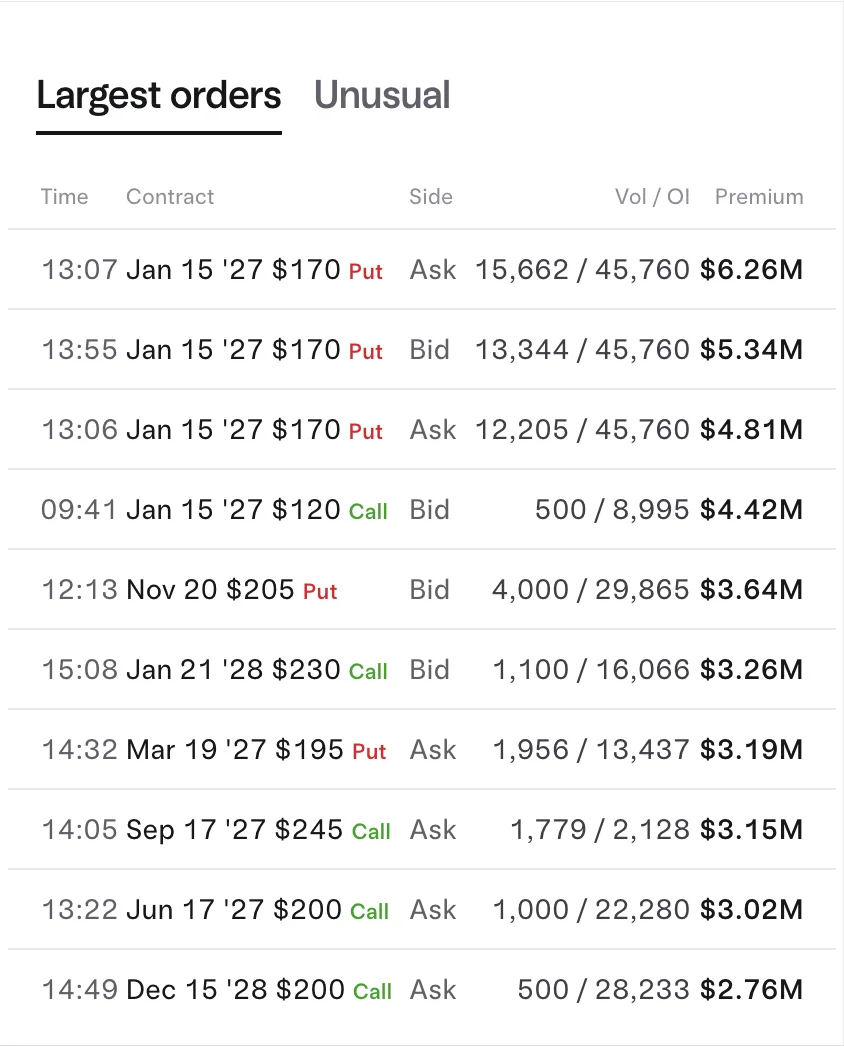
On the Live options flow page, blocks carry the Block type, with their Side chip, size, open interest and tags such as Opening, Spread or Complex. For one stock, the largest and unusual orders card on its options page (for example NVDA options) lists the biggest trades with size against open interest. The AI analyst will also read a big print for you. In one real answer it flagged a $114M print in NVDA November 20 $240 puts as a mid-price spread rather than a clean bet.
Common questions
How many contracts make a block?
There's no official cutoff in options flow, and tools differ. Tradytics uses 5,000 contracts in a single trade. Cboe's SAM auction, one route for large solicited orders, requires at least 500 contracts.
Are block trades bullish?
Not by themselves. A block of calls can be a buyer, a seller, a roll or one leg of a package. The side, open interest and any partner trade decide it.
Why do blocks print at the mid?
Because both sides agreed on a price before the trade, and a price between the bid and the ask is the usual compromise.
What's the difference between a block and a sweep?
A block is one big print, usually negotiated. A sweep is one order taking the best prices on several exchanges at once. See sweep vs block vs split.
Sources
- Cboe: U.S. Options Crossing Orders, how AIM and SAM cross facilitation and solicitation orders, and SAM's 500-contract minimum.
- OPRA, which disseminates consolidated last sale and quote data from the options exchanges.
- Options Industry Council: Options Basics, equity option contracts usually represent 100 shares, with premium priced per share.
- Options Industry Council: General Information FAQ, why open interest only updates after the day's trades are cleared.
- Most bullish options flow on 2026-11-02: MRVL ($23.33M net), AMZN ($16.59M net), TSLA ($12.30M net), LITE ($6.09M net), PLTR ($4.19M net).
- Most bearish options flow on 2026-11-02: AAPL ($40.79M net), AMD ($20.37M net), MU ($10.45M net), NVDA ($7.81M net), ORCL ($7.77M net).
Updated 2026-11-02 16:05 UTC