Sweep vs block vs split: what's the difference?
By Faizan Ahmad. Updated .
A sweep is one order filled across several exchanges at the same moment. A block is one very large trade that prints in a single piece (Tradytics marks any single trade of 5,000+ contracts as a block). A split is a large order filled in pieces on one exchange. Roughly, sweeps signal urgency, blocks signal size that was usually negotiated in advance, and splits signal patience. None of the three tells you on its own whether the trade was bought or sold, opened or closed, or a bet or a hedge.
Sweep vs block vs split at a glance
| Sweep | Block | Split | Single | |
|---|---|---|---|---|
| How it fills | One order takes the best prices on several exchanges at once | One large print, usually negotiated first | One large order, many fills over time | One ordinary print |
| Where | Several exchanges | One exchange, often via a crossing auction | One exchange | One exchange |
| Typical side chip | At ask or At bid (took the other side's price to fill now) | Often Mid (price agreed in advance) | Varies with each fill | Anything |
| What it suggests | Speed mattered more than price | Size too big for the screen | Price mattered more than speed | Nothing special about the fill |
| Main trap | Closing trades and hedges sweep too | Often one leg of a package | Each piece looks small | Big singles get overlooked |
| On Tradytics | Type: Sweep | Type: Block, any single trade of 5,000+ contracts | Type: Split | Type: Single |
Sweep: speed over price
When an order is bigger than the best quote on any one exchange, the trader can wait or sweep. A sweep uses an intermarket sweep order, which takes the full displayed size of every better-priced quote on other exchanges at the same time. The trader gives up a better price to get filled now. That urgency is why flow traders watch sweeps. Details in what is an options sweep.
Block: size in one print
A block is too big for the screen, so the two sides usually agree on a price first and then cross the trade on an exchange, often through an auction such as Cboe's AIM or SAM (SAM requires at least 500 contracts). Blocks frequently print near the mid, which gives no clear lean, and they often come in pairs: a call and a put, or two strikes, as one package. Details in what is a block trade in options.
Split: one exchange, many pieces
A split is a large order worked on one exchange and filled in several pieces, sometimes over seconds, sometimes longer. Think of it as the opposite of a sweep: instead of grabbing every exchange's quote at once, the trader lets the order fill at their price on one venue. That patience can mean a bigger player who cares about cost and doesn't want to push the price.
The trap is that each piece looks unremarkable on its own. A split only stands out when you add its fills together. Repeat prints in the same contract over a session are worth stacking, whether they're labeled Split or not.
The labels are conventions: a real example
On October 30, 2026, the SPX December 18 7000 call traded in size four times:
| Time (ET) | Contracts | Premium | Type |
|---|---|---|---|
| 10:42 AM | 5,000 | $348.68M | Block |
| 11:30 AM | 4,000 | $274.26M | Single |
| 11:37 AM | 2,500 | $170.75M | Single |
| 1:52 PM | 4,500 | $294.52M | Single |
Same contract, same day, three of the four within 1,000 contracts of each other, and only one is a block. That's because the block line is 5,000 contracts: the 4,500-contract print at 1:52 PM is a Single. The label sorts trades by how they filled. It doesn't rank them by importance.
Two more things from that day. Both the 10:42 AM and 1:52 PM call prints had a partner: an SPX December 18 8000 put of the same size in the same minute (5,000 contracts for $186.77M, then 4,500 for $191.79M). And of the eight biggest prints by premium, three were blocks, five were singles and none was a sweep. The biggest money usually moves in one piece, not by sweeping screens.
Which one matters most?
None by default. Each type answers a different question:
- Want urgency? Look at sweeps with an At ask or Above ask chip and an Opening tag, meaning size beat open interest.
- Want institutional size? Look at blocks, then check for a partner print in the same minute before reading a direction.
- Want accumulation? Look for splits and repeat prints in the same contract across hours or days.
Whatever the type, the read comes from the same checks: side, size vs open interest, premium for that stock, expiry and strike, and any matching leg. How to filter options flow turns these into a routine.
How to see it on Tradytics
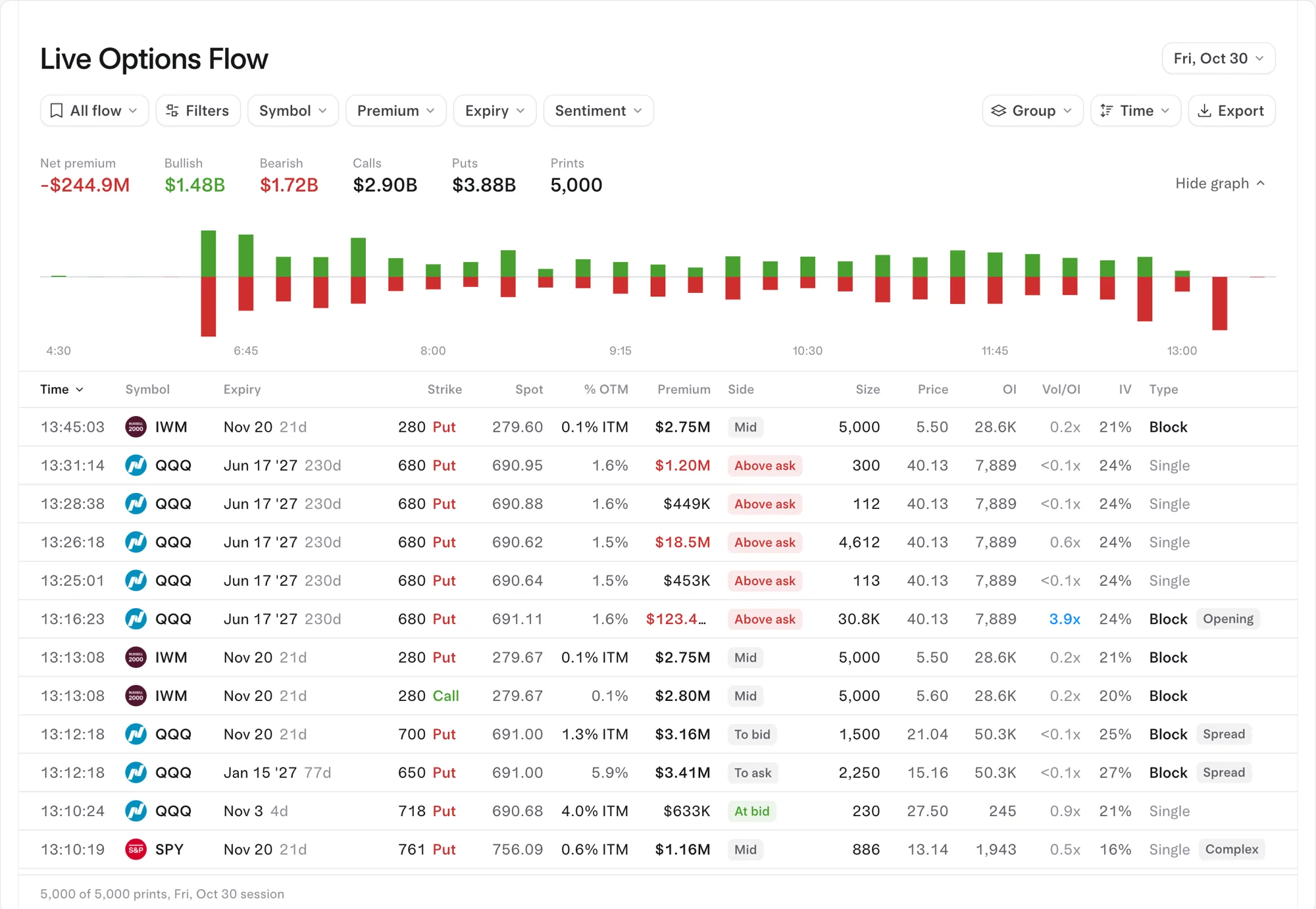
On the Live options flow page, the Type column shows Sweep, Block, Split or Single for every print, next to the Side chip, size, open interest and Vol/OI. Tags flag Opening, Spread, Complex and ITM trades, so a block that's really one leg of a package is easy to spot. The Group menu at the top stacks prints together, which is how you add up a split. Live and Pro are live to the second; Free shows yesterday's session.
Common questions
Is a sweep more bullish than a block?
No. Neither type has a direction. A call sweep at the ask leans bullish; a call block at the mid has no clear lean until you know more.
What is a single print in options flow?
One ordinary trade on one exchange that isn't a sweep, block or split. Singles can still be huge: the day's biggest print on October 30, 2026 was a single, 1,000 SPX December 18 12000 puts for $438.98M.
Do other flow tools use the same definitions?
Not exactly. "Sweep" is widely shared, but block and split cutoffs differ from tool to tool. Check each tool's definition before comparing counts.
Which type is most often a spread?
Blocks deserve the closest look, because big multi-leg trades are often negotiated as one package. Look for the Spread or Complex tag, or a same-size print in the same minute. See how to read spreads.
Sources
- Options Order Protection and Locked/Crossed Market Plan (2009), Section 2 definition of an intermarket sweep order.
- Cboe: U.S. Options Crossing Orders, how large facilitation and solicitation orders are crossed through AIM and SAM.
- OPRA, the consolidated feed every options trade prints on, whatever its type.
- Most bullish options flow on 2026-11-02: MRVL ($13.57M net), GOOGL ($7.70M net), TSLA ($5.62M net), CVNA ($3.08M net), NOW ($2.86M net).
- Most bearish options flow on 2026-11-02: AAPL ($15.98M net), MU ($11.76M net), NET ($10.00M net), ORCL ($9.52M net), NVDA ($6.73M net).
Updated 2026-11-02 15:10 UTC