What is an options sweep?
By Faizan Ahmad. Updated .
An options sweep is one large order that fills against the best available prices on several exchanges at the same moment, instead of waiting for a fill on one. The trader takes every contract offered at the best prices, usually paying the ask, which is why flow traders read sweeps as urgency. A sweep shows that someone wanted in or out fast. It doesn't show whether they opened or closed a position, or whether it was a bet or a hedge.
How a sweep actually happens
US-listed options trade on many exchanges at once, and each one shows its own best bid and offer. Those quotes are protected: under the options industry's order protection plan, a trade shouldn't print at a worse price than a better quote showing on another exchange. The plan calls that a trade-through.
So what happens when you want more contracts than any one exchange is offering at the best price? You can wait and buy in pieces, or you can send an intermarket sweep order (ISO). The plan defines an ISO as a limit order marked as an ISO and sent at the same time as other ISOs that take the full displayed size of every better-priced quote on other exchanges. In plain words: you hit every exchange's best price at once and take everything shown, then, if your limit allows, the next price level up.
That's the sweep. On the tape it shows up as a burst of prints in the same contract, on several exchanges, within a fraction of a second. All of them flow through OPRA, the consolidated feed that carries every options trade and quote from the exchanges. Flow tools group those prints back into one order and label it a sweep.
Why traders follow sweeps
Sweeping costs money. A trader who rests a limit order at the mid might save a few cents a contract; a sweeper gives that up and pays the offer on every exchange, sometimes climbing through several price levels. Someone accepted that cost because speed mattered more than price. That might mean news, an earnings date, a deadline, or simply a big player who doesn't want the market to see the order coming.
That's the whole case for watching sweeps: they're the closest thing in the flow to visible urgency. Repeated sweeps in the same contract over a day or several days carry more weight than one. So does a sweep whose size is bigger than the contract's open interest, because then at least part of it has to be new money.
What a sweep doesn't tell you
- Opening or closing. A trader buying back calls they sold last month sweeps the ask just like a new buyer. Only the next day's open interest settles it (see opening vs closing).
- Bet or hedge. A fund protecting a stock position sweeps puts the same way a bear does. For puts in particular, see is a put sweep bullish or bearish.
- Who it was. Sweeping is a routing choice, not a type of trader. Funds sweep, market makers sweep to adjust their risk, and routing systems sweep ordinary orders too.
- That it's big. A sweep can be a handful of contracts. The label describes how an order filled, not how much money it moved.
The biggest trades usually aren't sweeps
On October 30, 2026, the eight biggest options prints by premium ranged from $170.75M to $438.98M. Three were blocks and five were single prints. None was a sweep. The largest, an SPX December 18 12000 put at 3:26 PM, was 1,000 contracts and $438.98M in one print. The NVDA January 15, 2027 180 call at 11:55 AM was 52,800 contracts and $172.81M, also in one piece.
That's normal. Exchange screens rarely show enough size to fill a trade like that, so the biggest players negotiate the other side first and print it all at once. Sweeps live in the middle: big enough to need several exchanges, urgent enough not to wait for a negotiated block. The differences are laid out in sweep vs block vs split.
How to read a sweep in five checks
| Check | What to look for | Why it matters |
|---|---|---|
| Side | At ask or Above ask for buys; At bid or Below bid for sells | Sets the direction. A sweep at the mid has no clear lean. |
| Calls or puts | Calls bought or puts sold lean bullish; puts bought or calls sold lean bearish | Side and contract type together give the lean |
| Size vs open interest | Size bigger than open interest | At least part of it has to be a new position |
| Premium | Dollars spent, not contract count | On October 30, 2026, 19,170 cheap SPY puts cost less than 170 deep in-the-money AMD puts (see premium vs contracts) |
| Expiry and strike | Short-dated and out of the money | The classic directional bet. Deep in the money or months out often means stock replacement or a hedge. |
A sweep that passes all five (bought at the ask, bigger than open interest, real premium for that stock, short-dated and out of the money) is about as clean as flow gets. It's still one trader's view, not a forecast. Some platforms call a $1M+ sweep at the ask a golden sweep; the same checks apply.
How to see it on Tradytics
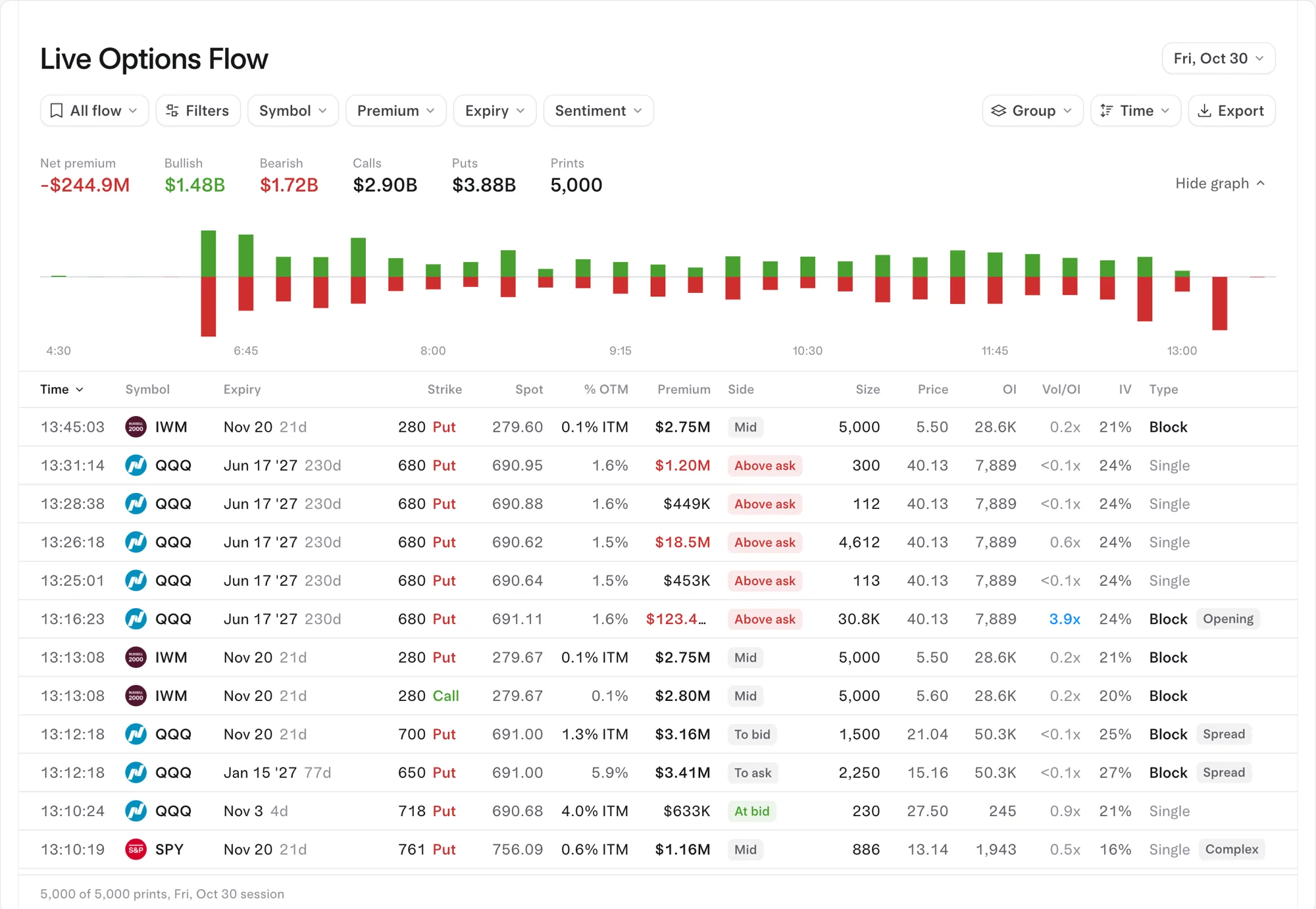
The Live options flow page marks every large print's Type as Sweep, Block, Split or Single, next to its Side chip, size, open interest, Vol/OI and an Opening tag when size beats open interest. Live and Pro show sweeps live to the second from OPRA; Free shows yesterday's session, which is enough to learn how they look.
Common questions
Are sweeps bullish?
Only call sweeps at the ask and put sweeps at the bid lean bullish. Put sweeps at the ask and call sweeps at the bid lean bearish.
Is a sweep the same as an intermarket sweep order?
Close. The ISO is the formal order type that lets one order take quotes on several exchanges at once. "Sweep" is what flow tools call the burst of prints it leaves on the tape.
Why does a sweep seem to show up after the stock moves?
Sometimes the sweep is a reaction to the move, not a cause of it. Why options flow alerts seem late covers this.
Do sweeps predict price moves?
Not reliably on their own. They show urgency, and urgency can come from hedging or closing as easily as from a new bet.
Sources
- Options Order Protection and Locked/Crossed Market Plan (2009), Section 2 definitions of intermarket sweep order, protected bid and offer, and trade-through.
- OPRA, the securities information processor that disseminates consolidated last sale and quote data from the options exchanges.
- Options Industry Council: General Information FAQ, how open interest depends on whether each side is opening or closing.
- Most bullish options flow on 2026-11-02: MRVL ($22.86M net), AMZN ($15.80M net), TSLA ($12.03M net), LITE ($6.09M net), PLTR ($4.32M net).
- Most bearish options flow on 2026-11-02: AAPL ($40.91M net), AMD ($20.30M net), MU ($10.61M net), ORCL ($7.99M net), NVDA ($7.77M net).
Updated 2026-11-02 16:05 UTC