Why premium matters more than the number of contracts
By Faizan Ahmad. Updated .
Premium is the dollars actually spent on a trade (contracts x price x 100), so it tells you how much money is at risk. The contract count alone doesn't, because an option can cost $3 a share or $400 a share. On October 30, 2026, 19,170 SPY puts cost $5.81M while 170 AMD puts cost $7.28M. Rank trades by premium, then check how much of that premium is intrinsic value, because deep in-the-money options inflate premium without being a bigger bet.
How option premium is calculated
An option's price is quoted per share, and a standard equity option covers 100 shares. Index options like SPX work the same way with a $100 multiplier per index point. So:
Premium = contracts x price per share x 100
Run it backwards and you can get the price from any flow row. The SPY January 29, 2027 605 put that printed 19,170 contracts for $5.81M cost about $3.03 a share ($5.81M / 19,170 / 100). The AMD December 15, 2028 910 put that printed 170 contracts for $7.28M cost about $428.24 a share. One trade had 113 times the contracts of the other and still moved less money.
Why contract counts mislead
Cheap options pile up contracts fast. That SPY 605 put was about 20% below where SPY traded ($756.39), so it was a low-cost, far out-of-the-money contract. A headline like "19,170 SPY puts" sounds enormous; $5.81M is a modest trade in a chain that saw $1.09B of put premium that day.
It was also only half the story. In the same minute, the SPY January 29, 2027 716 put traded the same 19,170 contracts for $21.80M (about $11.37 a share). Same size, same expiry, same minute: very likely one put spread, with one leg bought and the other sold. Counting contracts would have doubled the "size" of a trade whose real cost was the difference between the two legs. More on that in how to read spreads.
Where premium misleads too
Premium is better than contracts, but it has its own blind spot: intrinsic value. An option's price is intrinsic value (how far in the money it is) plus time value (what you pay for the chance of more). Out-of-the-money options are all time value. Deep in-the-money options are mostly intrinsic value, which behaves like the stock itself.
The biggest options print of October 30, 2026 shows the problem. At 3:26 PM, 1,000 SPX December 18 12000 puts traded for $438.98M, with SPX at 7,588.92. That put was 4,411.08 points in the money and cost about 4,389.80 points. Essentially all of the premium was intrinsic value. (SPX options are European-style and can only be exercised at expiration, so deep in-the-money puts can trade a little under intrinsic value.) By premium it was the day's largest trade, but almost none of that $438.98M paid for the chance of a big move. The put moves nearly point for point with the index, like a short index position for whoever holds it.
The same thing applies, less extremely, to the AMD 910 put above. It was about $402 in the money and cost about $428, so roughly 94% of its premium was intrinsic value. And the 52,800-contract NVDA January 15, 2027 180 call block ($172.81M) was about 79% intrinsic. For what in, at and out of the money mean, see ITM, ATM and OTM.
Contracts vs premium vs time value
| Measure | What it counts | Inflated by | Best used for |
|---|---|---|---|
| Contracts | How many contracts traded | Cheap, far out-of-the-money options | Comparing with open interest to spot new positions |
| Premium | Contracts x price x 100: dollars spent | Deep in-the-money options | Ranking trades by money at risk |
| Time value | Premium minus intrinsic value | Long-dated options and high implied volatility | How much was paid for the chance of a move |
| Notional | Contracts x 100 x stock price | Far out-of-the-money options, which count in full even though they move little with the stock | The size of the stock position the contracts refer to |
A better way to size a trade
- Start with premium, not contracts. It's the money on the line.
- Subtract intrinsic value. If most of the premium is intrinsic, treat the trade like a stock position, not an options bet. If it's all time value, it's a bet on a move, and the buyer loses all of it if the stock doesn't get past the strike.
- Compare with the stock's normal day. On October 30, 2026, NVDA options traded $1.18B in premium; Microsoft's traded $76.34M. A $1M trade is a rounding error in one and more than 1% of the day in the other.
- Check direction in dollars. That's why flow tools net bullish and bearish premium, not contracts. See what is net options flow.
Traders who want a closer measure of stock exposure use delta, which scales each contract by how much it moves with the stock. What is delta explains it. And if you're wondering why anyone piles into cheap, far out-of-the-money contracts in the first place, see why buy far out-of-the-money calls.
How to see it on Tradytics
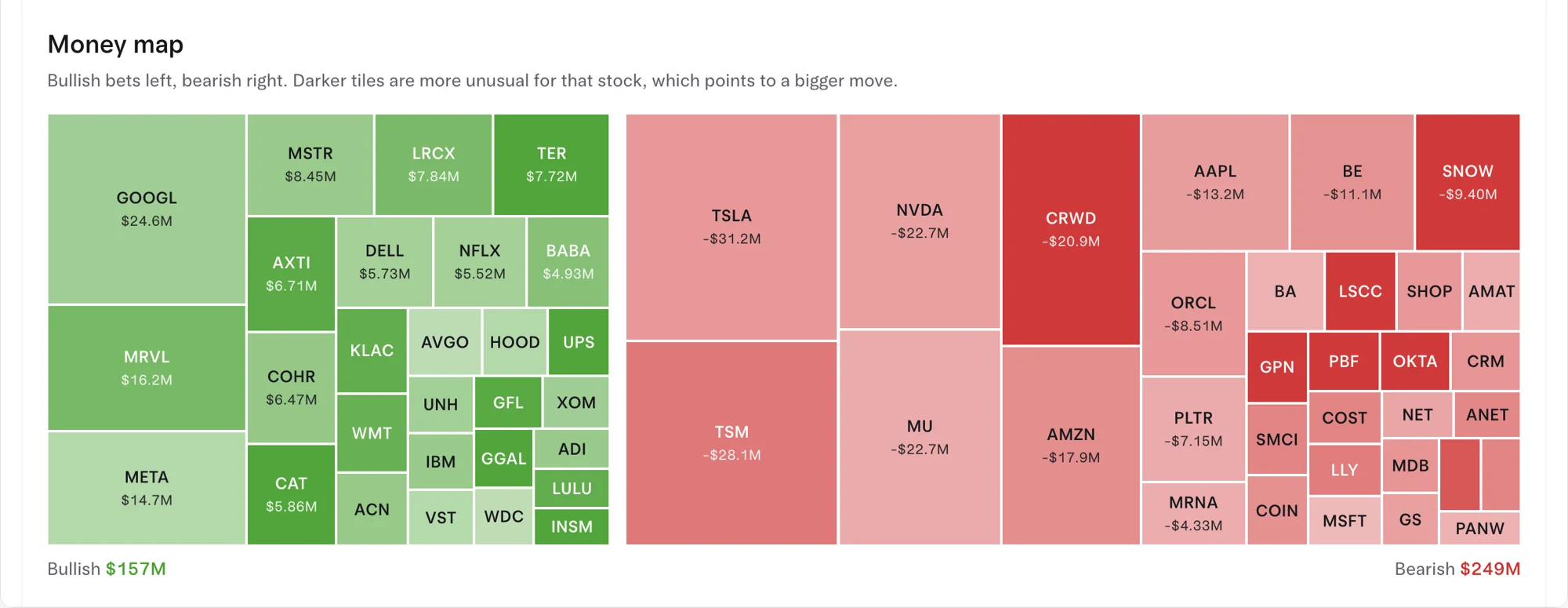
On the Live options flow page, every print shows Premium next to Size and Price, plus Spot and % OTM or ITM, so you can tell in one glance whether a big premium is a big bet or mostly intrinsic value. ITM prints carry an ITM tag. For the whole market, the money map on the options market page sizes each stock by net premium, green for bullish and red for bearish. Live and Pro are live to the second; Free shows yesterday's session.
Common questions
Is notional value the same as premium?
No. Notional is the stock value the contracts refer to. The NVDA block's 52,800 contracts covered 5.28 million shares, about $1.09B of stock at $205.81, while its premium was $172.81M.
Do contract counts matter at all?
Yes, for one thing in particular: comparing size with open interest. A trade bigger than open interest has to include new positions. See volume vs open interest.
What counts as a big premium?
It depends on the stock. Measure a trade against that ticker's usual daily options premium rather than a fixed dollar line.
Why are far out-of-the-money options so cheap?
Because they have no intrinsic value. Their whole price is time value, and they expire worthless unless the stock moves past the strike.
Sources
- Options Industry Council: Options Basics, equity option contracts usually represent 100 shares, with premium priced per share.
- Options Industry Council: Equity vs. Index Options, the $100 index multiplier and European-style exercise only at expiration.
- Cboe: SPX Options, contract multiplier of $100 and European, cash-settled terms.
- Options Industry Council: Long Call, intrinsic value is zero for at-the-money and out-of-the-money options, and the buyer's max loss is the premium.
- Most bullish options flow on 2026-11-02: MRVL ($22.86M net), AMZN ($15.80M net), TSLA ($12.21M net), LITE ($6.09M net), PLTR ($4.27M net).
- Most bearish options flow on 2026-11-02: AAPL ($40.91M net), AMD ($20.30M net), MU ($10.67M net), ORCL ($7.99M net), NVDA ($7.77M net).
Updated 2026-11-02 16:03 UTC