What do ITM, ATM and OTM mean?
By Faizan Ahmad. Updated .
ITM, ATM and OTM describe where an option's strike sits compared with the stock price. A call is in the money (ITM) when the stock is above the strike, and a put is in the money when the stock is below it; at the money (ATM) means the stock is at or very near the strike; out of the money (OTM) is the opposite of in the money. Moneyness matters because it decides how much of an option's price is real, exercisable value and how much is time value that can decay to zero.
How does moneyness work for calls and puts?
| Call | Put | |
|---|---|---|
| In the money | Stock above the strike | Stock below the strike |
| At the money | Stock at the strike | Stock at the strike |
| Out of the money | Stock below the strike | Stock above the strike |
With SPY at its October 30, 2026 close of $757.12, a $740 call is in the money by $17.12, a $758 call is at the money for practical purposes, and a $780 call is out of the money. Flip it for puts: the $780 put is in the money by $22.88 and the $740 put is out of the money. In practice, traders call the strike nearest the stock price "at the money", since the stock rarely sits exactly on a strike.
What are intrinsic value and time value?
Every option price splits into two parts. Intrinsic value is the amount the option is in the money: what you'd get by exercising right now. Time value is everything above that, the price of the chance that the stock moves further before expiry. An out-of-the-money option has zero intrinsic value, so its whole price is time value. The options disclosure document uses the same split, and adds that an option far in the money normally carries very little time value.
option price = intrinsic value + time value
Real contracts from October 30, 2026, split into both parts
Price per share is the premium ÷ contracts ÷ 100. Intrinsic value is measured against the stock price at the moment each trade printed.
| Contract | Stock at the trade | Moneyness | Price | Intrinsic | Time value |
|---|---|---|---|---|---|
| MSFT Oct 30, 2026 $430 call (expiring that day) | $524.67 | Deep ITM, by $94.67 | $95.50 | $94.67 | $0.83 |
| AAPL Dec 15, 2028 $190 call | $345.44 | Deep ITM, by $155.44 | $176.28 | $155.44 | $20.84 |
| TSLA Nov 20, 2026 $400 call | $396.73 | Near ATM, 0.8% OTM | $14.21 | $0 | $14.21 |
| AMZN Jan 15, 2027 $250 call | $240.30 | OTM, 4.0% above the stock | $10.50 | $0 | $10.50 |
| TSLA Dec 18, 2026 $360 put | $398.72 | OTM, 9.7% below the stock | $9.00 | $0 | $9.00 |
Read it top to bottom. The Microsoft call, expiring the same day, is 99% intrinsic value: with hours left there is almost nothing to pay for time, so it trades like 100 shares of Microsoft per contract. The Apple call is 88% intrinsic, but with more than two years to go it still carries $20.84 of time value. The two Tesla contracts and the Amazon call are pure time value, so every cent depends on what the stock does before expiry, and all of it can go to zero. Time values aren't comparable across rows, because each has a different stock, expiry and volatility; for one stock and one expiry, time value is largest at the money.
How does moneyness change an option's behavior?
| Deep in the money | At the money | Far out of the money | |
|---|---|---|---|
| Delta (calls) | Near 1 | About 0.50 | Near 0 |
| Cost | Highest | Middle | Lowest |
| Time value | Small | Largest in dollars | All of the price, small in dollars |
| Daily decay (theta) | Small | Largest | Small in dollars, large as a share of price |
| Gamma and vega | Low | Highest | Low |
| What it needs to pay off | Not much; it moves like the stock | A move your way | A big move, soon |
That last row is the trade-off. In-the-money options cost more but behave like stock. Far out-of-the-money options cost little and pay off big if a large move comes, but most expire worthless, which is the real story behind why someone would buy millions in far OTM calls. Because cheap OTM contracts make big contract counts easy, premium matters more than the number of contracts when you size up a trade.
What does "% OTM" mean on an options flow page?
It's how far the strike sits from the stock, as a percentage of the stock price. The standard arithmetic is (strike - stock) ÷ stock for calls, and (stock - strike) ÷ stock for puts. For the Amazon $250 call: ($250 - $240.30) ÷ $240.30 = 4.0% out of the money. A negative result means the option is in the money.
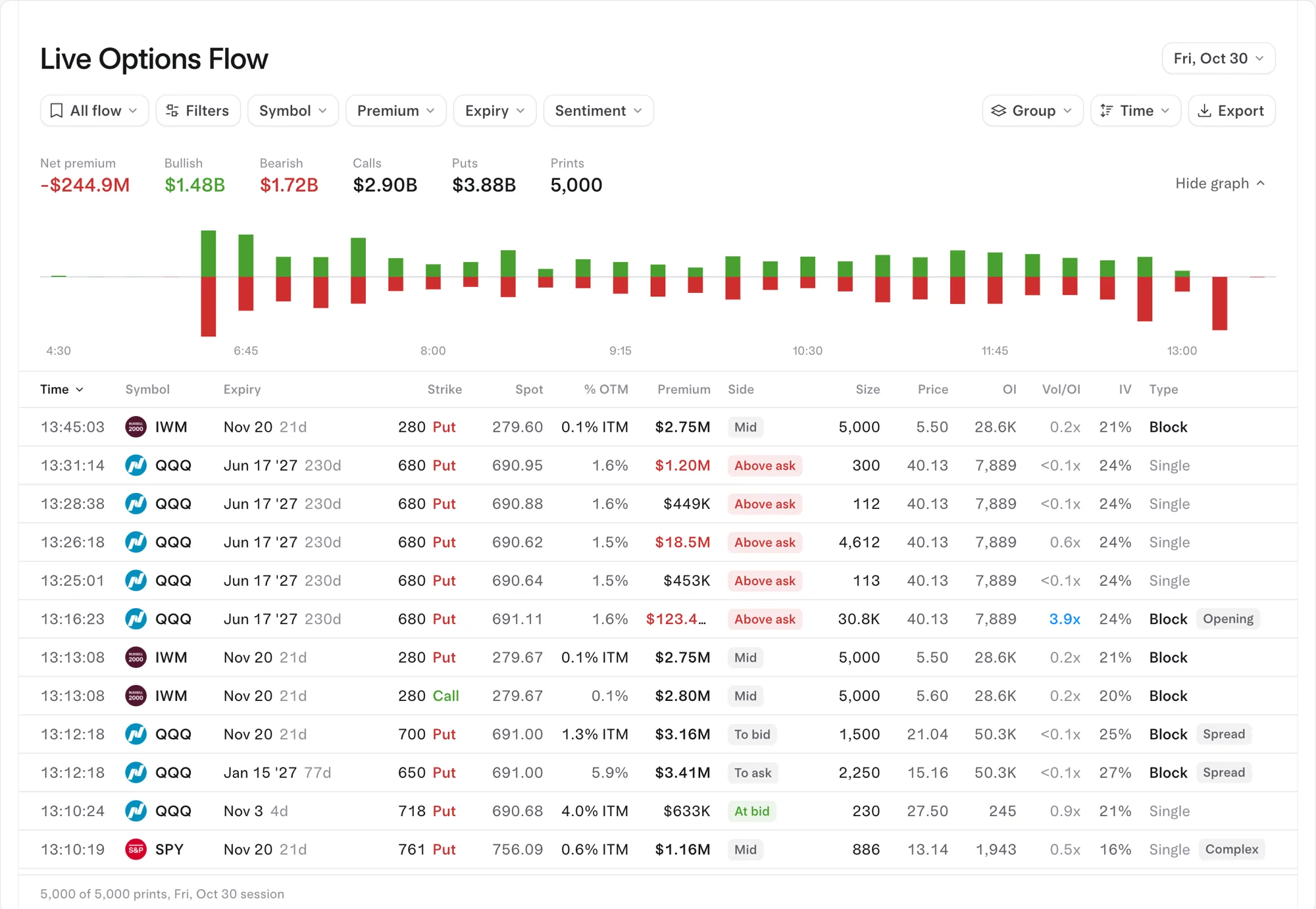
Flow traders use it to read intent. A large print far out of the money is usually a cheap, leveraged bet, a hedge, or one leg of a spread; a large print deep in the money often acts like a stock trade. The full walk-through of a row is in how to read options flow.
What happens at expiration?
At expiration, time value is gone and an option is worth exactly its intrinsic value. An in-the-money option is worth the amount it is in the money; an out-of-the-money option is worth nothing. An option can finish in the money and still lose money, if you paid more than its intrinsic value at expiry.
How to see it on Tradytics
On the live options flow page, every print shows spot and % OTM (marked ITM when it's in the money), and in-the-money trades carry an ITM tag. Each stock's research options page, such as NVDA options, plots open interest by strike around the current price, and the options strategy builder lets you pick any strike on the live chain and see its payoff. Free shows yesterday's flow; Live and Pro see it live.
Common questions
Is an at-the-money option exactly at the strike?
Rarely. The stock almost never sits exactly on a strike, so traders call the nearest strike at the money.
Are in-the-money options safer?
They're less likely to expire worthless, but they cost more, so more dollars are at risk if the stock moves against you.
What does "near the money" mean?
A strike within a few percent of the stock price, close enough that a normal move could push it in or out of the money.
Can an option trade below its intrinsic value?
Occasionally. The options disclosure document notes it happens with American-style options and is more likely with European-style ones, which can't be exercised early.
Sources
- OCC and the US options exchanges, Characteristics and Risks of Standardized Options (June 2024): definitions of in, at and out of the money, intrinsic value and time value, with examples.
- Cboe rule filing SR-CBOE-2019-126 (SEC Form 19b-4): delta nearing 100 as an option goes deeper in the money, and options being worth exactly intrinsic value at expiration.
- SPY options traded $333.35M in premium on 2026-11-02: $193.21M in calls and $140.14M in puts, a net bullish lean of $31.89M.
- Put/call ratio 0.73.
- Options price a move of about ±$6.07 by 2026-11-02.
- Max pain for 2026-11-02 is $765.0.
Updated 2026-11-02 16:03 UTC