Who trades in dark pools?
- Dark pool and block prints on 2026-11-20: 21,790 prints worth $322.08B, $157.80B of it in dark pools.
- Most traded in dark pools and blocks: SPY ($35.50B), QQQ ($19.11B), AAPL ($11.75B), NVDA ($11.61B), MSFT ($8.71B).
By Faizan Ahmad. Updated .
Mostly institutions: pension funds, mutual funds, hedge funds and the brokers that trade for them, moving orders too big to show on an exchange without pushing the price. The pools themselves are run by banks and brokers, which also match their own clients' orders inside them. Individual traders rarely trade in one directly, because most retail stock orders go to wholesalers instead. And no dark pool print tells you who the buyer or seller was.
Who uses dark pools, and what do their trades look like?
| Who | Why the dark helps | What their trading looks like |
|---|---|---|
| Pension funds, mutual funds, insurers | Buying or selling millions of shares without tipping off the market | Large orders, often sliced into pieces over hours or days |
| Hedge funds | Same reason, plus keeping a position quiet while it's built or sold | Anything from big blocks to a steady stream of small fills |
| Brokers and banks | Running a pool and matching their own clients' orders inside it | Client orders crossed against each other, small and large |
| Other trading firms | Depends on the pool: each sets its own rules for who may trade there | Varies by pool; described in its Form ATS-N |
| Individual investors | Rarely there directly; their orders mostly go to wholesalers | Small fills, usually off-exchange but not in a dark pool |
The SEC's classic illustration, from 2009 testimony, is a large pension fund that wants to sell a million shares: if it showed that order on an exchange, the price would likely drop before it could finish. The same testimony made a point that still holds. The early dark pools were built to cross large orders, and those still exist, but most newer pools trade smaller orders. So "dark pool" doesn't automatically mean "giant trade." Why institutions accept the trade-offs is covered in why dark pools exist.
Who runs dark pools?
Dark pools are alternative trading systems (ATSs). Each one is operated by a registered broker-dealer, which files a notice on Form ATS with the SEC before it starts; the SEC doesn't approve it in advance. Pools that trade listed stocks also file a public Form ATS-N describing how they operate and what their operator and its affiliates do in them.
As of October 2026, the SEC's Form ATS-N page lists about three dozen of these pools. Many carry their operators' names: JPM-X, MS POOL, UBS ATS, The Barclays ATS, Citi-ONE ATS, BNPP Cortex ATS, IBKR ATS and Stifel X. Others include Instinet BlockCross, Liquidnet's Negotiation ATS, IntelligentCross, OneChronos and Virtu MatchIt. If you want to know who is allowed into a specific pool and how it matches orders, its Form ATS-N is the place to read.
Can you see who is behind a dark pool print?
No. A print carries the stock, price, shares, time and the fact that it was reported off-exchange. It doesn't name the buyer, the seller or even which pool it came from. The closest public data is FINRA's: weekly share and trade counts for each ATS in each stock, published two weeks after the week for Tier 1 stocks and four weeks after for the rest. That tells you which pools traded a stock a few weeks ago. It never tells you who was in them.
It's also worth knowing that the "Dark pool" label on Tradytics, as on most data tools, covers any print reported to FINRA's facilities. That means a big print may have come from a dark pool, from a dealer trading out of its own inventory, or from a broker crossing two clients. How much trading happens in dark pools shows how the off-exchange market splits.
What does institutional size tell you about a print?
Size is the one clue you get. On October 30, 2026, Tesla printed 400,000 shares at $399.935 in a dark pool at 11:57 AM ET ($159.97M) and 375,000 shares at $396.043 at 2:42 PM ET ($148.52M). Meta printed 430,000 shares at $620.00 at 1:40 PM ET ($266.60M). No individual investor trades $160M of Tesla in one print, so these are institutions or the banks working for them.
But that's where the clue ends. Every print has a buyer and a seller. An institution-sized print can be a fund buying, a fund selling, a bank taking the other side of a client's order, or a rebalance with no view behind it at all. "Smart money was here" is a guess, not something the print says, which is why a print is neither bullish nor bearish on its own. Prints become useful in aggregate, as levels where size built up over several sessions.
Do retail traders ever trade in dark pools?
Rarely, and only indirectly. The SEC said in 2022 that retail brokers route more than 90% of individual investors' marketable stock orders to wholesalers, dealers that typically fill them internally. That's off-exchange, but it isn't a dark pool. Brokers can also route some orders to an ATS. Your broker's Rule 606 report lists the venues it used; does my order go through a dark pool? shows how to read it.
How Tradytics shows this
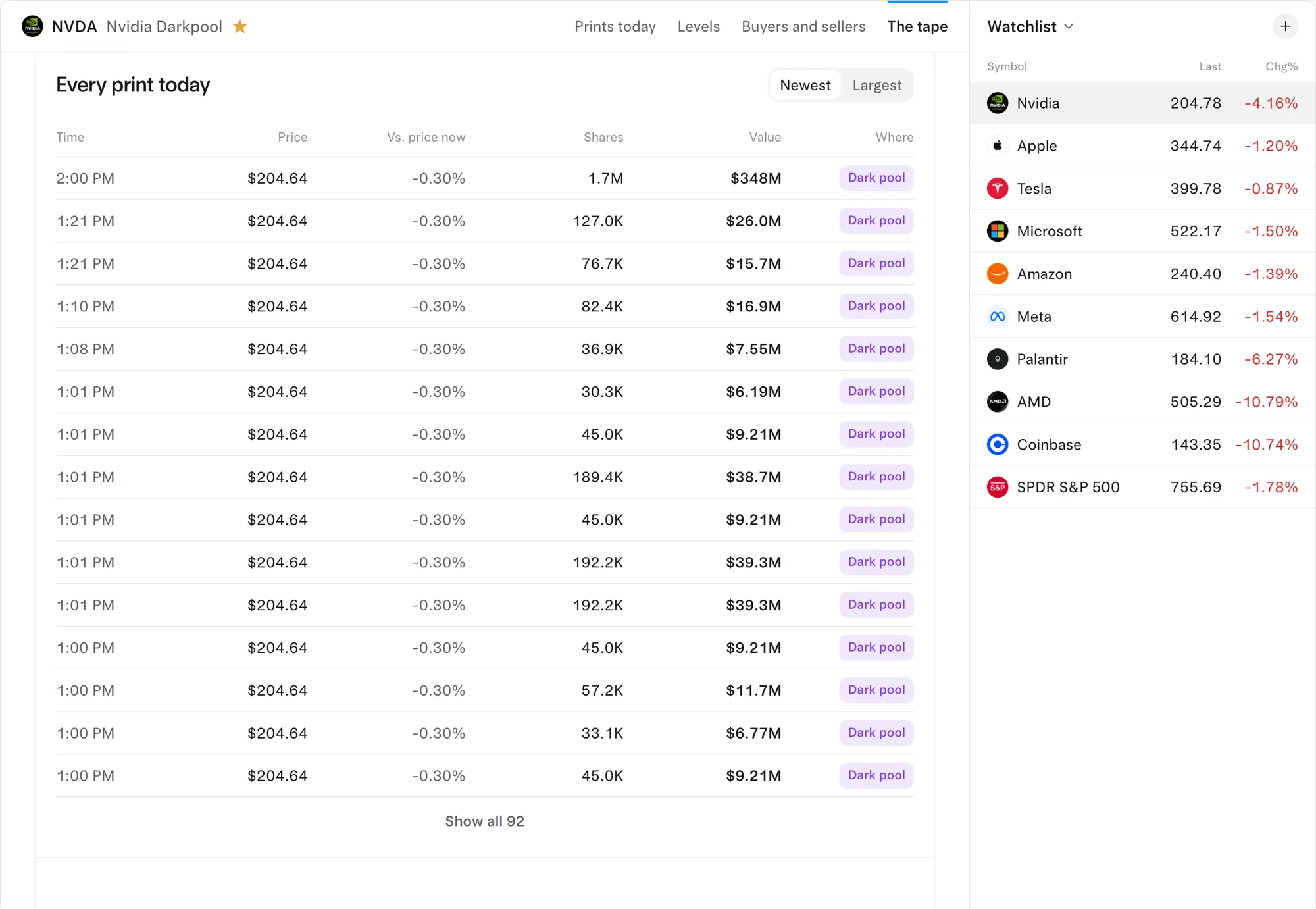
Since size is the one clue a print gives you, Tradytics makes size easy to judge: every dark pool block print is ranked against the stock's own last 12 months, so you see at a glance whether a Tesla print like the $159.97M one above is routine or the biggest of the year (more in ranked dark pool prints). A stock's dark pool page, like Tesla's, shows prints today, dark pool levels as a volume profile of where the dollars concentrated, how much traded against a usual day and the tape, which lists each print's time, price, shares, value and venue. The same levels sit on the chart, with dark pool history since January 2022 in the API, and the market-wide list is the dark pool page. Free shows the previous session; Plus and Pro show today's prints and every stock's dark pool research.
On Tradytics: ranked dark pool prints, history since January 2022 in the dark pool data API, and dark pool rules tested in the backtester.
Common questions
Do hedge funds use dark pools to hide selling?
They use them to hide size, buying as much as selling. A print shows that a trade happened, not which side wanted it.
Can I trade in a dark pool myself?
Not directly. Your broker decides routing, and its Rule 606 report shows the venues it used, including any ATSs.
How many dark pools are there?
About three dozen ATSs trading listed stocks have Form ATS-N filings on the SEC's website as of October 2026.
How is a dark pool trade reported?
It's reported to a FINRA trade reporting facility, as soon as practicable and no later than 10 seconds after execution, with later reports flagged late.
Sources
- SEC testimony on dark pools (October 28, 2009): the pension fund example, block-crossing pools vs pools for smaller orders, and dealers that internalize customer orders.
- SEC, Form ATS-N Filings: the list of NMS stock ATSs and what Form ATS-N discloses.
- SEC, Alternative Trading System List: ATSs register as broker-dealers and file Form ATS, which the SEC doesn't approve in advance.
- FINRA Regulatory Notice 19-29: security-specific ATS volume published two weeks later for Tier 1 stocks and four weeks for others.
- SEC fact sheet, Proposed Rule to Enhance Order Competition (2022): more than 90% of retail marketable orders routed to wholesalers.