What is max pain, and does it work?
By Faizan Ahmad. Updated .
Max pain is the strike price at which the options expiring on a given date would pay out the least to their holders, so the most calls and puts expire worthless. The theory says hedging pulls the price toward it into expiration. It's a weak guide: on the October 30, 2026 expiration, SPY closed $7.88 below its $765 max pain, and none of the nine big names below closed at theirs. Research does find stocks cluster near strike prices at expiration, but the pull is small and news easily overwhelms it.
How is max pain calculated?
- Take every strike for one expiration date and its open interest in calls and puts.
- Pretend the stock settles at the first strike. For each call with a strike below that price and each put with a strike above it, work out what holders would collect: the amount in the money × open interest × 100.
- Add up all those payouts.
- Repeat for every strike.
- Max pain is the strike with the smallest total payout.
Two details matter. Max pain is specific to one expiry, so a stock has a different max pain for each date. And it uses open interest, which is counted once a day, so it's built from positions as of the prior close.
Why is max pain supposed to work?
The popular story is that option sellers "pin" the stock where they pay the least. That's not how it works: option sellers are thousands of separate traders and desks, mostly hedged, with no way to coordinate.
The documented mechanism is narrower. Ni, Pearson and Poteshman (Journal of Financial Economics, 2005) found that on expiration dates, the closing prices of stocks with listed options cluster at strike prices, shifting optionable stocks' returns by at least 16.5 basis points on average. They traced it to market makers rebalancing hedges near big strikes and to manipulation by firm proprietary traders. Notice what that finding is about: closes landing near strikes, especially heavily traded ones. That's related to max pain but not the same thing, and the effect is a fraction of a percent.
Did max pain work on October 30, 2026?
October 30 was an expiration day (weekly options on stocks and ETFs, and the end-of-month expiration for index options on Cboe's calendar), so it's a clean check: Tradytics' max pain for that day's expiry against where each stock actually closed.
| Ticker | Max pain (October 30 expiry) | Close | Close vs max pain | Day's move |
|---|---|---|---|---|
| SPY | $765 | $757.12 | $7.88 below | -1.59% |
| QQQ | $705 | $692.74 | $12.26 below | -3.16% |
| Nvidia (NVDA) | $215 | $205.25 | $9.75 below | -3.94% |
| Amazon (AMZN) | $250 | $240.80 | $9.20 below | -1.23% |
| Meta (META) | $645 | $614.00 | $31.00 below | -1.68% |
| AMD | $550 | $508.22 | $41.78 below | -10.28% |
| Tesla (TSLA) | $375 | $400.22 | $25.22 above | -0.76% |
| Apple (AAPL) | $320 | $345.10 | $25.10 above | -1.09% |
| Microsoft (MSFT) | $480 | $522.99 | $42.99 above | -1.35% |
Nine out of nine missed, by between 1% (SPY) and about 8% (Microsoft and AMD) of the closing price. Six closed below max pain and three above. Every one of them fell on the day: the S&P 500 dropped 1.59% and technology sank 4.55% as Intel's weak outlook hit chip stocks. On a day like that, price goes where the news sends it.
One day isn't a study. It does show the two biggest problems with max pain: it says nothing about news, and several of these levels sat far from price before the day even started, so there was no realistic "pull" to speak of.
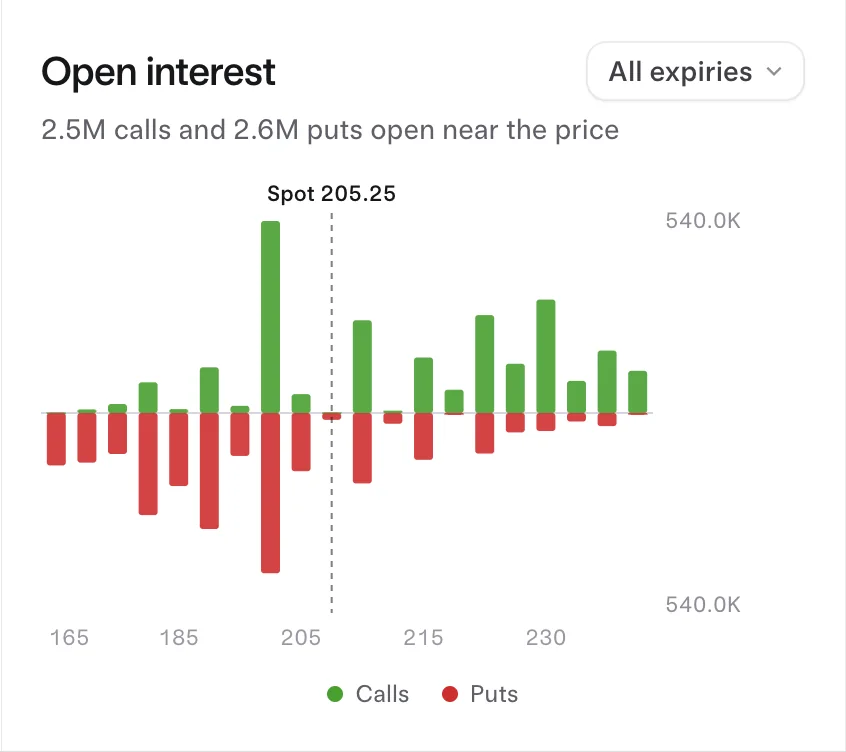
Why max pain often misses
- Open interest doesn't say who's on which side. Max pain assumes option sellers as a group want the smallest payout, but many open contracts are hedges, spreads or covered calls whose owners care about something else. See how to tell if options were bought or sold.
- It ignores what dealers actually hold. Pinning comes from dealers long gamma near a strike. Max pain doesn't measure dealer gamma at all; call and put walls try to.
- It's built from yesterday. Positions opened or closed on expiration day itself aren't in the count.
- It can sit far from price. Microsoft's $480 max pain was $42.99 under its close. A level that far away isn't pulling anything.
- News beats it. Earnings, macro data and sector moves are bigger forces than expiration hedging.
When is max pain worth a glance?
- On quiet days with no big news.
- In the last hours of a monthly OPEX, when the most open interest expires at once.
- When max pain is close to price and lines up with a strike carrying heavy open interest or a big positive dealer gamma bar.
- As a check on, not a replacement for, the expected move to the same expiry. A max pain outside that range has little chance of being reached.
How to see it on Tradytics
Each options research page, such as SPY options, shows open interest by strike with max pain, next to Dealer levels and the expected move, so you can see in one place whether max pain agrees with anything else. You can also ask the AI analyst (Chat button on any page) "What's SPY's max pain for Friday?" and it pulls the open interest for that expiry.
Common questions
Is max pain market manipulation?
Max pain itself is just a calculation. Research has found some expiration-day manipulation by firm proprietary traders, but the main documented effect is hedging, and it's small.
Does max pain work for SPY?
Not reliably. SPY has an expiration every weekday, so any single day's max pain covers a slice of its positions, and the index moves on macro news.
When is max pain most accurate?
On calm monthly expiration days, close to the end of the session, when it sits near the price and near a heavy strike.
What's the difference between max pain and gamma walls?
Max pain uses one expiry's open interest to find the lowest payout. Gamma walls use dealer gamma across expiries to find where hedging is heaviest. They often point to different strikes.
Sources
- Ni, Pearson and Poteshman, Stock Price Clustering on Option Expiration Dates (Journal of Financial Economics, 2005): closes cluster at strikes on expiration dates; at least 16.5 basis points; hedging and manipulation.
- Options Industry Council, Open Interest: Why It Matters: how the OCC calculates open interest.
- Cboe, 2026 Options Expiration Calendar: standard monthly, weekly and end-of-month expiration dates.
- SPY options traded $335.60M in premium on 2026-11-02: $193.59M in calls and $142.01M in puts, a net bullish lean of $32.05M.
- Put/call ratio 0.73.
- Options price a move of about ±$6.07 by 2026-11-02.
- Max pain for 2026-11-02 is $765.0.
Updated 2026-11-02 16:05 UTC