Block trades vs dark pool prints
- Dark pool and block prints on 2026-11-20: 21,790 prints worth $322.08B, $157.80B of it in dark pools.
- Most traded in dark pools and blocks: SPY ($35.50B), QQQ ($19.11B), AAPL ($11.75B), NVDA ($11.61B), MSFT ($8.71B).
By Faizan Ahmad. Updated .
A block trade is about size; a dark pool print is about where the trade happened. A block is simply a big trade (the top size category in FINRA's block statistics is 10,000 shares or $200,000 and up), and it can print on an exchange or off one. A dark pool print is any trade reported off-exchange, big or small. The biggest print of the day is often neither secret nor dark: on October 30, 2026, Nvidia's largest was the 4:00 PM Nasdaq closing auction, 30,459,238 shares at $204.64, worth $6.23B, on a lit exchange.
What counts as a block trade?
There's no single legal cutoff. When FINRA publishes block statistics for dark pools, it sorts trades into size categories, the largest being 10,000 shares or more, $200,000 or more, or both together. Data tools and desks draw their own lines, usually relative to how much the stock normally trades. Options have their own version (see what is a block trade in options?).
Where a block prints depends on how it was arranged. It can cross in an exchange auction, as a negotiated cross on an exchange, or off-exchange in a dark pool or with a dealer.
What counts as a dark pool print?
Any stock trade reported to one of FINRA's trade reporting facilities instead of executed on an exchange. Tradytics shows all of these as "Dark pool," which strictly includes dealer trades as well as true dark pools (ATSs). Size isn't part of the definition: back in 2009 the SEC noted that most newer dark pools trade smaller orders, while the original block-crossing pools still exist. The prints traders watch are the big ones, but most off-exchange trades are far smaller. More in what are dark pool prints?
Block trade vs dark pool print, side by side
| Block trade | Dark pool print | |
|---|---|---|
| Defined by | Size | Venue |
| Can happen on an exchange? | Yes: auctions and negotiated crosses | No, off-exchange only |
| Size | No legal cutoff; 10,000 shares or $200K and up is FINRA's top block category | Any size |
| How fast it's public | On an exchange: on the tape at once. Off-exchange: within 10 seconds, big negotiated ones often later | Within 10 seconds; late reports flagged, and big negotiated ones often late |
| Shown on Tradytics as | The exchange's name, or "Dark pool" if it traded off-exchange | "Dark pool" |
Five kinds of big prints from one day
October 30, 2026 had all of them:
| Kind | Example | Lit or dark | What it is |
|---|---|---|---|
| Closing auction | AMD, 4:00 PM ET: 6,064,370 shares at $504.80 on Nasdaq ($3.06B) | Lit | Orders that want the official closing price, crossed at one price |
| Exchange block during the session | Meta, 12:10 PM ET: 500,000 shares at $621.23 on NYSE Chicago ($310.62M) | Lit | A big block printed on an exchange, public at once |
| Dark pool block during the session | Meta, 1:40 PM ET: 430,000 shares at $620.00 ($266.60M) | Dark | Size traded during the session, reported after the fact |
| Dark pool block at the closing price | Tesla, 4:00 PM ET: 563,667 shares at $399.81 ($225.36M), the same price as Tesla's 4:00 PM Nasdaq auction print | Dark | Business done at the close, booked off-exchange |
| Late dark pool print | SPY, 4:28 PM ET: 3,684,100 shares at $769.559 ($2.84B), about $12 above SPY's close | Dark | An earlier deal booked late at an old price |
Meta's two rows are the cleanest comparison: two blocks of similar size, 90 minutes apart and $1.23 apart in price. One printed on an exchange, under its name; the other traded in the dark and was reported to FINRA. Both are blocks. Only one is a dark pool print. The SPY row is explained in what is a late dark pool print?
Why are so many huge prints at 4:00 PM?
Closing auctions. In Nvidia, Apple ($4.27B), Microsoft ($4.18B), Amazon ($2.36B), AMD ($3.06B), Meta ($1.44B) and Tesla ($1.22B), the single biggest print of October 30, 2026 was the 4:00 PM Nasdaq print. AMD's auction alone was almost 50 times its biggest dark pool print that day ($62.88M). Those auction prints are lit, public at once and not dark pool trades, yet a careless reading of a "biggest prints" list can mistake them for hidden institutional bets.
Why the difference matters when you read prints
- Don't count a closing auction as dark pool money. It's the market's daily closing match, with buyers and sellers on both sides. Tradytics' dark pool levels count off-exchange prints only and leave exchange blocks like the auction out.
- Timing differs. An exchange block is on the tape the moment it prints; a dark pool block may land minutes or hours later at an old price. See is dark pool data real time?
- Size isn't direction. A block has a buyer and a seller like any trade, so a big print, lit or dark, is neither bullish nor bearish on its own.
- Venue isn't size. "Dark pool" on a print says where it was reported, not that it was large or important.
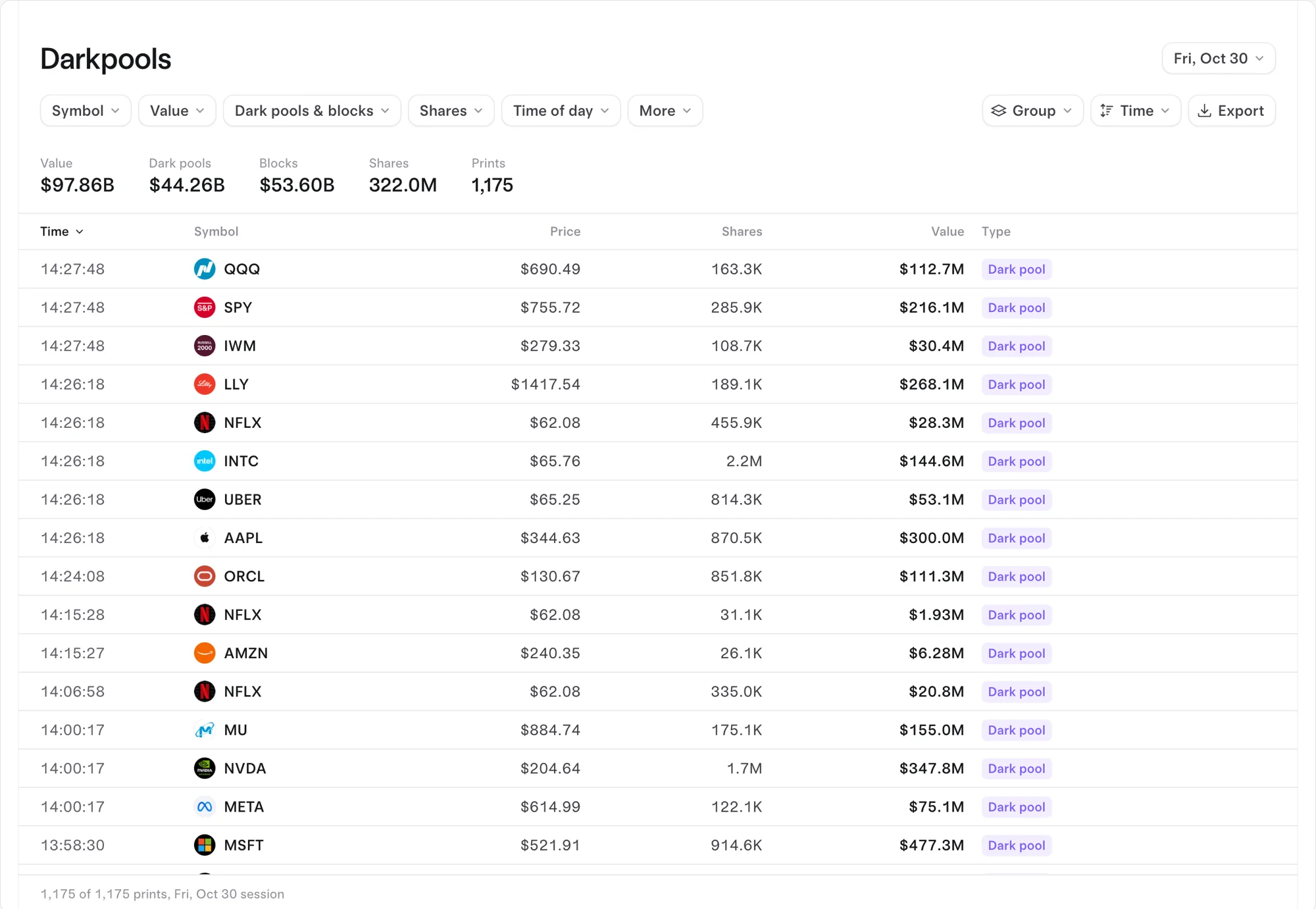
How Tradytics shows this
The dark pool page lists every dark pool block print and exchange block together, with separate totals for each and the venue on every row: "Dark pool" or the exchange's name. Each dark pool print is ranked against the stock's own last 12 months, so you see at a glance whether today's print is the biggest of the year rather than just big in dollars (see ranked dark pool prints). A stock's dark pool page, like Meta's, plots both kinds on the day's price line and builds its levels from the dark pool prints, as a volume profile of where the dollars concentrated; the same levels sit on the chart, with dark pool history since January 2022 in the API. Free shows the previous session; Plus and Pro show today's prints and every stock's dark pool research.
On Tradytics: ranked dark pool prints, history since January 2022 in the dark pool data API, and dark pool rules tested in the backtester.
Common questions
Are all dark pool prints block trades?
No. Size isn't part of the definition, and most off-exchange trades are small. The ones worth reading are large next to the stock's usual day.
Is a block trade bullish?
Not by itself. Every block has a buyer and a seller, and a block priced off an earlier close may not reflect the current market at all.
Can a block trade happen on an exchange?
Yes. Closing auctions and negotiated crosses print on exchanges under the exchange's name, like Meta's 500,000-share block on NYSE Chicago at 12:10 PM ET on October 30, 2026.
Do options blocks go through dark pools?
No. Listed options trade on exchanges, so every options block prints on an exchange. See are there dark pools for options?
Sources
- FINRA Regulatory Notice 16-14: the share and dollar size categories FINRA uses for block statistics, the largest being 10,000 shares or more and $200,000 or more.
- FINRA Rule 6380A, Transaction Reporting: off-exchange trades reported within 10 seconds, later reports designated late.
- FINRA, Trade Reporting Facility (TRF): where trades effected otherwise than on an exchange are reported.
- SEC testimony on dark pools (October 28, 2009): block-crossing pools vs newer pools built for smaller orders.