How Tradytics Signals are built: millions of backtests on 5 years of real quotes
By Faizan Ahmad. Updated .
Building an options signal engine that looks good on paper is easy. Building one that survives real bid-ask spreads, bear markets, and unseen future quarters is brutally hard. Here is how we approached the research behind Tradytics Signals without giving away the proprietary formulas under the hood.
Millions of backtests, one strict filter
Over the past year, our research pipeline tested millions of combinations across institutional options flow, dark pool activity, dealer positioning, and market volatility regimes. Most ideas that traders swear by failed immediately once we plugged in real historical option quotes instead of idealized stock moves.
To keep ourselves honest, we locked down strict evaluation rules before selecting a single setup:
- Real historical OPRA quotes only: every entry is priced at the real market ask, and every mark and exit uses real historical option pricing across five full years (January 2022 through November 2026, covering 1,229 trading sessions).
- Three-way chronological split: ideas were discovered on a training window (2022 to mid-2024), checked on a separate validation window (mid-2024 through Q3 2025), and then evaluated on a completely sealed out-of-sample holdout (Q4 2025 through November 2026) that was never touched during tuning.
- No cherry-picking regimes: a signal suite only counts if it holds up across both calm bull trends and ugly bear drawdowns like 2022.
- Strict statistical testing: we verified results with block-bootstrapped confidence intervals and autocorrelation-adjusted significance tests so clustered winning weeks could not fool us.
What survived the five-year real-quote test
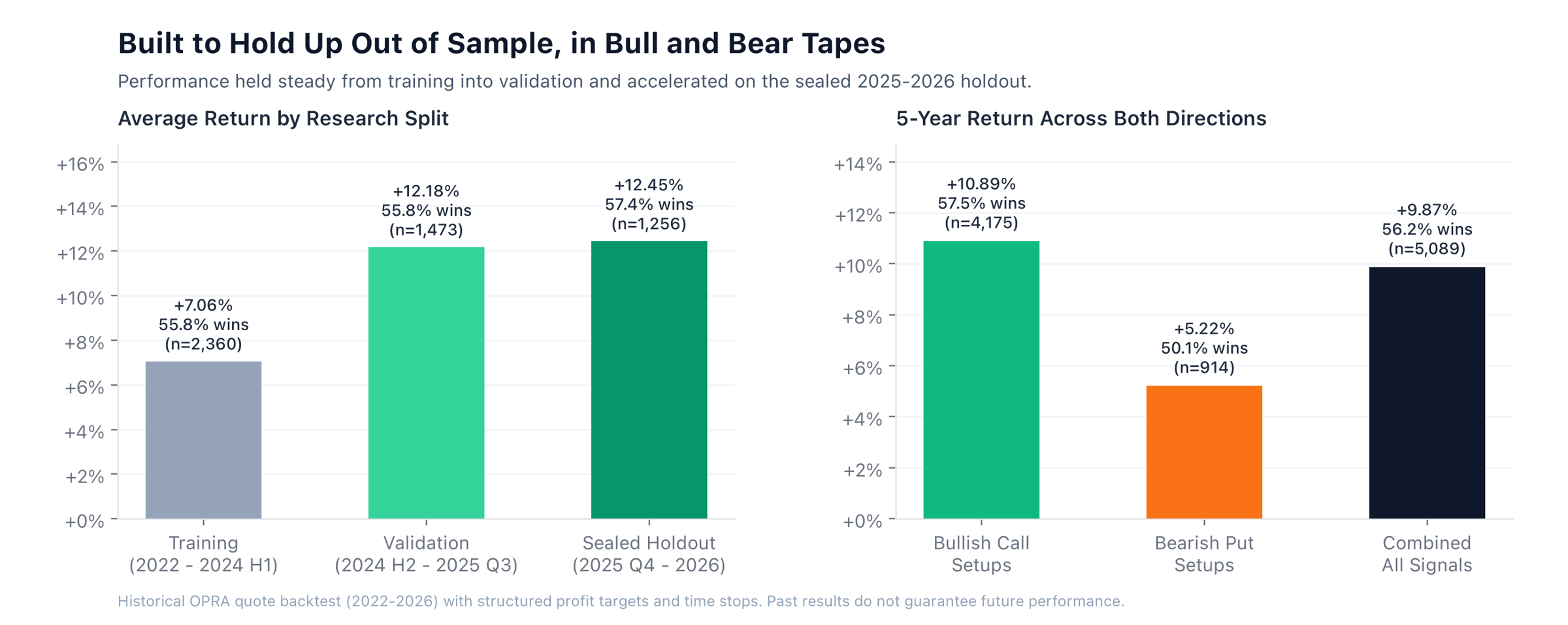
Out of millions of backtested candidates, only eight clean directional setups (six bullish call setups and two bearish put setups) survived every filter. Together, they produced 5,089 settled signals over five years with steady improvement from training into unseen out-of-sample data.
| Research Period | Settled Signals | Avg Return / Signal | Win Rate | Profit Factor |
|---|---|---|---|---|
| Training (2022 to 2024 H1) | 2,360 | +7.06% | 55.8% | 1.30 |
| Validation (2024 H2 to 2025 Q3) | 1,473 | +12.18% | 55.8% | 1.55 |
| Sealed Out-of-Sample (2025 Q4 to 2026) | 1,256 | +12.45% | 57.4% | 1.56 |
| Full 5-Year Combined | 5,089 | +9.87% | 56.2% | 1.43 |
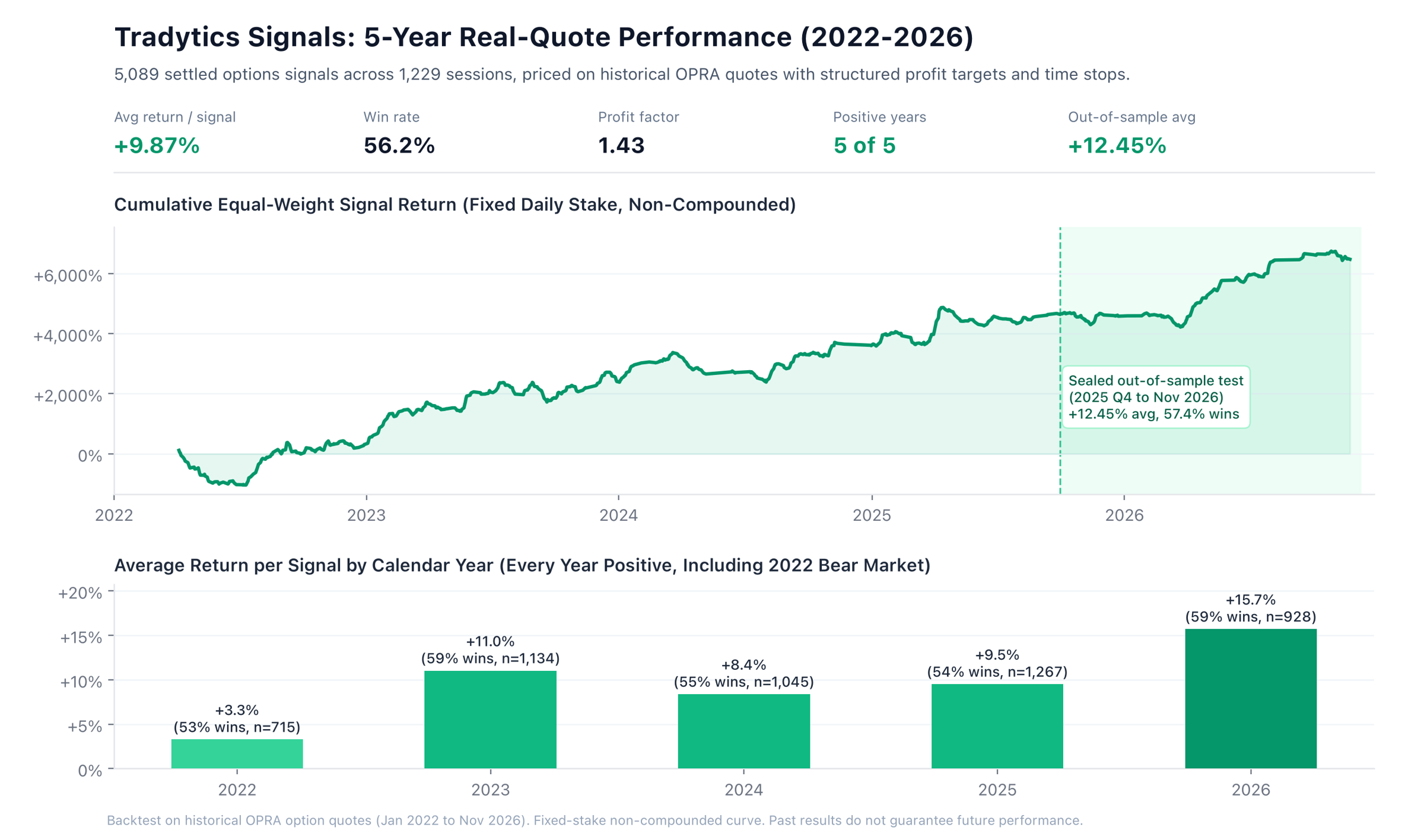
The statistical confidence is unusually strong for options data: a block-bootstrapped 95% confidence interval of +3.19% to +13.05% per trade (p = 0.0003), an annualized Sharpe of 2.28 over five years (2.99 out of sample), and five consecutive positive calendar years from 2022 through 2026.
Why exit discipline mattered just as much as entries
One of our biggest research findings had nothing to do with picking stocks. Holding long options all the way to expiration turns a huge share of profitable trades into losers because of late-life theta decay and sudden reversals.
Adding a simple, deterministic exit framework transformed the payoff curve: sell half at +35%, move the runner's stop to entry price (breakeven), target +100% on the remainder, and exit cleanly after 5 or 10 trading days if the move never develops. Across five years of real quotes, 49.0% of all signals reached the +35% first target and 18.9% hit the +100% double.
Why we throttle calls when the market turns weak
Even great call flow struggles when the broader tape is breaking down. Rather than blindly firing bullish setups into every selloff, the engine continuously evaluates overall market health and throttles bullish call frequency during stressed conditions while allowing selective bearish put setups to take over.
That single choice is why the full portfolio stayed positive even through the 2022 bear market (+3.3% average return across 715 signals) while capturing strong upside in 2023 (+11.0%), 2024 (+8.4%), 2025 (+9.5%), and 2026 (+15.7%).
Why there is no made-up AI confidence score
Every signal is selected by deterministic quantitative rules tested across millions of historical paths. We use a language model strictly to turn the contract and context into a short, readable English summary after a signal has already fired. The model never picks the trade and never invents a fake 92% score.
Keep exploring Tradytics
Signals sits alongside the rest of our data stack: clean options flow, ranked dark pool prints, backtesting, custom dashboards, portfolio analytics, prediction market probabilities, the AI Fund, and the public API and MCP.
Common questions
Why don't you publish the exact entry formulas? Because edge in liquid options markets decays when exact triggers get crowded. We stay completely transparent on live entries, real-time marks, exit rules, and full wins-and-losses tracking, while keeping our proprietary signal parameters private.
Does historical performance guarantee future profits? Never. Options involve substantial risk and can expire worthless. Always size positions conservatively and treat Signals as structured research, not financial advice.