Where does Tradytics get its data, and is it real time?
By Faizan Ahmad. Updated .
Tradytics gets its options flow from OPRA, the consolidated tape of trades from every US options exchange, and on the Live and Pro plans it is live to the second (Free shows yesterday's session). Dark pool prints come from FINRA's trade reporting facilities, where off-exchange trades are reported after they execute, plus large exchange blocks. Tradytics shows those prints within about 15 minutes of their report, so dark pool data is not real time; it is read for levels built from 10 sessions of prints, not for the second a trade happened.
Tradytics data sources at a glance
| Data | Where it comes from | Live and Pro | Free |
|---|---|---|---|
| Options flow | OPRA: trades from every US options exchange | Live, to the second | Yesterday's session |
| Dark pool prints | Off-exchange trades reported to FINRA's trade reporting facilities, plus exchange blocks of at least 25,000 shares and $250K | Within about 15 minutes of their report | Yesterday's session |
| Dark pool levels | Built by Tradytics from the last 10 sessions of prints | Included | Included |
| Dealer gamma | Computed by Tradytics from open interest by strike | Included | Included |
| Scanner signals | Computed by Tradytics for every US stock and ETF | Updated after the close at 4:05, 6:05 and 8:10 PM ET | Same |
| AI trade ideas | The Tradytics AI desk | Pro as they open; Live the next day | The next day |
Where does Tradytics options flow come from?
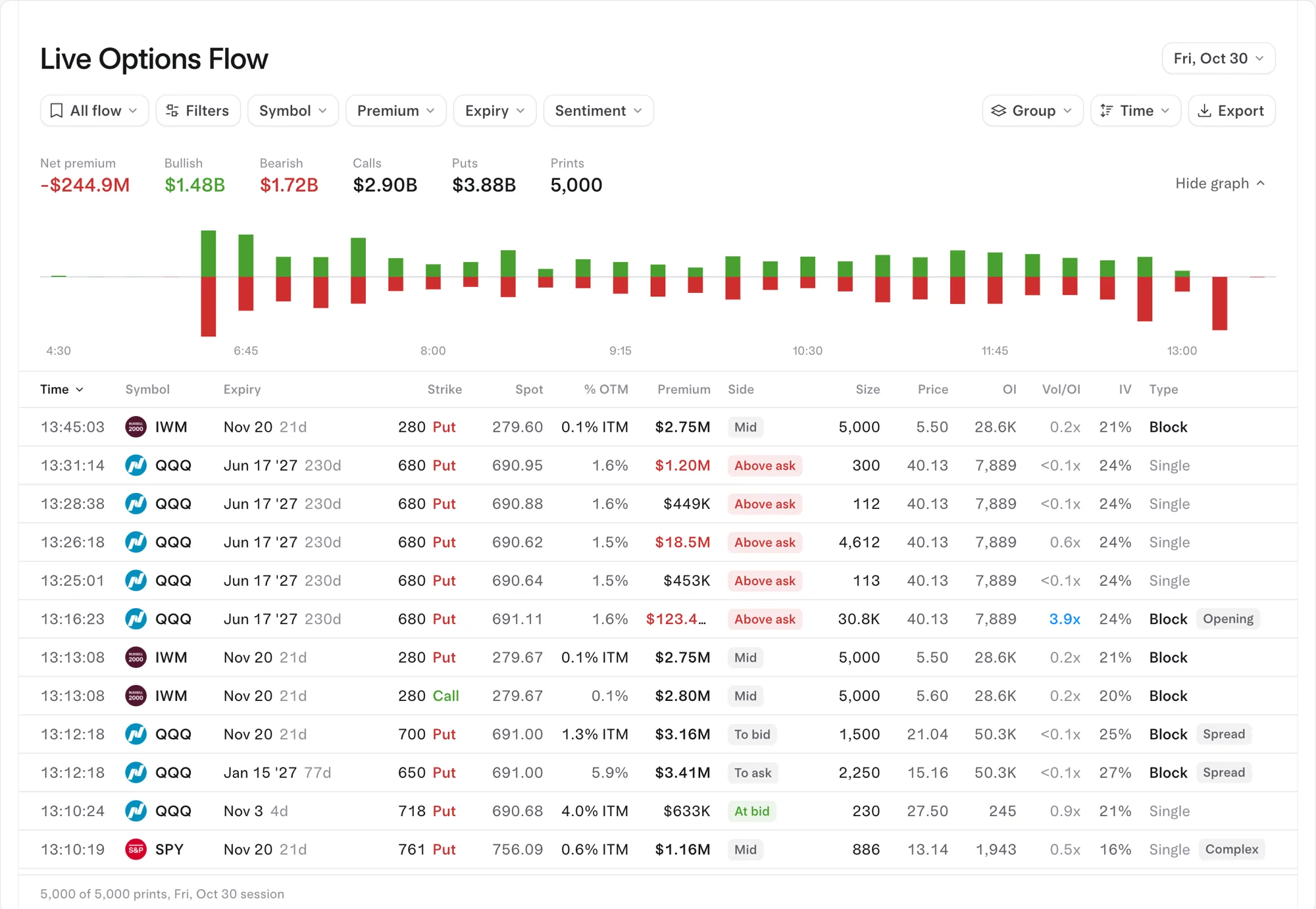
From OPRA, the Options Price Reporting Authority. OPRA is the registered processor that sends out consolidated last-sale and quote information from the US options exchanges, so every exchange's trades land on one tape. Tradytics reads that tape and lists the large prints with their time, symbol, expiry, strike, call or put, spot price, how far out of the money, premium, side, size, price, open interest, Vol/OI, implied volatility, trade type and tags.
On October 30, 2026, that came to 73,896 large prints, with $11.84B in call premium and $12.72B in put premium. The side chip on each print (At ask, To bid, Mid and so on) shows where the trade hit between the bid and the ask, which is the main clue to whether it was bought or sold. For how to read each column, see how to use the Tradytics options flow page, and for the bigger picture, where options flow data comes from.
Is Tradytics options flow real time?
Yes, on Live ($39 a month) and Pro ($69 a month): each print shows up live, to the second. The Free plan shows yesterday's session instead, the full prior session after it ends.
Where do Tradytics dark pool prints come from?
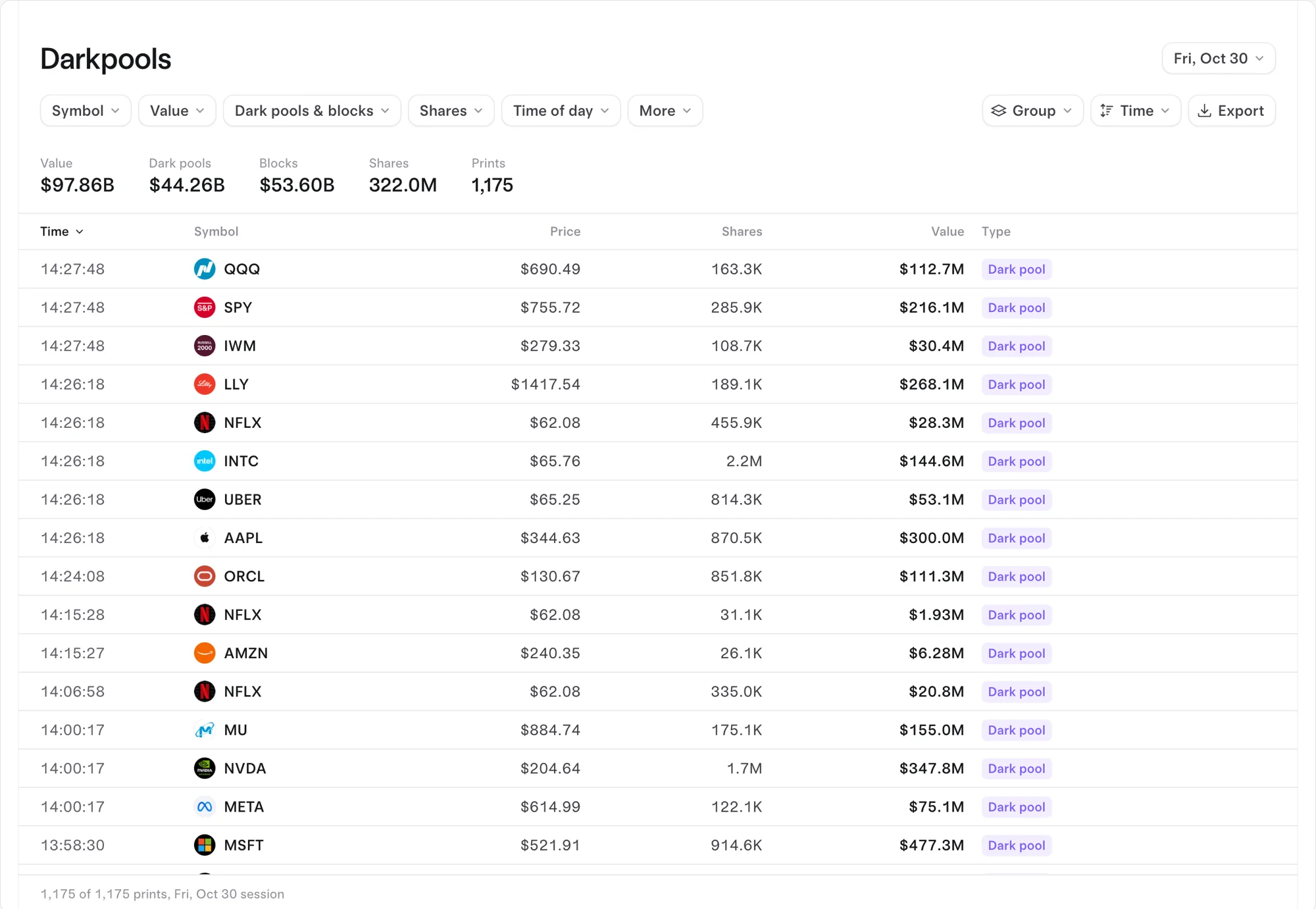
When a broker or a dark pool fills a stock trade away from an exchange, the trade is reported to one of FINRA's trade reporting facilities, the system FINRA runs for reporting trades made otherwise than on an exchange. Tradytics shows every one of those off-exchange prints, labeled "Dark pool", along with every exchange block of at least 25,000 shares and $250K in US stocks and ETFs. That is about 12,000 prints a session, each with its price, shares, value, venue and sale condition.
Is Tradytics dark pool data real time?
No. Dark pool prints are after-the-fact reports by nature. Off-exchange trades are reported to FINRA after they execute. FINRA's rule asks for a report as soon as practicable and no later than 10 seconds after execution, and reports that miss that window are marked late. The biggest trades (negotiated blocks, average-price and portfolio trades) are often reported late, sometimes hours later, at a price from earlier in the day, and flagged with late or out-of-sequence condition codes.
Tradytics shows prints within about 15 minutes of their report. That window doesn't matter for how dark pool data is used: traders read it for levels, the prices where size built up over days. Tradytics builds those levels from 10 sessions of prints, so a 15-minute window changes nothing about them.
A real example shows why the second a print appears is the wrong thing to watch. On October 30, 2026, a 3,684,100-share SPY dark pool print worth $2.84B was reported at 4:28 PM ET at $769.559. SPY had closed at $757.12, about $12 lower, and $769.559 was right at the prior day's close. It was a late, previously agreed trade, not a fresh bet at that price. More on this in is dark pool data real time? and what is a late dark pool print?
Where do the other numbers come from?
- Dealer gamma is computed from open interest by strike and shown as dollars of stock dealers trade per 1% move, with the call wall, put wall and gamma flip.
- Dark pool levels are the prices where the most dark pool dollars printed over the last 10 sessions.
- The scanner runs 120 signals on every US stock and ETF after the close, at 4:05, 6:05 and 8:10 PM ET.
- "Why it's moving" stories on stock pages are written each day by the Tradytics AI for the 100 largest stocks and the most-viewed others.
- The AI analyst pulls from the same data: options flow, dark pool prints, dealer gamma, prices and charts, research, news and the scanner.
Common questions
Is Tradytics options flow delayed?
Not on Live or Pro, where it is live to the second. On Free you see yesterday's session.
Does Tradytics show every options trade?
It reads every US options exchange's trades from OPRA, and the flow page lists the large prints.
Why can't dark pool data be real time?
Because a print only exists once the trade is reported, after it executes, and the largest negotiated trades are often reported late, sometimes hours later.
Does the API use the same data?
Yes. The Pro API and MCP server serve options flow, dark pool prints, prices, the market, research, the scanner and AI trade signals, with 50,000 calls a day. Docs are at /docs.
Sources
- OPRA: describes itself as the registered securities information processor that disseminates consolidated last-sale and quotation information from the national securities exchanges.
- FINRA Trade Reporting Facility: the facility FINRA members use to report transactions made otherwise than on an exchange.
- FINRA Rule 6380A: trades must be reported as soon as practicable and no later than 10 seconds after execution; those reported later are designated late.